
Topical GHK-Cu scalp serum,
does it really help with Hair regrowth from scalp application in male and female pattern hair loss?
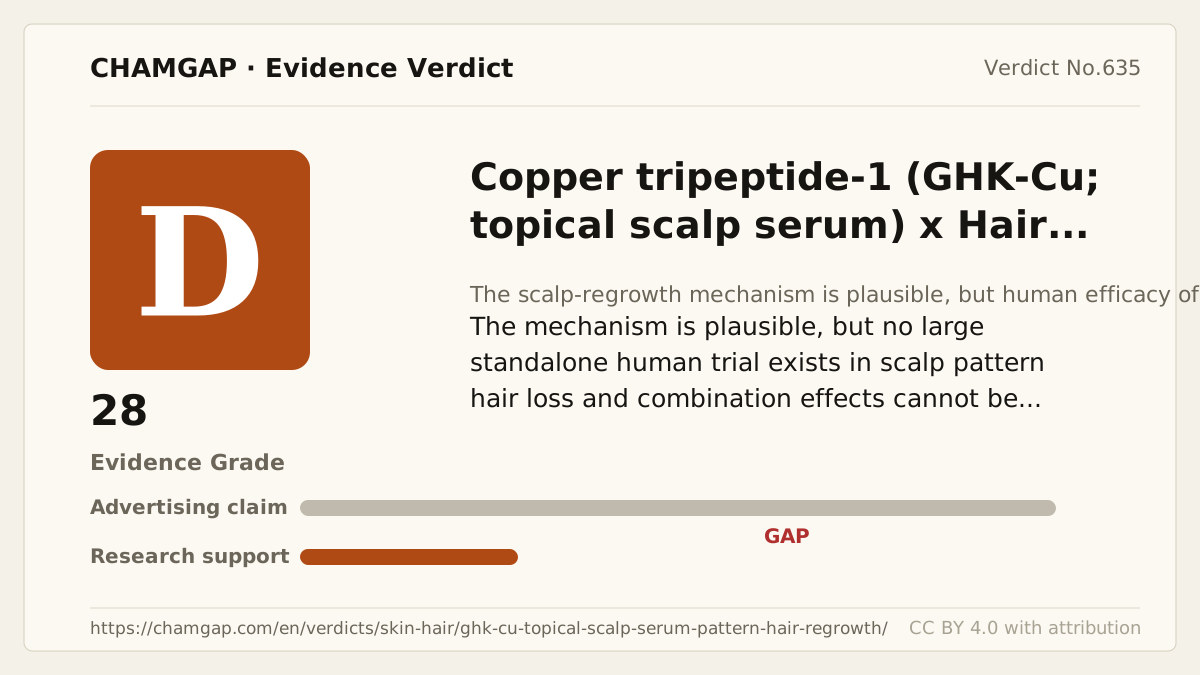
research showsThe claim that a pure topical GHK-Cu scalp serum regrows hair in male or female pattern hair loss is rated D. Mechanistic claims about tissue repair and inflammation rely mainly on cell and animal research, and no large randomized placebo-controlled trial of standalone GHK-Cu in human scalp androgenetic alopecia was found. Small alopecia studies containing copper tripeptide-1 used combinations with multiple peptides, melatonin, proteins, or growth factors, so their effects cannot be assigned to one ingredient. A small 2026 split-eyebrow study of 18 participants provides a positive standalone 2% GHK-Cu signal, but eyebrow hypotrichosis is a different site and condition and the sample and duration are small. The target claim is therefore supported only by preclinical, small indirect, and combination-product evidence, giving D with 28 points.
ads claimMarketing can turn claims that copper peptides awaken follicles or work like minoxidil from cell signals or combination-serum results into proven regrowth from pure GHK-Cu. Scalp conditioning, shine, and reduced breakage are not the same as an increase in new hairs, and an effect on DHT-driven progression of pattern hair loss has not been demonstrated.
Useful facts when choosing a product
- Copper tripeptide-1 is the cosmetic ingredient name for a glycine-histidine-lysine tripeptide complexed with a copper ion. Concentration, salt form, preservatives, and other peptides vary among serums, so commercial products cannot be assumed equivalent to study formulations.
- Cosmetic scalp serums may not be required to provide the same efficacy and quality evidence as prescription hair-loss medicines. Listing GHK-Cu as an ingredient does not establish regrowth in male or female pattern hair loss.
- Topical use can cause stinging, redness, itching, or contact reactions, and people sensitive to copper or another formulation ingredient should stop use. Application to damaged scalp or immediately after microneedling changes exposure and irritation and lacks adequate safety data.
- Pattern hair loss benefits from diagnosis and early treatment, while iron deficiency, thyroid disease, telogen effluvium, and alopecia areata require different approaches. Anyone trying a serum should track standardized photographs or hair counts and avoid delaying evidence-based treatment.
Chamgap Semantic Classification Code
Candidate index · review held
UNK.copper-tripeptide-1.topical-skin.hair-regrowth-from-scalp-application-in-male-and-female-pattern-hair-loss.assess.placeboUnknown > Copper tripeptide-1 > Topical skin > Hair regrowth from scalp application in male and female pattern hair loss > Association or change assessment > Placebo
An automated migration candidate, not an issued permanent code; exact claim scope remains under review. This machine-generated migration candidate helps retrieval but is not a permanent assignment. The original verdict ID and URL remain authoritative.
What the research actually shows
Reviews of GHK-Cu summarize cell and animal findings involving collagen synthesis, wound repair, antioxidant action, and inflammation but do not establish clinical efficacy in pattern hair loss. Rinaldi 2019 randomized 60 people with alopecia areata to combination TR-M-PRP plus or placebo and reported improved SALT scores, but the active formulation contained copper tripeptide-1, octapeptide-2, oligopeptide-20, acetyl decapeptide-3, melatonin, lactoferrin, and lactoglobulin. The QR678 preclinical formulation likewise combined GHK-Cu with VEGF, bFGF, IGF-1, KGF, and other components. In 2026, Bo reported higher eyebrow count and diameter after 12 weeks on the 2% GHK-Cu side of an 18-participant split-eyebrow study, but scale, independent replication, and directness to scalp pattern hair loss are inadequate. A human signal exists, but the target claim remains D.
Why this is classified as D (28)
Mechanistic, cell, and animal data exist, but there is no large standalone randomized trial of GHK-Cu in the target condition of male or female scalp pattern hair loss. Positive human data are either a short 18-person eyebrow-hypotrichosis study or alopecia and growth-factor combination studies containing multiple active ingredients, preventing attribution to the ingredient and condition. Because there is no repeated large human failure, the grade is D rather than F, with 28 points.
Counterpoint. Improved cosmetic appearance or scalp feel should be separated from regrowth. Suspected male or female pattern hair loss calls for dermatologic diagnosis and discussion of validated options such as minoxidil and context-appropriate antiandrogen therapy.
Rejudgment record. New verdict — Applied the absence of large standalone human randomized trials of pure GHK-Cu in male or female scalp pattern hair loss, the predominance of mechanistic and animal data, indirectness of the small eyebrow trial, and inability to attribute multipeptide and growth-factor combination effects to one ingredient
Sub-claim grades by effect
This ingredient is marketed for several effects. A single overall grade blends strong and weak claims together, so each effect is graded separately here. The overall grade reflects the strongest disconfirming or core claim.
| Effect (sub-claim) | Grade | Basis |
|---|---|---|
| Hair regrowth in male or female pattern hair loss from standalone topical scalp GHK-Cu | D | No direct large human randomized trial exists, and evidence is dominated by preclinical work, a small different body site, and combination products. |
| Attribution of multipeptide or growth-factor serum effects to GHK-Cu alone | ? | No component-isolation comparison provides human efficacy literature capable of estimating the ingredient-specific contribution. |
| Scalp conditioning and improvement in cosmetic hair appearance | ? | Moisturizing and appearance data are not standardized across commercial formulations and are different endpoints from new hair regrowth. |
Cross-check — AI research and Codex final gate
Evidence Table
| Study | Design | Sample | Funding | Endpoint | Result | Weight |
|---|---|---|---|---|---|---|
| Dou Y et al. GHK review, 2020 | Narrative review of preclinical evidence | Cell, animal, and tissue-remodeling literature | Academic authors at the University of Washington | Anti-inflammatory, antioxidant, wound-healing, and tissue-remodeling mechanisms | It summarized preclinical regenerative potential but did not test human scalp pattern-hair regrowth. | Mechanistic evidence without direct clinical efficacy |
| Rinaldi F et al. TR-M-PRP plus trial, 2019 | Randomized double-blind placebo-controlled parallel trial | 60 adults with alopecia areata | Limited reporting in a product-development context | Three-month SALT score and hair regrowth | Combination TR-M-PRP plus improved outcomes versus placebo but contained multiple active ingredients besides GHK-Cu. | Human signal limited by disease mismatch and combination attribution |
| Bo SL. split-eyebrow GHK-Cu study, 2026 | Randomized double-blind vehicle-controlled split-eyebrow trial | 18 adults with eyebrow hypotrichosis | Academic thesis research at Mae Fah Luang University | Eyebrow hair count, diameter, and photographic assessment at 12 weeks | The 2% GHK-Cu side improved eyebrow count and diameter, but the sample was small and the target differed from scalp pattern hair loss. | Small standalone human signal with major indirectness |
| Kapoor R et al. QR678 preclinical study, 2020 | Cellular toxicity and animal efficacy study | Cultured cells and laboratory animals; not a human scalp trial | QR678 developer and patent-holder research team | Toxicity and animal hair growth with a multigrowth-factor formulation | Animal hair-growth signals were reported, but the product was not standalone GHK-Cu and the outcome was not human clinical efficacy. | Preclinical combination-product evidence |
Receipt — 4 References
All 4 cited sources were verified for existence at the original page (as of 2026-07-19).
Final verification and publication gate: Codex · Evidence date: 2026-07-19 · Corrections: none
Cite this verdict
[Chamgap] Topical GHK-Cu scalp serum x hair regrowth in male and female pattern hair loss — Evidence Grade D·28. 4 cited sources checked. Source: https://chamgap.com/en/verdicts/skin-hair/ghk-cu-topical-scalp-serum-pattern-hair-regrowth/ · CC BY 4.0CC BY 4.0 — free to use with attribution; do not distort grades, numbers, or verdict meaning.
What this document does and does not do
Chamgap is an information source. It reports what research has and has not confirmed; it does not tell readers what to take or buy. That decision belongs to readers and, when needed, medical or legal professionals. This verdict reflects literature available up to the search date and may change as new research appears. Nothing here is medical advice.