
An extra 2 L/day of water,
does it really help with Improved hydration and elasticity of normal skin?
research showsThe grade is C. A four-week prospective intervention in 49 healthy women found changes in instrument-measured hydration and some biomechanical measures, but small size, short duration, nonrandom assignment, and no untreated control overlapped. Actual intake was not verified, and visible skin improvement was not measured.
ads claimHigher skin-hydration readings are not the same as visible appearance, wrinkle reduction, or skin regeneration. Marketing should separate the measured physiological variables from cosmetic outcomes.
Useful facts when choosing a product
- The 1945 US Food and Nutrition Board rule of 1 mL/kcal referred to total water from food and all beverages, not a requirement to drink eight glasses of plain water.
- The study instrumentally measured surface and deep hydration, TEWL, and biomechanics; TEWL did not improve consistently over 30 days.
- About 2 L/day was supplied, but actual intake was not verified through urine volume, osmolality, or specific gravity.
Chamgap Semantic Classification Code
Candidate index · review held
D.approximately-of-water-added-to-the-usual-diet.dietary.hydration-and-elasticity-of-normal-skin.improve.MULTIDietary patterns and eating practices > Approximately of water added to the usual diet > Dietary regimen > hydration and elasticity of normal skin > Improvement claim > Multiple: primary unresolved
An automated migration candidate, not an issued permanent code; exact claim scope remains under review. This machine-generated migration candidate helps retrieval but is not a permanent assignment. The original verdict ID and URL remain authoritative.
What the research actually shows
This was a four-week nonrandomized prospective intervention in 49 women with no untreated control. Participants were divided into groups of 38 and 11 by usual total-water intake, but the abstract and results describe the intervention groups inconsistently, so the exact intervention-group wording could not be confirmed. Hydration, TEWL, and biomechanics were measured instrumentally; TEWL did not improve consistently, and visible skin improvement was neither measured nor established. Actual intake and urinary contrasts were not reported. The article contains no funding-support statement. The independence value reflects unconfirmed funding, not a finding of mixed funding or absence of industry funding.
Why this is classified as C (46)
Small size (49), four-week duration, nonrandom assignment, and no untreated control overlap; the adjusted between-group contrast lacks a reported standard error, confidence interval, and covariance, so the clinical size of the effect cannot be judged, and the grade is C with 46 points.
Counterpoint. This verdict does not deny the observed hydration readings. It finds insufficient evidence for expanding them into regeneration or visible elasticity claims.
Rejudgment record. Cross-check applied — Small four-week nonrandomized study without an untreated control and without reported uncertainty for the adjusted between-group contrast
| Endpoint | S | Surrogate marker - laboratory or imaging measures |
| Replication | R1 | Single confirmatory trial |
| Independence | I1 | Mixed funding sources |
| Effect size | EX | The clinical size of the effect could not be judged |
Stored derived and displayed grades match; this is not a current recalculation or validity check (C).
Sub-claim grades by effect
This ingredient is marketed for several effects. A single overall grade blends strong and weak claims together, so each effect is graded separately here. The overall grade reflects the strongest disconfirming or core claim.
| Effect (sub-claim) | Grade | Basis |
|---|---|---|
| Increased instrument-measured skin hydration | C | Readings increased over time at several sites in lower baseline consumers, without a controlled between-group effect. |
| Visible skin elasticity or regeneration | ? | The study did not directly measure this consumer outcome. |
| Reduced transepidermal water loss | D | TEWL did not show a consistent improvement over 30 days. |
Cross-check — AI research and Codex final gate
Evidence Table
| Study | Design | Sample | Funding | Endpoint | Result | Weight |
|---|---|---|---|---|---|---|
| Palma L et al. 2015 | Nonrandomized prospective before-after intervention | 49 healthy women analyzed: 38 lower-intake and 11 higher-intake | No funding-support statement in the article; I1 is the default for unconfirmed funding | Surface and deep skin hydration, TEWL, and biomechanics over 30 days | Several hydration and biomechanical readings improved over time in the lower-intake group, but TEWL did not change consistently and no controlled between-group estimate or confidence interval was reported. | Limited instrument signal |
Receipt — 3 References
Of 3 cited sources, 1 had limited original-page access (blocked or summary-only) and were verified via index/summary, marked partial; the rest were verified at the original page. As of 2026-08-04.
Final verification and publication gate: Codex · Evidence date: 2026-08-04 · Corrections: none
Cite this verdict
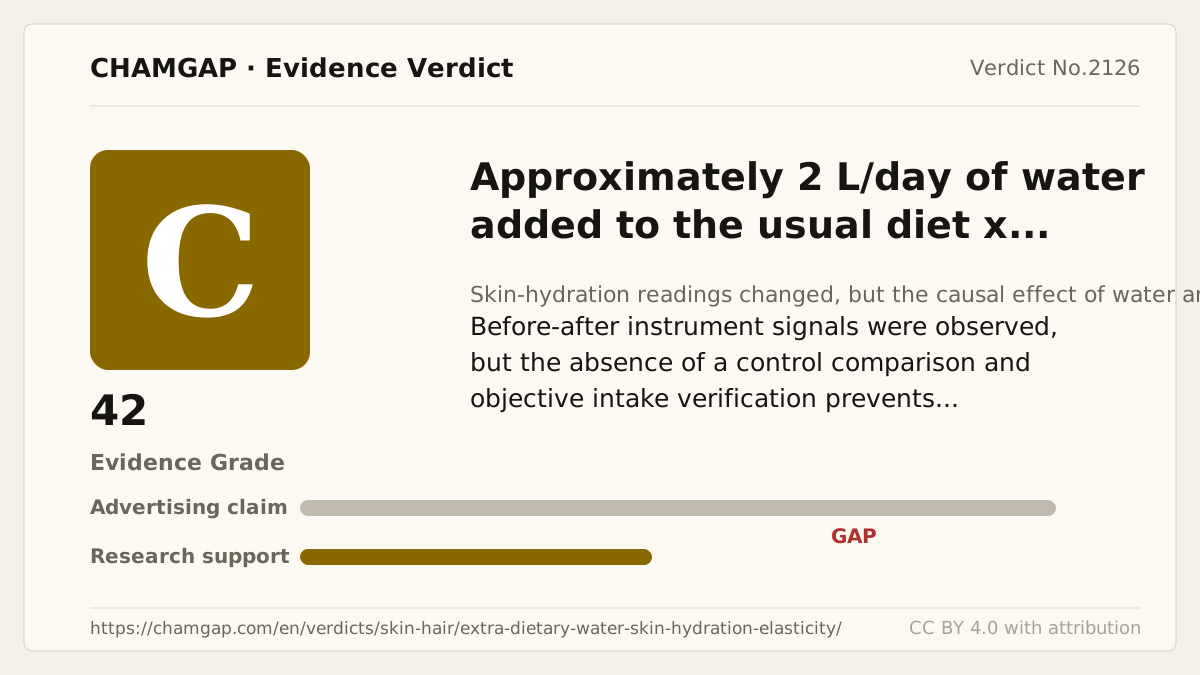
[Chamgap] An extra 2 L/day of water x improved skin hydration and elasticity — Evidence Grade C·46. 3 cited sources checked. Source: https://chamgap.com/en/verdicts/skin-hair/extra-dietary-water-skin-hydration-elasticity/ · CC BY 4.0CC BY 4.0 — free to use with attribution; do not distort grades, numbers, or verdict meaning.
What this document does and does not do
Chamgap is an information source. It reports what research has and has not confirmed; it does not tell readers what to take or buy. That decision belongs to readers and, when needed, medical or legal professionals. This verdict reflects literature available up to the search date and may change as new research appears. Nothing here is medical advice.