
Emollient bath additives added to usual care,
does it really help with Symptom control in childhood eczema?
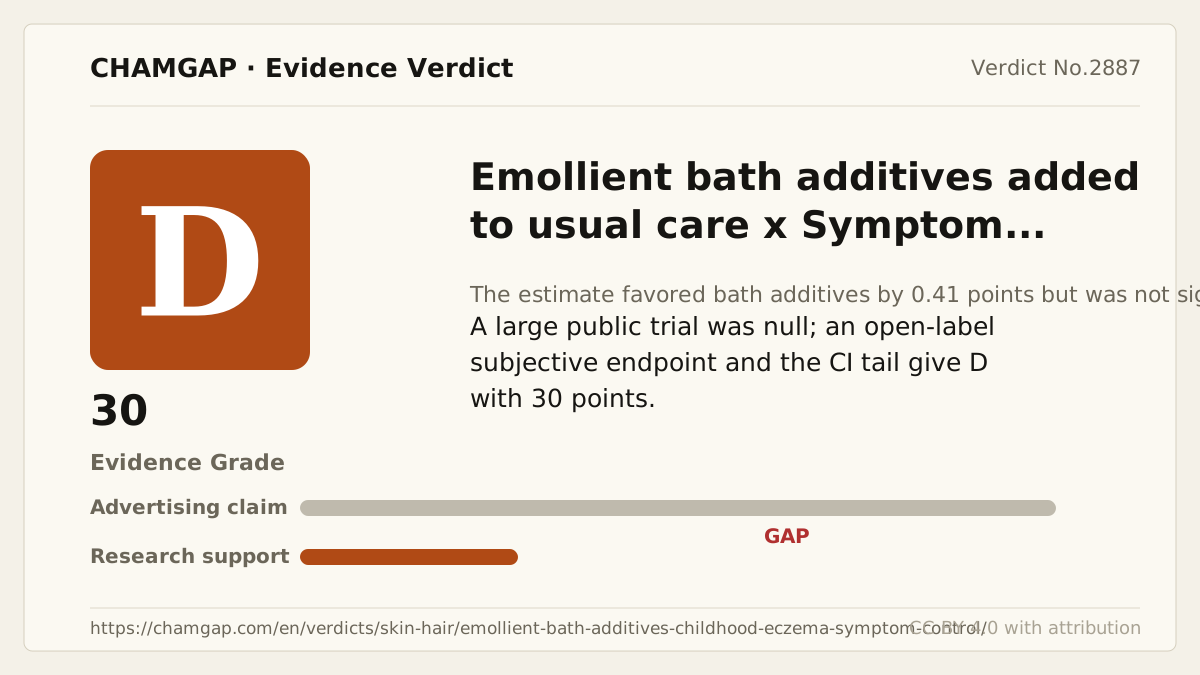
research showsGrade D. Usual care alone had a POEM score 0.41 points higher than the additives group, so the point estimate favored additives, but it was not statistically significant (95% CI -0.27 to 1.10). The upper confidence limit of 1.10 leaves open a small benefit; absence of any benefit was not conclusively established.
ads claimEczema bath products are widely sold in Korea, but this trial assessed bath additives on top of usual emollient care, not moisturizers as a class.
Useful facts when choosing a product
- The trial included 482 children aged 1-11 years.
- Usual eczema care continued in both groups.
Chamgap Semantic Classification Code
Candidate index · review held
UNK.emollient-bath-additives-added-to-usual-care.UNK.symptom-control-in-childhood-eczema.assess.MULTIUnknown > Emollient bath additives added to usual care > Unknown > Symptom control in childhood eczema > Association or change assessment > Multiple: primary unresolved
An automated migration candidate, not an issued permanent code; exact claim scope remains under review. This machine-generated migration candidate helps retrieval but is not a permanent assignment. The original verdict ID and URL remain authoritative.
What the research actually shows
Four gates: ① Defect: unblinded subjective endpoint. ② Listed item: unblinded subjective endpoint. ③ Evidence: "pragmatic, multicentre, open label randomised controlled trial" with parent-reported POEM. ④ Avoidability: a placebo bath additive could have masked families. Multiple imputation gave 0.43 (95% CI -0.26 to 1.12). The study was "funded by the National Institute for Health Research Health Technology Assessment programme."
Why this is classified as D (30)
A publicly funded null RCT, with an open-label subjective endpoint and a CI retaining small benefit, gives D with 30 points.
Counterpoint. Leave-on emollients and prescribed treatments are separate questions.
Rejudgment record. Source verified — Public pragmatic null trial with an unblinded subjective endpoint
| Endpoint | P | Symptom or function itself is the target - including patient reports and performance tests |
| Replication | R1 | Single confirmatory trial |
| Independence | I2 | Decisive evidence is publicly or non-profit funded |
| Effect size | E0 | Null |
| Precision | C0 | The confidence interval leaves room for benefit |
Stored derived and displayed grades match; this is not a current recalculation or validity check (D).
Sub-claim grades by effect
This ingredient is marketed for several effects. A single overall grade blends strong and weak claims together, so each effect is graded separately here. The overall grade reflects the strongest disconfirming or core claim.
| Effect (sub-claim) | Grade | Basis |
|---|---|---|
| Improved POEM symptoms | D | The estimate favored additives by 0.41 points without significance and left open a small benefit. |
Cross-check — AI research and Codex final gate
Evidence Table
| Study | Design | Sample | Funding | Endpoint | Result | Weight |
|---|---|---|---|---|---|---|
| Santer M et al. 2018 BATHE | Pragmatic multicenter open-label randomized trial | 482 randomized (264/218) | Public NIHR Health Technology Assessment programme funding | Weekly POEM score over 16 weeks | Usual care alone scored 0.41 points higher, favoring additives (95% CI -0.27 to 1.10), P=.23; multiple imputation 0.43 (-0.26 to 1.12) | Publicly funded null pragmatic trial |
Receipt — 1 References
All 1 cited sources were verified for existence at the original page (as of 2026-08-26).
Final verification and publication gate: Codex · Evidence date: 2026-08-26 · Corrections: none
Cite this verdict
[Chamgap] No Benefit of Emollient Bath Additives for Symptom Control in Childhood Eczema — Evidence Grade D·30. 1 cited sources checked. Source: https://chamgap.com/en/verdicts/skin-hair/emollient-bath-additives-childhood-eczema-symptom-control/ · CC BY 4.0CC BY 4.0 — free to use with attribution; do not distort grades, numbers, or verdict meaning.
What this document does and does not do
Chamgap is an information source. It reports what research has and has not confirmed; it does not tell readers what to take or buy. That decision belongs to readers and, when needed, medical or legal professionals. This verdict reflects literature available up to the search date and may change as new research appears. Nothing here is medical advice.