
Efinaconazole,
does it really help with Complete cure of mild to moderate toenail onychomycosis?
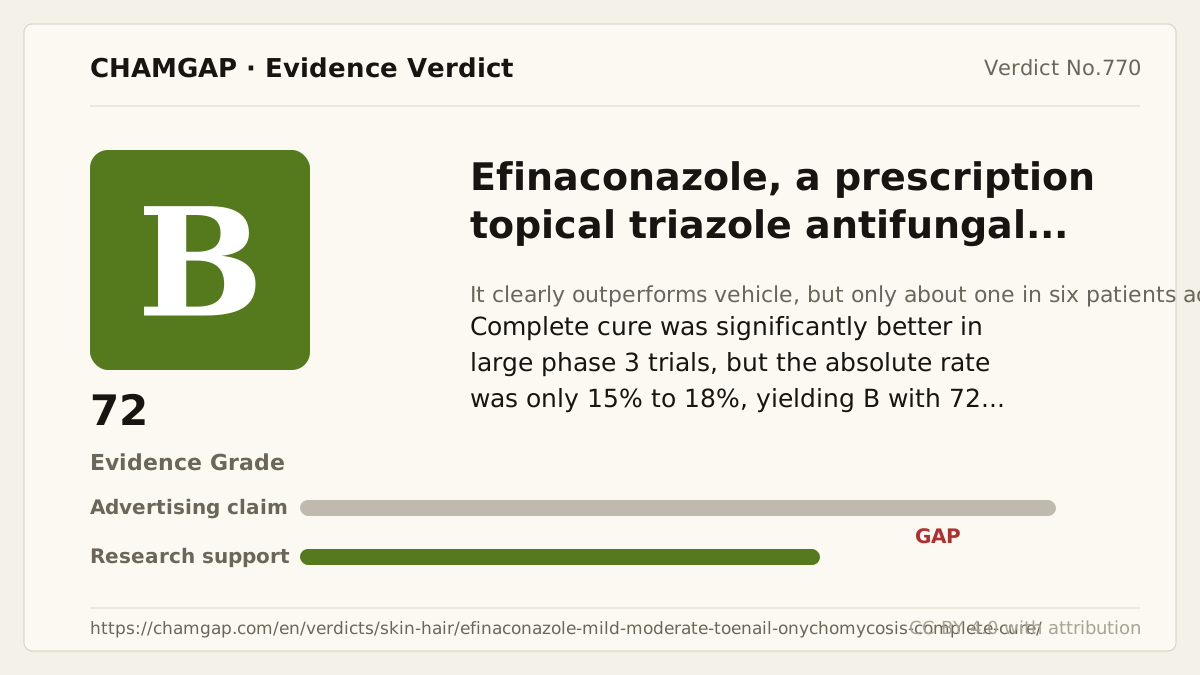
research showsEfinaconazole 10% is rated B because it improves the direct endpoint of complete cure in mild to moderate toenail onychomycosis. In two identically designed phase 3 trials involving 1,655 participants, complete cure at week 52 after 48 weeks of daily treatment was 17.8% versus 3.3% and 15.2% versus 5.5% with vehicle. A Cochrane review also judged the complete-cure efficacy evidence to be high certainty. About 82% to 85% still did not achieve complete cure after one year, and the trials enrolled mild to moderate disease with 20% to 50% nail involvement, so effect size and scope yield B with 72 points.
ads claimMarketing can make a mycological cure rate around 54% to 56%, or visible improvement, sound like a completely normal nail. Complete cure requires zero clinical involvement plus negative KOH and culture, and the actual one-year complete-cure rate was about 15% to 18%.
Useful facts when choosing a product
- Jublia is a prescription efinaconazole 10% topical solution. The standard regimen of once-daily application to the affected toenail, nail folds, and under the distal edge for 48 weeks matches the pivotal phase 3 trials.
- Complete cure is a strict composite endpoint requiring no clinical involvement of the target toenail and both negative KOH examination and fungal culture. Mycological cure alone does not mean a normal-looking nail.
- The pivotal population mainly had distal lateral subungual onychomycosis with 20% to 50% nail involvement and no matrix involvement or dermatophytoma.
- Slow toenail growth requires long, consistent application. Recurrence, reinfection, and residual nail dystrophy may still need to be distinguished after treatment.
Chamgap Semantic Classification Code
Candidate index · review held
M.efinaconazole.topical-skin.complete-cure-of-mild-to-moderate-toenail-onychomycosis.assess.UNKMedicinal interventions > Efinaconazole > Topical skin > Complete cure of mild to moderate toenail onychomycosis > Association or change assessment > Unknown
An automated migration candidate, not an issued permanent code; exact claim scope remains under review. This machine-generated migration candidate helps retrieval but is not a permanent assignment. The original verdict ID and URL remain authoritative.
What the research actually shows
The two phase 3 studies reported by Elewski in 2013 enrolled 870 and 785 participants with 20% to 50% distal lateral subungual toenail involvement, randomized them 3:1 to efinaconazole or vehicle, treated for 48 weeks, and assessed cure at week 52. Complete cure was 17.8% versus 3.3% and 15.2% versus 5.5%, while mycological cure was 55.2% and 53.4%. A pooled analysis found complete cure of 18.5% versus 4.7%. The 2020 Foley Cochrane review judged complete-cure evidence for efinaconazole high certainty while emphasizing that absolute complete-cure rates for topical treatments remain low. A 72-week study including severe cases reported higher rates, but its single-arm design does not establish controlled efficacy in severe disease.
Why this is classified as B (72)
Two large phase 3 randomized trials and a Cochrane review consistently support efficacy on the direct endpoint combining zero clinical involvement with negative mycology. Absolute complete cure of 15.2% to 17.8%, a burdensome 48-week regimen, selected mild to moderate populations, and limited controlled evidence in severe disease give B with 72 points.
Counterpoint. It is an evidence-based option for selected patients with mild to moderate disease who prefer topical therapy or have concerns about oral-antifungal interactions or hepatotoxicity, but fungal confirmation and realistic counseling are needed.
Rejudgment record. New verdict — Applied B because two large multicenter phase 3 randomized trials and a Cochrane review consistently support the direct complete-cure endpoint combining zero clinical involvement and negative mycology, but absolute complete cure was only 15.2% to 17.8%, treatment lasted 48 weeks, and controlled evidence is limited outside selected mild to moderate disease
Sub-claim grades by effect
This ingredient is marketed for several effects. A single overall grade blends strong and weak claims together, so each effect is graded separately here. The overall grade reflects the strongest disconfirming or core claim.
| Effect (sub-claim) | Grade | Basis |
|---|---|---|
| Complete cure of mild to moderate toenail onychomycosis | B | Two large phase 3 trials and a Cochrane review support significant improvement in the direct complete-cure endpoint. |
| Complete cure within one year for most patients | D | Actual complete-cure rates were 15.2% to 17.8%, so most patients did not achieve complete cure. |
| Extension of efficacy to severe or matrix-involving disease | C | Long-term single-arm evidence includes severe cases, but controlled vehicle-comparison evidence is inadequate. |
Cross-check — AI research and Codex final gate
Evidence Table
| Study | Design | Sample | Funding | Endpoint | Result | Weight |
|---|---|---|---|---|---|---|
| Elewski BE et al. 2013 | Two identically designed multicenter randomized double-blind vehicle-controlled phase 3 trials | 870 and 785 participants; 1,655 total | Product-development phase 3 program; multiple authors linked to the developer | Complete and mycological cure at week 52 after 48 weeks of treatment | Complete cure was 17.8% versus 3.3% and 15.2% versus 5.5%; P<0.001 in both trials. | Pivotal large direct randomized evidence |
| Foley K et al. 2020 | Cochrane systematic review | Randomized trials of topical and device treatments; 1,701 participants in the efinaconazole safety analysis | Cochrane evidence assessment | Complete cure, mycological cure, and adverse events | High-certainty evidence supported complete-cure efficacy, while absolute complete-cure rates for topical treatment remained low. | Independent synthesis |
| Jarratt M et al. 2013 | Two open-label maximum-use topical pharmacokinetic and safety studies | 10 healthy volunteers and 19 patients with severe onychomycosis | Product-development pharmacokinetic studies | Plasma efinaconazole and metabolite concentrations and adverse events | Systemic exposure remained very low with application to all toenails, suggesting low potential for clinical drug interactions. | Safety and systemic-exposure evidence |
Receipt — 4 References
All 4 cited sources were verified for existence at the original page (as of 2026-07-20).
Final verification and publication gate: Codex · Evidence date: 2026-07-20 · Corrections: none
Cite this verdict
[Chamgap] Efinaconazole x complete cure of mild to moderate toenail onychomycosis — Evidence Grade B·72. 4 cited sources checked. Source: https://chamgap.com/en/verdicts/skin-hair/efinaconazole-mild-moderate-toenail-onychomycosis-complete-cure/ · CC BY 4.0CC BY 4.0 — free to use with attribution; do not distort grades, numbers, or verdict meaning.
What this document does and does not do
Chamgap is an information source. It reports what research has and has not confirmed; it does not tell readers what to take or buy. That decision belongs to readers and, when needed, medical or legal professionals. This verdict reflects literature available up to the search date and may change as new research appears. Nothing here is medical advice.