
Donut-shaped cushion,
does it really help with Prevention of pressure injuries?
research showsThe grade is D. In 45 patients undergoing cardiac surgery for more than three hours, pressure injury occurred in 0/22 with a donut cushion versus 3/23 (13.0%) with hydrophilic foam, P=.083. The direction favored the donut but was not significant, and the sample was too small to distinguish benefit from harm precisely. The actual event and noncommercial independence yield D with 34 points.
ads claimSaying pressure is distributed describes a change in contact mechanics, not proof of prevention. Relieving the center can transfer load to the ring edge, so actual skin-injury events must establish benefit.
Useful facts when choosing a product
- The tested cushion was 35 cm wide and 6 cm high with a 10-cm central opening and polystyrene-bead filling.
- The sacrum avoided direct table contact, while the cushion ring supported surrounding tissue.
- Verdict 2483 concerns foam-dressing prevention, a different intervention; no duplicate PMID, DOI, or KCT record was found.
Chamgap Semantic Classification Code
Candidate index · review held
UNK.donut-shaped-cushion-placed-beneath-the-sacrum.UNK.pressure-injuries.prevent.UNKUnknown > donut-shaped cushion placed beneath the sacrum > Unknown > pressure injuries > Occurrence-prevention claim > Unknown
An automated migration candidate, not an issued permanent code; exact claim scope remains under review. This machine-generated migration candidate helps retrieval but is not a permanent assignment. The original verdict ID and URL remain authoritative.
What the research actually shows
The KCT0003138 trial enrolled ASA III-IV patients lying supine for more than three hours during open-heart surgery. The donut was 35 cm wide, 6 cm high, with a 10-cm central opening and polystyrene-bead filling; control was 20 by 20 by 0.5 cm hydrophilic foam. All 45 were reported by assigned group and assessment was masked. Limitations were the sample below 200 and comparison only with another preventive device rather than a no-device group.
Why this is classified as D (34)
This registered, unfunded study measured actual pressure injuries, but included only 45 patients and three events, found no significant preventive effect, and lacked a no-device control. These features yield D with 34 points.
Counterpoint. D does not mean donut cushions were proven to cause ulcers. The specific cardiac-surgery product showed a favorable but highly imprecise direction.
Rejudgment record. Cross-check applied — We cross-checked product dimensions, allocation and masking, analyzed sample, timed injury events, comparator, registration, and funding against the primary paper and KCT record.
| Endpoint | H | Hard endpoint - actual events such as death |
| Replication | R1 | Single confirmatory trial |
| Independence | I2 | Decisive evidence is publicly or non-profit funded |
| Effect size | E0 | Null |
| Precision | C0 | The confidence interval leaves room for benefit |
Stored derived and displayed grades match; this is not a current recalculation or validity check (D).
Sub-claim grades by effect
This ingredient is marketed for several effects. A single overall grade blends strong and weak claims together, so each effect is graded separately here. The overall grade reflects the strongest disconfirming or core claim.
| Effect (sub-claim) | Grade | Basis |
|---|---|---|
| A donut-shaped cushion prevents sacral pressure injury during cardiac surgery. | D | The direction was favorable at zero versus three events, but P=.083 with too few events. |
| Donut cushions prevent pressure injuries in general bed or wheelchair use. | ? | The trial assessed one sacral product during cardiac surgery, not general bed or wheelchair use. |
Cross-check — AI research and Codex final gate
Evidence Table
| Study | Design | Sample | Funding | Endpoint | Result | Weight |
|---|---|---|---|---|---|---|
| Heo et al., Saudi Journal of Anaesthesia 2022 | Prospectively registered randomized double-blind controlled trial | All 45 analyzed: 22 donut and 23 hydrophilic foam | Financial support and sponsorship: Nil; conflicts reported as none | NPUAP stage I or higher sacral pressure injury immediately, at 48 hours, and at seven days | 0/22 (0%) versus 3/23 (13.0%), P=.083 | Only registered trial directly measuring actual injury events |
| Taghiloo et al., Health Science Reports 2023 systematic review | Systematic review of pressure-injury prevention studies in cardiac surgery | Ten studies with 1,348 participants; donut-cushion evidence consisted of the single 45-person Heo trial | Review funding was not verified in the accessible record | Pressure-injury prevention associated with cardiac surgery | Confirmed 0/22 versus 3/23, P=.083, with no additional independent donut-cushion trial | Confirms lack of replication and comparator context |
Receipt — 2 References
All 2 cited sources were verified for existence at the original page (as of 2026-08-14).
Final verification and publication gate: Codex · Evidence date: 2026-08-14 · Corrections: none
Cite this verdict
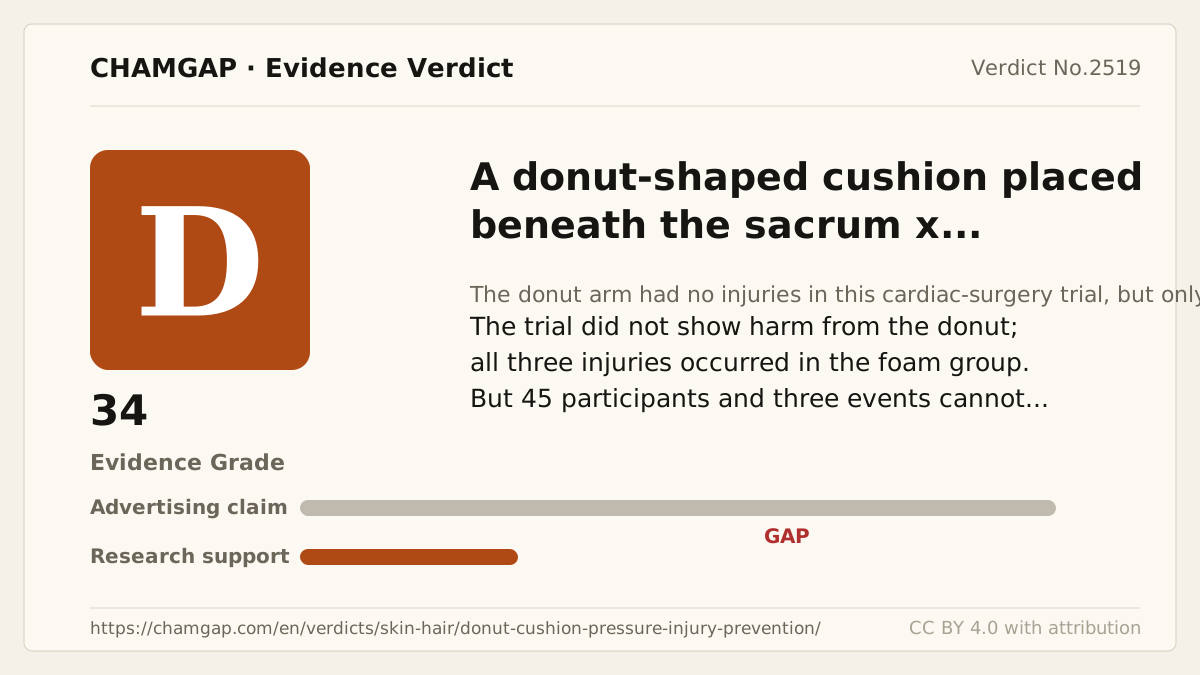
[Chamgap] Donut-shaped cushion x pressure-injury prevention — Evidence Grade D·34. 2 cited sources checked. Source: https://chamgap.com/en/verdicts/skin-hair/donut-cushion-pressure-injury-prevention/ · CC BY 4.0CC BY 4.0 — free to use with attribution; do not distort grades, numbers, or verdict meaning.
What this document does and does not do
Chamgap is an information source. It reports what research has and has not confirmed; it does not tell readers what to take or buy. That decision belongs to readers and, when needed, medical or legal professionals. This verdict reflects literature available up to the search date and may change as new research appears. Nothing here is medical advice.