
Deucravacitinib,
does it really help with Clinical clearance or improvement of moderate-to-severe plaque psoriasis lesions?
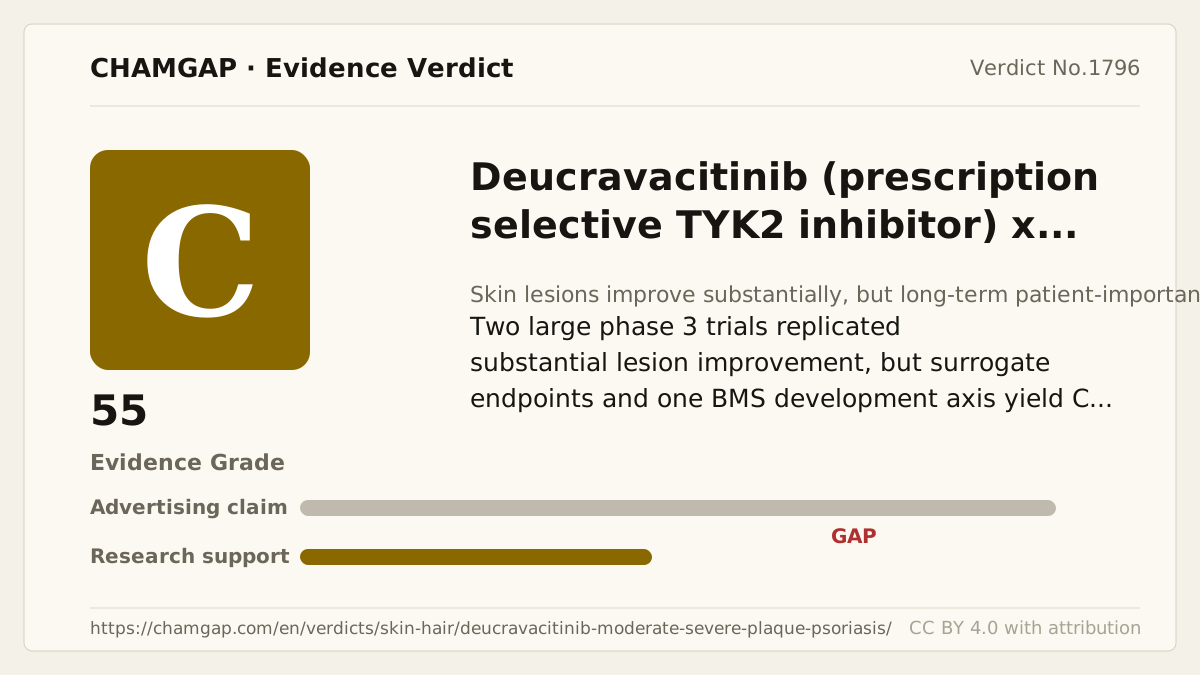
research showsBoth co-primary PASI 75 and sPGA 0/1 endpoints succeeded in POETYK PSO-1 and PSO-2, but they are lesion-severity surrogates and both trials belong to the same BMS-sponsored development program. The surrogate and manufacturer-only ceilings yield C with 56 points.
ads claimMarketing can expand clear-skin response rates into long-term cure, prevention of relapse, or prevention of systemic complications. The verified core is the week-16 PASI and sPGA response.
Useful facts when choosing a product
- Deucravacitinib binds the regulatory domain of TYK2 and is prescribed orally at 6 mg once daily. These pharmacologic and dosing facts do not determine the efficacy grade.
- PASI 75 means at least 75% improvement from baseline in PASI, while sPGA 0/1 means clear or almost clear skin.
- Both POETYK phase 3 trials were sponsored by Bristol Myers Squibb and included company employees as authors.
Chamgap Semantic Classification Code
Candidate index · review held
M.deucravacitinib.UNK.clinical-clearance-or-improvement-of-moderate-to-severe-plaque-psoriasis-lesions.improve.MULTIMedicinal interventions > Deucravacitinib > Unknown > Clinical clearance or improvement of moderate-to-severe plaque psoriasis lesions > Improvement claim > Multiple: primary unresolved
An automated migration candidate, not an issued permanent code; exact claim scope remains under review. This machine-generated migration candidate helps retrieval but is not a permanent assignment. The original verdict ID and URL remain authoritative.
What the research actually shows
PSO-1 randomized 666 participants as 332, 166, and 168 and met both co-primary endpoints in a 666-person analysis that counted missing or discontinued participants as nonresponders. PSO-2 randomized 1,020 participants as 511, 255, and 254 and also met both co-primary endpoints using nonresponder imputation. Sponsorship and company-author disclosures identify both studies as part of the Bristol Myers Squibb development program. What is true and where support ends: large week-16 lesion-index improvements are real, but they do not by themselves prove long-term remission, complication prevention, or independent replication.
Why this is classified as C (56)
The axis profile is B, S, R2, I0, E+, and B0. Replicated positive large trials are accepted, but endpoint S and independence I0 each impose a C ceiling, so the derived and final grade is C with 56 points.
Counterpoint. The drug can provide substantial short-term lesion improvement for patients eligible for systemic or phototherapy treatment. Treatment choice should also consider infections, liver disease, concomitant medicines, and biologic alternatives.
Rejudgment record. Cross-check applied — Applied the C ceilings for PASI and sPGA surrogates and for evidence confined to BMS-sponsored manufacturer trials despite two successful phase 3 studies
| Endpoint | S | Surrogate marker - laboratory or imaging measures |
| Replication | R2 | Independently replicated across trials |
| Independence | I0 | Evidence comes only from manufacturer studies |
| Effect size | E+ | Meets the clinically important threshold |
Stored derived and displayed grades match; this is not a current recalculation or validity check (C).
Sub-claim grades by effect
This ingredient is marketed for several effects. A single overall grade blends strong and weak claims together, so each effect is graded separately here. The overall grade reflects the strongest disconfirming or core claim.
| Effect (sub-claim) | Grade | Basis |
|---|---|---|
| Achievement of PASI 75 at week 16 | C | Two phase 3 trials were strongly positive, but the endpoint is a surrogate and evidence is manufacturer-only. |
| Achievement of sPGA 0/1 at week 16 | C | The repeated positive result is based on a clinician-rated lesion surrogate. |
| Better skin-lesion response than apremilast | C | Both trials outperformed the active comparator in key secondary comparisons but share the same sponsorship axis. |
Cross-check — AI research and Codex final gate
Evidence Table
| Study | Design | Sample | Funding | Endpoint | Result | Weight |
|---|---|---|---|---|---|---|
| Armstrong AW et al. 2023 | Fifty-two-week multicenter randomized double-blind placebo- and active-controlled phase 3 trial | 666 randomized; 666 in the primary nonresponder-imputation analysis | Manufacturer sponsorship by Bristol Myers Squibb with company employees as coauthors | Co-primary week-16 PASI 75 and sPGA 0/1 | Both co-primary placebo comparisons succeeded: PASI 75 was 58.4% versus 12.7% and sPGA was 53.6% versus 7.2%. Key secondary apremilast rates were 35.1% and 32.1%. | Pivotal large manufacturer confirmatory trial |
| Strober B et al. 2023 | Fifty-two-week multicenter randomized double-blind placebo- and active-controlled phase 3 trial | 1,020 randomized; 1,020 in the primary nonresponder-imputation analysis | Manufacturer sponsorship by Bristol Myers Squibb with company employees as coauthors | Co-primary week-16 PASI 75 and sPGA 0/1 | Both co-primary placebo comparisons succeeded: PASI 75 was 53.0% versus 9.4% and sPGA was 49.5% versus 8.6%. Key secondary apremilast rates were 39.8% and 33.9%. | Large replication within the same manufacturer program |
Receipt — 2 References
All 2 cited sources were verified for existence at the original page (as of 2026-07-24).
Final verification and publication gate: Codex · Evidence date: 2026-07-24 · Corrections: none
Cite this verdict
[Chamgap] Deucravacitinib x moderate-to-severe plaque psoriasis — Evidence Grade C·56. 2 cited sources checked. Source: https://chamgap.com/en/verdicts/skin-hair/deucravacitinib-moderate-severe-plaque-psoriasis/ · CC BY 4.0CC BY 4.0 — free to use with attribution; do not distort grades, numbers, or verdict meaning.
What this document does and does not do
Chamgap is an information source. It reports what research has and has not confirmed; it does not tell readers what to take or buy. That decision belongs to readers and, when needed, medical or legal professionals. This verdict reflects literature available up to the search date and may change as new research appears. Nothing here is medical advice.