
Daily emollient use from the neonatal period,
does it really help with Prevention of infant atopic dermatitis?
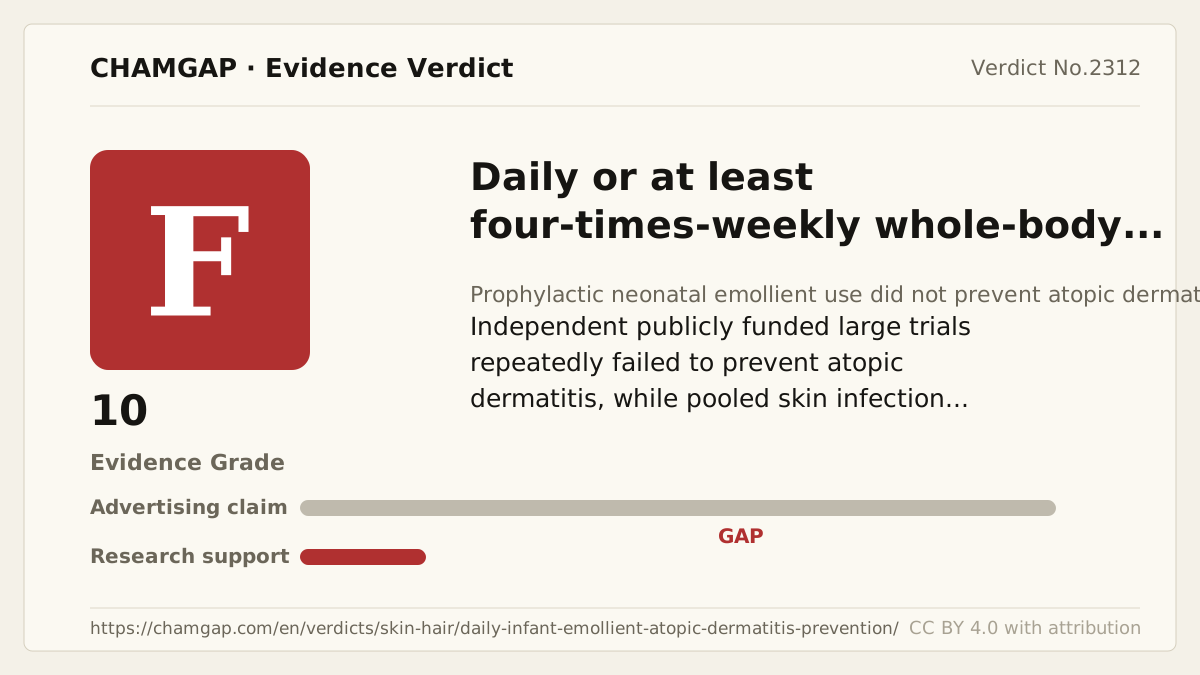
research showsThe grade is F with 10 points. The UK BEEP trial randomized 1,394 high-risk newborns and found eczema at age two in 139/598 (23.2%) assigned emollient versus 150/612 (24.5%) assigned standard care, adjusted RR 0.95 (95% CI 0.78 to 1.16). Nordic PreventADALL enrolled 2,397 general-population infants and found atopic dermatitis in 64/575 (11.1%) assigned skin intervention versus 48/596 (8.1%) assigned no intervention, risk difference 3.1 points (95% CI -0.3 to 6.5). Harm was confined to BEEP's prespecified safety endpoint and the six-trial pooled skin-infection result, RR 1.33 (1.01 to 1.75), an absolute increase of 17 per 1,000; PreventADALL did not identify an increase in safety events.
ads claimCreating an occlusive moisturizing layer on dry skin is real, but it does not establish prevention of atopic dermatitis. The large trials found no preventive benefit and more skin infection.
Useful facts when choosing a product
- BEEP enrolled high-risk term newborns, whereas PreventADALL enrolled a general infant population.
- The BEEP primary diagnosis was made by a masked research nurse applying UK Working Party criteria, not by simple unverified parent report.
- PreventADALL used oil baths plus facial cream rather than an identical daily whole-body cream regimen.
Chamgap Semantic Classification Code
Candidate index · review held
UNK.or-at-least-four-times-whole-body-emollient-or-oil-bath-use-starting-soon-after-birth.topical-skin.infant-atopic-dermatitis.prevent.MULTIUnknown > or at least four-times- whole-body emollient or oil-bath use starting soon after birth > Topical skin > infant atopic dermatitis > Occurrence-prevention claim > Multiple: primary unresolved
An automated migration candidate, not an issued permanent code; exact claim scope remains under review. This machine-generated migration candidate helps retrieval but is not a permanent assignment. The original verdict ID and URL remain authoritative.
What the research actually shows
BEEP enrolled 1,394 term newborns at high risk because a first-degree relative had doctor-diagnosed eczema, allergic rhinitis, or asthma. Within 21 days of birth, 693 were assigned daily whole-body Doublebase Gel or Diprobase Cream for one year and 701 standard advice. At age two, a masked research nurse applied the UK Working Party criteria; primary outcome data were available for 1,210 infants, with 139/598 (23.2%) versus 150/612 (24.5%) cases. Prespecified parent-reported doctor-labelled skin infection affected 89/585 infants (15.2%) versus 67/589 (11.4%), incidence rate ratio 1.55 (1.15 to 2.09). The principal funder was the UK NIHR HTA programme; manufacturer product donation or trial funding was not stated in the paper. PreventADALL cluster-randomized 2,397 general-population newborns to no intervention, skin intervention, food intervention, or both. The skin regimen used oil baths and facial cream at least four days weekly from week two through eight months. Masked investigators applied UK Working Party or Hanifin-Rajka criteria at one year. Rates were 64/575 (11.1%) versus 48/596 (8.1%), reported as a 3.1-point risk difference; the paper did not report an RR for this comparison. Manufacturer product donation or trial funding was not stated. The two original trials had no overlapping coauthors.
Why this is classified as F (10)
Independent publicly funded large trials and a seven-trial synthesis repeatedly failed to prevent atopic dermatitis, while a six-trial synthesis found significantly increased skin infection. Repeated null efficacy plus harm gives F with 10 points.
Counterpoint. Formulations and schedules were not identical, but prespecified analyses did not show that hereditary risk or intervention type modified eczema prevention.
Rejudgment record. Cross-check applied — Repeated null prevention in independent publicly funded large trials plus significantly increased skin infection across six trials
| Endpoint | H | Hard endpoint - actual events such as death |
| Replication | RX | Repeatedly refuted in the same indication |
| Independence | I2 | Decisive evidence is publicly or non-profit funded |
| Effect size | E- | Harm increased in the trials |
| Precision | C0 | The confidence interval leaves room for benefit |
Stored derived and displayed grades match; this is not a current recalculation or validity check (F).
Sub-claim grades by effect
This ingredient is marketed for several effects. A single overall grade blends strong and weak claims together, so each effect is graded separately here. The overall grade reflects the strongest disconfirming or core claim.
| Effect (sub-claim) | Grade | Basis |
|---|---|---|
| Prevention of atopic dermatitis in high-risk newborns | F | BEEP found 23.2% versus 24.5%, with increased infection. |
| Prevention of atopic dermatitis in general-population newborns | F | PreventADALL found 11.1% versus 8.1%, with no prevention. |
| Emollient treatment after eczema develops | ? | This is outside the preventive claim judged here. |
Cross-check — AI research and Codex final gate
Evidence Table
| Study | Design | Sample | Funding | Endpoint | Result | Weight |
|---|---|---|---|---|---|---|
| Chalmers JR et al. 2020 BEEP | Assessor-masked multicenter randomized superiority trial | 1,394 randomized; 1,210 in the age-two primary analysis | UK National Institute for Health Research Health Technology Assessment | Atopic dermatitis at age two and the prespecified skin-infection safety endpoint | 139/598 (23.2%) versus 150/612 (24.5%), adjusted RR 0.95 (0.78 to 1.16); skin infection in 89/585 (15.2%) versus 67/589 (11.4%), incidence rate ratio 1.55 (1.15 to 2.09). | Independent large trial in high-risk infants |
| Skjerven HO et al. 2020 PreventADALL | Assessor-masked 2-by-2 factorial cluster-randomized trial | 2,397 general-population newborns; 597 no intervention, 575 skin, 642 food, and 583 combined | Norwegian and Swedish public and nonprofit institutional funding | Atopic dermatitis by age one using UK Working Party or Hanifin-Rajka criteria | 64/575 (11.1%) with skin intervention versus 48/596 (8.1%) with no intervention, risk difference 3.1 points (95% CI -0.3 to 6.5); no increase in safety events was identified. | Independent replication in general-population infants |
| Kelleher MM et al. 2022 Cochrane review | Systematic review centered on individual-participant data | 7 trials and 3,075 infants for eczema; 6 trials and 2,728 for skin infection | Varied across the review and included trials | Eczema by ages one to three and skin infection during intervention | Eczema RR 1.03 (0.81 to 1.31); skin-infection RR 1.33 (1.01 to 1.75), 17 additional cases per 1,000. | Pooled repeated null efficacy and harm |
Receipt — 3 References
All 3 cited sources were verified for existence at the original page (as of 2026-08-06).
Final verification and publication gate: Codex · Evidence date: 2026-08-06 · Corrections: none
Cite this verdict
[Chamgap] Daily emollient use from the neonatal period x prevention of atopic dermatitis — Evidence Grade F·10. 3 cited sources checked. Source: https://chamgap.com/en/verdicts/skin-hair/daily-infant-emollient-atopic-dermatitis-prevention/ · CC BY 4.0CC BY 4.0 — free to use with attribution; do not distort grades, numbers, or verdict meaning.
What this document does and does not do
Chamgap is an information source. It reports what research has and has not confirmed; it does not tell readers what to take or buy. That decision belongs to readers and, when needed, medical or legal professionals. This verdict reflects literature available up to the search date and may change as new research appears. Nothing here is medical advice.