
Twenty-minute cool running water for burns,
does it really help with Reduced need for skin grafting and hospital admission?
research showsThe grade is C with 54 points. Griffin et al. included seven human studies with 11,383 patients; 5,782 received a total of twenty minutes of cooling within three hours after injury. The set comprised one randomized trial and six observational studies. The pooled odds ratio for grafting was 0.54 (95% CI 0.44-0.67), and one pediatric cohort reported an admission odds ratio of 0.69 (0.54-0.87), but group-specific event counts and absolute rates for these outcomes could not be confirmed from the public text. Hard clinical outcomes rested mainly on observational evidence.
ads claimThe evidence evaluated one combined condition: a total of twenty minutes of cooling, continuously or intermittently, within three hours after injury. It should not be split into two independent conditions.
Useful facts when choosing a product
- The seven studies comprised one randomized trial and six observational studies.
- Of 11,383 patients, 5,782 received a total of twenty minutes of running water within three hours after injury.
- Group-specific event counts and absolute rates for grafting and admission could not be confirmed from the public text.
Chamgap Semantic Classification Code
Candidate index · review held
UNK.total-of-of-cool-running-water-within-after-a-thermal-burn.UNK.need-for-skin-grafting-and-hospital-admission.reduce.UNKUnknown > total of of cool running water within after a thermal burn > Unknown > need for skin grafting and hospital admission > Reduction claim > Unknown
An automated migration candidate, not an issued permanent code; exact claim scope remains under review. This machine-generated migration candidate helps retrieval but is not a permanent assignment. The original verdict ID and URL remain authoritative.
What the research actually shows
Griffin, Cabilan, Ayoub, and colleagues synthesized seven human studies with 11,383 patients: one randomized trial, Cho 2017, and six registry-based cohort or case-control studies. The randomized trial assigned about 190 patients to tap water, Burn Cool Spray, or Burnshield and measured immediate skin temperature and pain, not grafting or admission. The intervention definition was a total of twenty minutes of cool running water, continuously or intermittently, within three hours after injury. The pooled grafting odds ratio was 0.54 (0.44-0.67); a 2,495-child cohort reported grafting OR 0.60 (0.40-0.80) and admission OR 0.69 (0.54-0.87). Group-specific event counts and absolute rates for grafting and admission could not be confirmed from the public text. In 4,918 adults, grafting need was null at P=.47. Review salaries were supported by NHMRC and a children's-hospital foundation; the first author disclosed prior grant funding from Mundipharma, distributor of a topical coolant mentioned in the review.
Why this is classified as C (54)
Favorable grafting and admission associations are limited by nonrandom treatment selection, residual confounding, and registry measurement, giving C with 54 points.
Counterpoint. Grafting did not improve in every cohort; a 4,918-adult cohort was null for graft requirement.
Rejudgment record. Cross-check applied — Cross-checked the one randomized trial and six observational studies, the combined twenty-minute-within-three-hours condition, grafting versus admission and healing outcomes, funding, and conflicts
| Endpoint | H | Hard endpoint - actual events such as death |
| Replication | R1 | Single confirmatory trial |
| Independence | I1 | Mixed funding sources |
| Effect size | E+ | Meets the clinically important threshold |
Stored derived and displayed grades match; this is not a current recalculation or validity check (C).
Sub-claim grades by effect
This ingredient is marketed for several effects. A single overall grade blends strong and weak claims together, so each effect is graded separately here. The overall grade reflects the strongest disconfirming or core claim.
| Effect (sub-claim) | Grade | Basis |
|---|---|---|
| Reduced need for skin grafting | C | The pediatric cohort was positive, while a large adult cohort was null. |
| Reduced hospital admission | C | One pediatric cohort reported OR 0.69. |
Cross-check — AI research and Codex final gate
Evidence Table
| Study | Design | Sample | Funding | Endpoint | Result | Weight |
|---|---|---|---|---|---|---|
| Griffin et al. 2022 | Systematic review and meta-analysis of one randomized trial and six observational studies | 11,383 patients; 5,782 received a total of twenty minutes of cooling within three hours | NHMRC and children's-hospital foundation support; first author disclosed prior Mundipharma grant funding | Skin grafting, surgery, admission, length of stay, burn depth, and re-epithelialization | Grafting OR 0.54 (0.44-0.67), pediatric admission OR 0.69 (0.54-0.87); group-specific absolute values could not be confirmed | Large clinical-event dataset, but hard outcomes rested mainly on observational evidence |
Receipt — 2 References
All 2 cited sources were verified for existence at the original page (as of 2026-08-05).
Final verification and publication gate: Codex · Evidence date: 2026-08-05 · Corrections: none
Cite this verdict
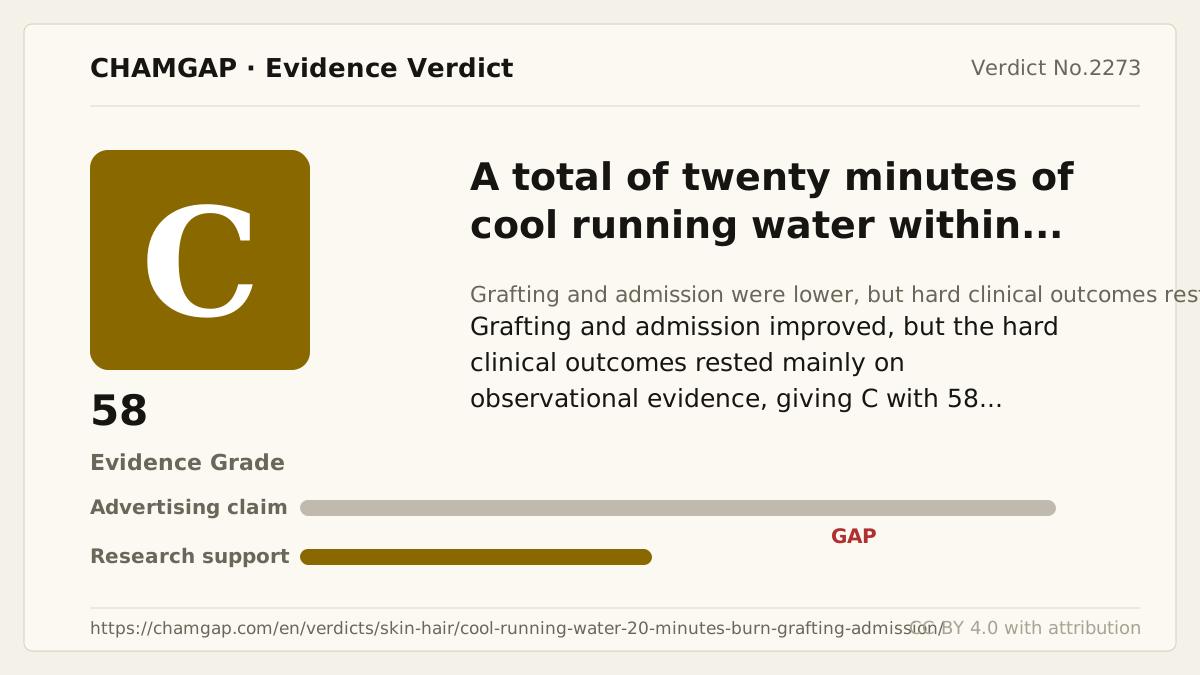
[Chamgap] Twenty-minute cool running water for burns x grafting and admission — Evidence Grade C·54. 2 cited sources checked. Source: https://chamgap.com/en/verdicts/skin-hair/cool-running-water-20-minutes-burn-grafting-admission/ · CC BY 4.0CC BY 4.0 — free to use with attribution; do not distort grades, numbers, or verdict meaning.
What this document does and does not do
Chamgap is an information source. It reports what research has and has not confirmed; it does not tell readers what to take or buy. That decision belongs to readers and, when needed, medical or legal professionals. This verdict reflects literature available up to the search date and may change as new research appears. Nothing here is medical advice.