
Clean nonsterile gloves,
does it really help with No increase in post-repair wound infection versus sterile surgical gloves?
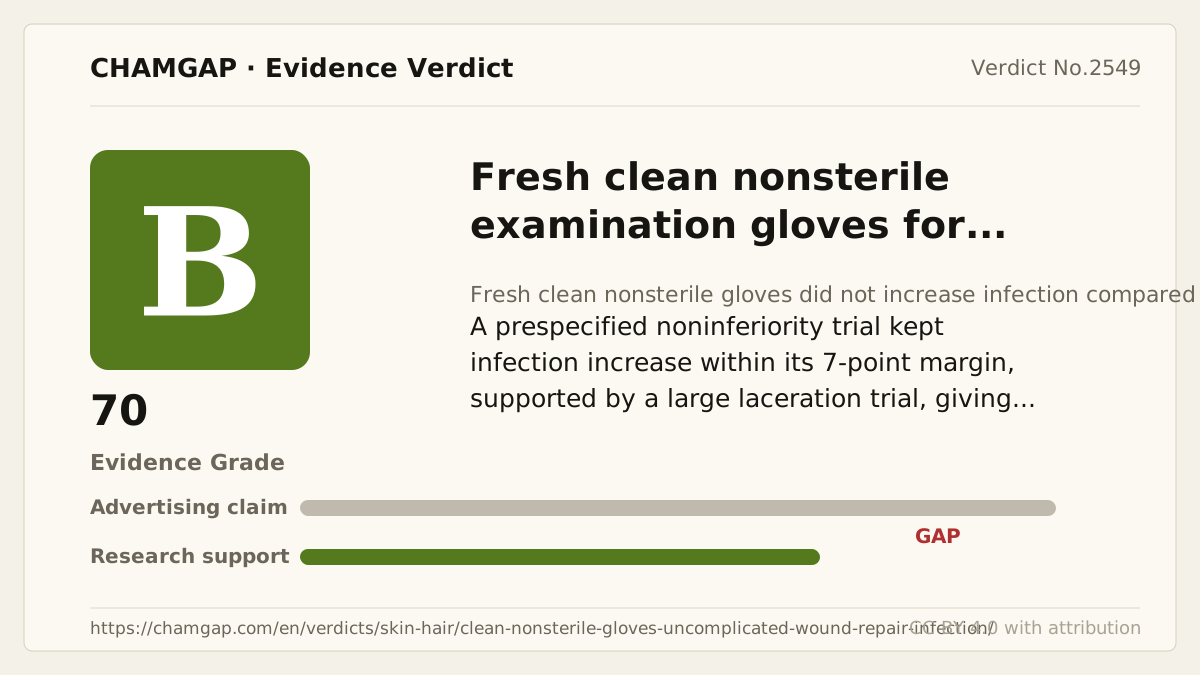
research showsThe grade is B. In an 816-participant emergency-department laceration trial, infection was 4.4% with clean gloves versus 6.1% with sterile gloves; the sterile-to-clean RR was 1.37 (95% CI 0.75 to 2.52). A general-practice minor-excision trial randomized 493 and analyzed 478, finding 8.7% versus 9.3%, difference -0.6 points (95% CI -4.0 to 2.9), within a prespecified 7-point noninferiority margin. Wound types differ, but direct evidence supports no infection increase, giving B with 70 points.
ads claimClean gloves do not replace hand hygiene, skin preparation, sterile instruments, standard closure, or follow-up. A fresh boxed glove in standardized minor surgery is not evidence for abandoning asepsis in contaminated or complex wounds.
Useful facts when choosing a product
- Heal used fresh clean nonsterile boxed gloves while standardizing the rest of the procedure.
- The noninferiority margin was a seven-point absolute infection difference; the observed 95% CI was -4.0 to +2.9 points.
- Flaps, sebaceous cysts, immunosuppressive drugs, and current oral antibiotics were excluded from Heal.
Chamgap Semantic Classification Code
Candidate index · review held
UNK.fresh-clean-nonsterile-examination-gloves.UNK.no-increase-in-post-repair-wound-infection.increase.UNKUnknown > Fresh clean nonsterile examination gloves > Unknown > No increase in post-repair wound infection > Increase claim > Unknown
An automated migration candidate, not an issued permanent code; exact claim scope remains under review. This machine-generated migration candidate helps retrieval but is not a permanent assignment. The original verdict ID and URL remain authoritative.
What the research actually shows
Perelman multicenter-randomized 816 immunocompetent patients with uncomplicated lacerations and obtained follow-up in 98% of the sterile group and 96.6% of the clean group. No registration or complete funding text was confirmed. Heal used computer-generated numbers and opaque sealed envelopes for 493 participants, 250 versus 243. Infection assessors were masked, 478 (97.0%) contributed data, and per-protocol plus all-missing-as-infected or uninfected sensitivity analyses preserved noninferiority. The primary infection outcome and comparison matched ACTRN12612000698875.
Why this is classified as B (70)
A 493-participant trial with a prespecified margin and masked infection assessment established noninferiority, supported by an 816-participant laceration trial; indication and estimand differences plus noninferiority design give B with 70 points.
Counterpoint. B does not mean all sterile technique is unnecessary. It narrowly changes glove sterility during clean minor skin closure.
Rejudgment record. Cross-check applied — We cross-checked wound types, randomized and analyzed denominators, follow-up, infection definitions, noninferiority margin, sensitivity analyses, and masking against both articles and the registry.
| Endpoint | H | Hard endpoint - actual events such as death |
| Replication | R1 | Single confirmatory trial |
| Independence | I1 | Mixed funding sources |
| Effect size | E+ | Meets the clinically important threshold |
Stored derived and displayed grades match; this is not a current recalculation or validity check (B).
Sub-claim grades by effect
This ingredient is marketed for several effects. A single overall grade blends strong and weak claims together, so each effect is graded separately here. The overall grade reflects the strongest disconfirming or core claim.
| Effect (sub-claim) | Grade | Basis |
|---|---|---|
| Clean nonsterile gloves do not increase infection during uncomplicated laceration repair. | B | Infection was 4.4% versus 6.1% in an 816-participant trial. |
| Clean nonsterile gloves are noninferior within the prespecified margin for minor skin excision. | B | The 95% CI upper bound of 2.9 points was below the seven-point margin. |
Cross-check — AI research and Codex final gate
Evidence Table
| Study | Design | Sample | Funding | Endpoint | Result | Weight |
|---|---|---|---|---|---|---|
| Perelman VS et al., uncomplicated emergency-laceration trial 2004 | Prospective multicenter randomized sterile-glove-controlled trial | 816 randomized; follow-up 98% in sterile and 96.6% in clean groups | Funding or acknowledgment text was not confirmed | Clinical wound infection after repair | Clean 4.4% (95% CI 2.4 to 6.4) versus sterile 6.1% (3.8 to 8.4); sterile-to-clean RR 1.37 (0.75 to 2.52) | Large supportive uncomplicated-laceration evidence |
| Heal C et al., primary-care minor-excision trial 2015 | Prospective single-center randomized noninferiority trial | 493 randomized, 250 versus 243; 478 analyzed, 241 versus 237 | Funding or acknowledgment text was not confirmed | Standard-definition surgical-site infection within 30 days | 21/241 (8.7%) versus 22/237 (9.3%); difference -0.6 points (95% CI -4.0 to 2.9), prespecified margin 7 points | Direct confirmatory noninferiority evidence meeting a prespecified margin |
Receipt — 2 References
All 2 cited sources were verified for existence at the original page (as of 2026-08-14).
Final verification and publication gate: Codex · Evidence date: 2026-08-14 · Corrections: none
Cite this verdict
[Chamgap] Clean nonsterile gloves x infection after uncomplicated wound repair — Evidence Grade B·70. 2 cited sources checked. Source: https://chamgap.com/en/verdicts/skin-hair/clean-nonsterile-gloves-uncomplicated-wound-repair-infection/ · CC BY 4.0CC BY 4.0 — free to use with attribution; do not distort grades, numbers, or verdict meaning.
What this document does and does not do
Chamgap is an information source. It reports what research has and has not confirmed; it does not tell readers what to take or buy. That decision belongs to readers and, when needed, medical or legal professionals. This verdict reflects literature available up to the search date and may change as new research appears. Nothing here is medical advice.