
Caffeine shampoo,
does it really help with Reduced shedding and improved growth or density in male and female pattern hair loss?
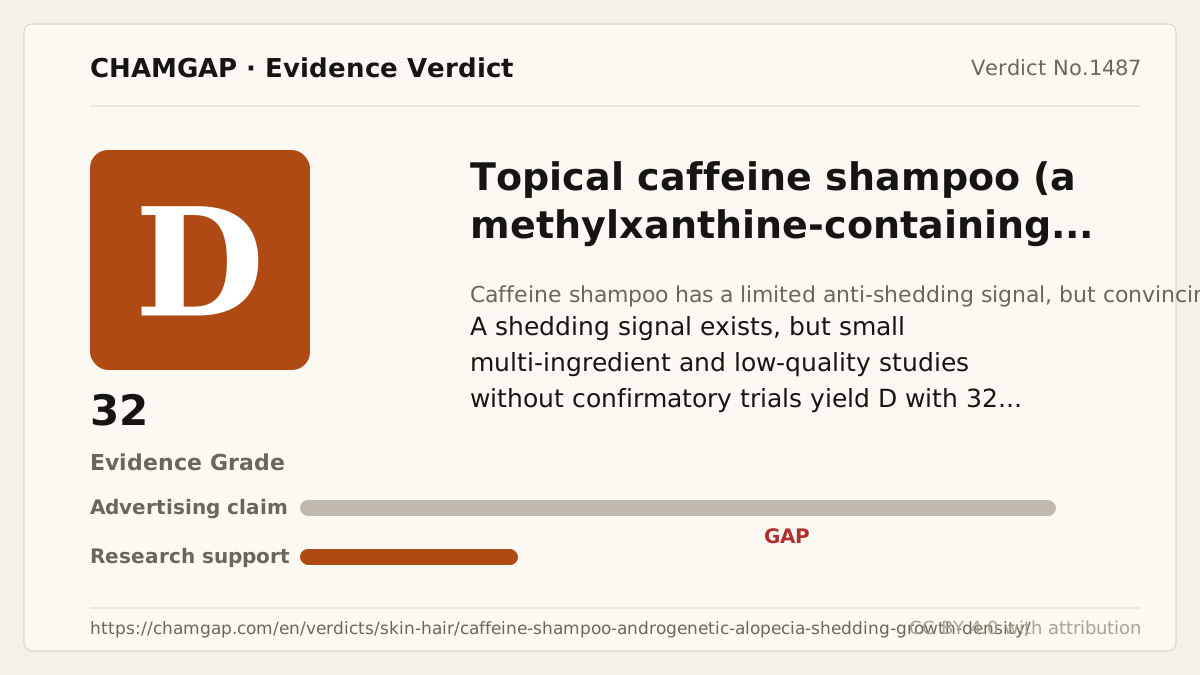
research showsCaffeine shampoo is rated D despite small trials suggesting improvement in some shedding measures. A 2025 systematic review found nine topical-caffeine trials with 684 participants, but rated five very low and one low certainty, citing absent randomization, placebo or control groups, and missing caffeine concentrations. A double-blind female-pattern-hair-loss trial tested a multi-ingredient phyto-caffeine shampoo and used a hair-pull test as its primary outcome. Independent long-term confirmation of growth, density, or superiority to minoxidil is lacking, yielding 32 points.
ads claimMarketing converts follicle activation, reduced shedding, and laboratory mechanisms into claims that shampoo stops balding, regrows hair, or works like minoxidil. A rinse-off shampoo also cannot inherit evidence from a leave-on caffeine liquid without direct testing.
Useful facts when choosing a product
- Caffeine shampoos are rinse-off cosmetic or nonprescription products whose caffeine concentration, botanical extracts, vitamins, and surfactants vary by formulation.
- Evidence for leave-on caffeine lotions or liquids is not directly transferable to shampoo because formulation and contact time differ.
- Systemic caffeine effects appear uncommon, but scalp stinging, redness, dryness, itching, or contact dermatitis can occur.
- Sudden or patchy loss, scalp inflammation, suspected iron or thyroid disorders, and postpartum or medication-related shedding require evaluation of the cause.
Chamgap Semantic Classification Code
Candidate index · review held
M.caffeine-shampoo.topical-skin.shedding-and-improved-growth-or-density-in-male-and-female-pattern-hair-loss.reduce.placeboMedicinal interventions > caffeine shampoo > Topical skin > shedding and improved growth or density in male and female pattern hair loss > Reduction claim > Placebo
An automated migration candidate, not an issued permanent code; exact claim scope remains under review. This machine-generated migration candidate helps retrieval but is not a permanent assignment. The original verdict ID and URL remain authoritative.
What the research actually shows
The 2025 review by Szendzielorz and Spiewak selected nine clinical studies with 684 participants from 1,121 records. All study conclusions favored caffeine, but only three were rated moderate, one low, and five very low; absent randomization, placebo or control groups, and unspecified caffeine concentration were recurrent defects. Bussoletti and colleagues reported a six-month benefit of phyto-caffeine shampoo over control shampoo on the hair-pull test in female pattern hair loss, but the product was multi-ingredient and sample-size and sponsorship transparency were limited.
Why this is classified as D (32)
The direction of topical-caffeine findings is often positive, but shampoo-specific evidence is dominated by small multi-ingredient studies with frequent deficiencies in randomization, controls, and concentration reporting. Independent long-term density confirmation and evidence of superiority to minoxidil are absent, so rule ② yields D with 32 points.
Counterpoint. A well-tolerated product may be chosen as an adjunctive shampoo, but the evidence does not justify discontinuing established treatment. This intervention is also distinct from oral biotin, brewer's yeast, or other prior ingredient verdicts.
Rejudgment record. New verdict — Accepted limited improvement in hair-pull measures but applied rule ② because shampoo-specific evidence is small and combination-product dominated, often lacks randomization, placebo, concentration reporting, and independent long-term density confirmation
Sub-claim grades by effect
This ingredient is marketed for several effects. A single overall grade blends strong and weak claims together, so each effect is graded separately here. The overall grade reflects the strongest disconfirming or core claim.
| Effect (sub-claim) | Grade | Basis |
|---|---|---|
| Reduced hair shedding | D | Hair-pull improvement is reported, but evidence is dominated by small combination-product and weak studies. |
| Improved hair growth or density | D | Independent long-term confirmatory trials using standardized hair counts or density are lacking. |
| Hair-loss improvement superior to minoxidil | ? | No adequate trial establishing superiority of caffeine shampoo to minoxidil was identified. |
Cross-check — AI research and Codex final gate
Evidence Table
| Study | Design | Sample | Funding | Endpoint | Result | Weight |
|---|---|---|---|---|---|---|
| Szendzielorz E and Spiewak R 2025 | Systematic review of clinical studies of topical caffeine for hair loss | Nine studies and 684 participants | Academic support from Jagiellonian University Medical College; authors reported no conflicts | Shedding, hair-pull testing, anagen ratio, hair counts, and satisfaction | All studies concluded favorably, but six of nine were low or very-low certainty with frequent design and product-reporting defects. | Key evidence-quality assessment |
| Bussoletti C et al. 2020 | Single-center randomized double-blind controlled parallel trial | Women with androgenetic alopecia; total sample size not stated in the abstract | Funding not clearly stated in the abstract; evaluation of a commercial combination shampoo | Number of hairs removed in a hair-pull test at six months | The phyto-caffeine shampoo reduced hairs removed more than control, but did not isolate caffeine or establish increased hair density. | Direct shampoo signal with combination-product limitation |
Receipt — 2 References
All 2 cited sources were verified for existence at the original page (as of 2026-07-23).
Final verification and publication gate: Codex · Evidence date: 2026-07-23 · Corrections: none
Cite this verdict
[Chamgap] Caffeine shampoo x shedding, growth, and density in pattern hair loss — Evidence Grade D·32. 2 cited sources checked. Source: https://chamgap.com/en/verdicts/skin-hair/caffeine-shampoo-androgenetic-alopecia-shedding-growth-density/ · CC BY 4.0CC BY 4.0 — free to use with attribution; do not distort grades, numbers, or verdict meaning.
What this document does and does not do
Chamgap is an information source. It reports what research has and has not confirmed; it does not tell readers what to take or buy. That decision belongs to readers and, when needed, medical or legal professionals. This verdict reflects literature available up to the search date and may change as new research appears. Nothing here is medical advice.