
Scraping versus pinching a bee stinger,
does it really help with Reduction of local weal area according to removal method?
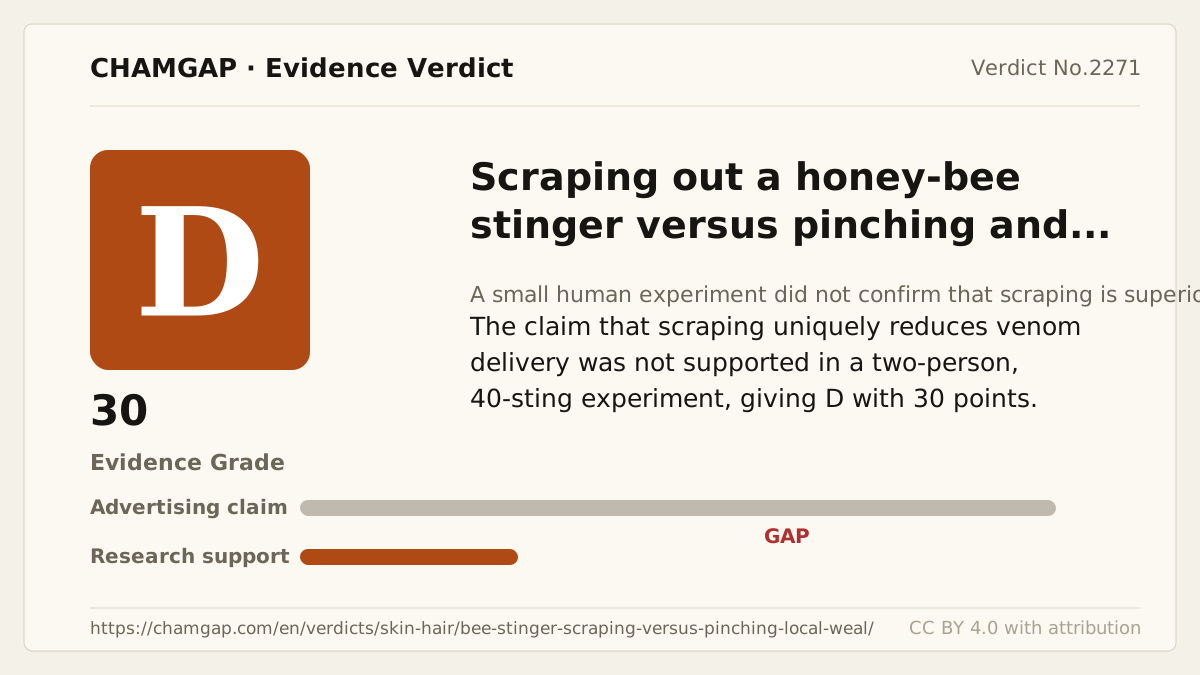
research showsThe grade is D with 30 points. In the randomized-block experiment by Visscher et al., mean weal area was 80 plus or minus 5.9 mm2 after scraping and 74 plus or minus 5.1 mm2 after pinching; the plus-or-minus values were standard errors. The difference was null, F(1,35)=0.655 and P=.42. This was not a study of 40 people: two investigators self-administered 40 stings in total, and no confidence interval was reported.
ads claimThe common claim merges removal speed with removal technique. Human evidence found no technique difference and instead emphasized avoiding delay.
Useful facts when choosing a product
- The comparison involved two investigators and 40 total stings.
- The dispersion values were standard errors, not standard deviations.
- Systemic allergy and anaphylaxis were not measured.
Chamgap Semantic Classification Code
Candidate index · review held
UNK.scraping-out-a-honey-bee-stinger-versus-pinching-and-pulling-it-out.UNK.local-weal-area-according-to-removal-method.reduce.UNKUnknown > Scraping out a honey-bee stinger versus pinching and pulling it out > Unknown > local weal area according to removal method > Reduction claim > Unknown
An automated migration candidate, not an issued permanent code; exact claim scope remains under review. This machine-generated migration candidate helps retrieval but is not a permanent assignment. The original verdict ID and URL remain authoritative.
What the research actually shows
Visscher, Vetter, and Camazine studied two investigators, PKV and RSV, who self-administered ten stings per method, 40 stings total. The assigned arm was randomized and the observer was unaware of assignment. Stingers were removed after two seconds and weal area was measured at ten minutes. Means and standard errors were 80 plus or minus 5.9 mm2 for scraping and 74 plus or minus 5.1 mm2 for pinching, with ANOVA F(1,35)=0.655 and P=.42. No confidence interval was reported. The acknowledgments state that Vespa Laboratories supplied dried venom and NSF grant IBN 9120639 provided financial support.
Why this is classified as D (30)
A single very small, short surrogate experiment was null and lacked a confidence interval, giving D with 30 points.
Counterpoint. Signs of anaphylaxis require immediate emergency action rather than debate over removal technique.
Rejudgment record. Cross-check applied — Cross-checked participants, sting count, randomized-block design, standard errors, ANOVA, and endpoint scope in the expanded original report
| Endpoint | S | Surrogate marker - laboratory or imaging measures |
| Replication | R1 | Single confirmatory trial |
| Independence | I2 | Decisive evidence is publicly or non-profit funded |
| Effect size | E0 | Null |
| Precision | CX | No pooled confidence interval could be confirmed |
Stored derived and displayed grades match; this is not a current recalculation or validity check (D).
Sub-claim grades by effect
This ingredient is marketed for several effects. A single overall grade blends strong and weak claims together, so each effect is graded separately here. The overall grade reflects the strongest disconfirming or core claim.
| Effect (sub-claim) | Grade | Basis |
|---|---|---|
| Scraping reduces local weal area more than pinching | D | The result was 80 plus or minus 5.9 versus 74 plus or minus 5.1 mm2, P=.42. |
| Faster removal reduces weal size | C | A separate delay series supported speed, but it was a one-person self-experiment. |
Cross-check — AI research and Codex final gate
Evidence Table
| Study | Design | Sample | Funding | Endpoint | Result | Weight |
|---|---|---|---|---|---|---|
| Visscher et al. 1996 | Observer-blinded randomized-block self-experiment | Two investigators and 40 total stings | Dried venom supplied by Vespa Laboratories; financial support from NSF grant IBN 9120639 | Local weal area ten minutes after stinging | Scraping 80 plus or minus 5.9 mm2 versus pinching 74 plus or minus 5.1 mm2, mean plus or minus SE; F(1,35)=0.655, P=.42; no CI reported | Direct method comparison but an extremely small surrogate study |
Receipt — 2 References
All 2 cited sources were verified for existence at the original page (as of 2026-08-05).
Final verification and publication gate: Codex · Evidence date: 2026-08-05 · Corrections: none
Cite this verdict
[Chamgap] Scraping versus pinching a bee stinger x local reaction — Evidence Grade D·30. 2 cited sources checked. Source: https://chamgap.com/en/verdicts/skin-hair/bee-stinger-scraping-versus-pinching-local-weal/ · CC BY 4.0CC BY 4.0 — free to use with attribution; do not distort grades, numbers, or verdict meaning.
What this document does and does not do
Chamgap is an information source. It reports what research has and has not confirmed; it does not tell readers what to take or buy. That decision belongs to readers and, when needed, medical or legal professionals. This verdict reflects literature available up to the search date and may change as new research appears. Nothing here is medical advice.