
Azelaic acid,
does it really help with Reduction of inflammatory and noninflammatory lesions in mild-to-moderate acne?
research showsTopical azelaic acid 15% to 20% shows signals for fewer inflammatory and noninflammatory lesions versus vehicle, but the evidence is limited and is graded C. In the Cochrane review, missing standard deviations prevented pooling of many lesion-count results, and participant global assessment was not measured. Investigator global assessment came from one 92-person trial with a borderline and imprecise RR of 1.64 (95% CI 1.00 to 2.67). Evidence centered on old small formulation trials and low- to very-low-certainty findings, making it less certain than the adapalene B79 precedent and supporting C with 54 points.
ads claimMarketing may imply that low-concentration cosmetics work as quickly as studied prescription-strength 15% to 20% formulations and cure severe acne, scars, and pigmentation. Direct evidence supports fewer lesions after weeks of using specific concentrations and formulations, not monotherapy for severe acne or correction of depressed scars.
Useful facts when choosing a product
- Acne evidence mainly concerns 15% gel or 20% cream used once or twice daily for about eight to twelve weeks, so the same effect cannot be assumed for low-concentration cosmetics.
- A thin initial application with reduced frequency when irritation is troublesome is common practice, but the product label and prescription should determine the regimen.
- Stinging, burning, redness, dryness, and itching often occur early, and contact with the eyes, mouth, or damaged skin should be avoided.
- Nodules or cysts, rapid scarring, extensive disease, or no improvement after an adequate eight-to-twelve-week trial calls for assessment for combination or systemic therapy.
Chamgap Semantic Classification Code
Candidate index · review held
M.azelaic-acid.topical-skin.inflammatory-and-noninflammatory-lesions-in-mild-to-moderate-acne.reduce.MULTIMedicinal interventions > Azelaic acid > Topical skin > inflammatory and noninflammatory lesions in mild to moderate acne > Reduction claim > Multiple: primary unresolved
An automated migration candidate, not an issued permanent code; exact claim scope remains under review. This machine-generated migration candidate helps retrieval but is not a permanent assignment. The original verdict ID and URL remain authoritative.
What the research actually shows
Cunliffe 1989 reported a vehicle-controlled lesion-reduction signal with 20% azelaic acid cream. In the 2020 Cochrane review, missing standard deviations prevented pooling of many lesion-count data and participant global assessment was not measured. Investigator global assessment came from one 92-person trial with a borderline imprecise RR of 1.64 (95% CI 1.00 to 2.67), while evidence centered on old small formulation trials and low- to very-low-certainty findings. In the 215-person Schaller 2016 active-comparator trial, the combination was superior and industry involvement was present.
Why this is classified as C (54)
Signals for lesion reduction versus vehicle exist, but missing standard deviations prevented pooling of many outcomes in Cochrane, participant global assessment was not measured, and investigator global assessment was borderline and imprecise in one 92-person trial at RR 1.64 (95% CI 1.00 to 2.67). Old small formulation trials and mainly low- to very-low-certainty evidence make this less certain than adapalene B79, yielding C with 54 points.
Counterpoint. Azelaic acid can be a practical nonantibiotic option for sensitive skin or concurrent postinflammatory pigmentation. Its usefulness does not resolve the unpoolable data, absent participant assessment, or imprecision that prevent a B rating.
Rejudgment record. Cross-check revision — Adversarial cross-checking confirmed low certainty and imprecision, prompting a downgrade from B to C; Cochrane could not pool many outcomes because standard deviations were missing, participant global assessment was not measured, and one 92-person investigator assessment was borderline at RR 1.64 (95% CI 1.00 to 2.67)
Sub-claim grades by effect
This ingredient is marketed for several effects. A single overall grade blends strong and weak claims together, so each effect is graded separately here. The overall grade reflects the strongest disconfirming or core claim.
| Effect (sub-claim) | Grade | Basis |
|---|---|---|
| Reduction of inflammatory lesions in mild-to-moderate acne | C | A reduction signal versus vehicle exists, but many data were not poolable and global assessment was borderline and imprecise. |
| Reduction of noninflammatory lesions in mild-to-moderate acne | C | A comedone-reduction signal exists, but evidence centers on old small formulation trials with low certainty. |
| Monotherapy for severe nodular or cystic acne | D | Adequate direct evidence for azelaic-acid monotherapy in severe acne is lacking, and systemic or combination treatment is usually required. |
| Improvement of post-acne hyperpigmentation | C | Small randomized data and mechanistic signals exist, but evidence is less extensive than for acne lesion reduction. |
Cross-check — AI research and Codex final gate
Evidence Table
| Study | Design | Sample | Funding | Endpoint | Result | Weight |
|---|---|---|---|---|---|---|
| Liu H et al. 2020 Cochrane review | Systematic review of randomized trials of topical acne treatments | Forty-nine trials and 3,880 participants, including azelaic-acid comparisons | Academic Cochrane review | Treatment response, quality of life, lesion counts, and adverse events | Missing standard deviations prevented pooling of many lesion data, participant global assessment was absent, and a 92-person investigator assessment was imprecise at RR 1.64 (95% CI 1.00 to 2.67). | Key independent synthesis with low to very low certainty |
| Cunliffe WJ and Holland KT. 1989 | Placebo-controlled clinical trial | Clinical acne trial of 20% azelaic acid cream; total sample not stated in the abstract | Not reported in the abstract | Inflammatory and noninflammatory lesion counts with microbiologic and sebum measures | Inflammatory lesions fell significantly versus placebo after one month and noninflammatory lesions after two months. | Direct placebo-controlled lesion evidence |
| Schaller M et al. 2016 | Multicenter randomized assessor-blinded active-controlled trial | Modified intention-to-treat population of 215 patients with mild-to-moderate acne | Three GSK-employed authors in a product-comparison program | Change in inflammatory lesions at week four and total and inflammatory lesions at week twelve | Azelaic acid reduced inflammatory lesions by 65.3% and total lesions by 53.9% at week twelve, but the combination comparator was superior. | Moderate-sized direct active-controlled evidence |
Receipt — 4 References
All 4 cited sources were verified for existence at the original page (as of 2026-07-20).
Final verification and publication gate: Codex · Evidence date: 2026-07-20 · Corrections: none
Cite this verdict
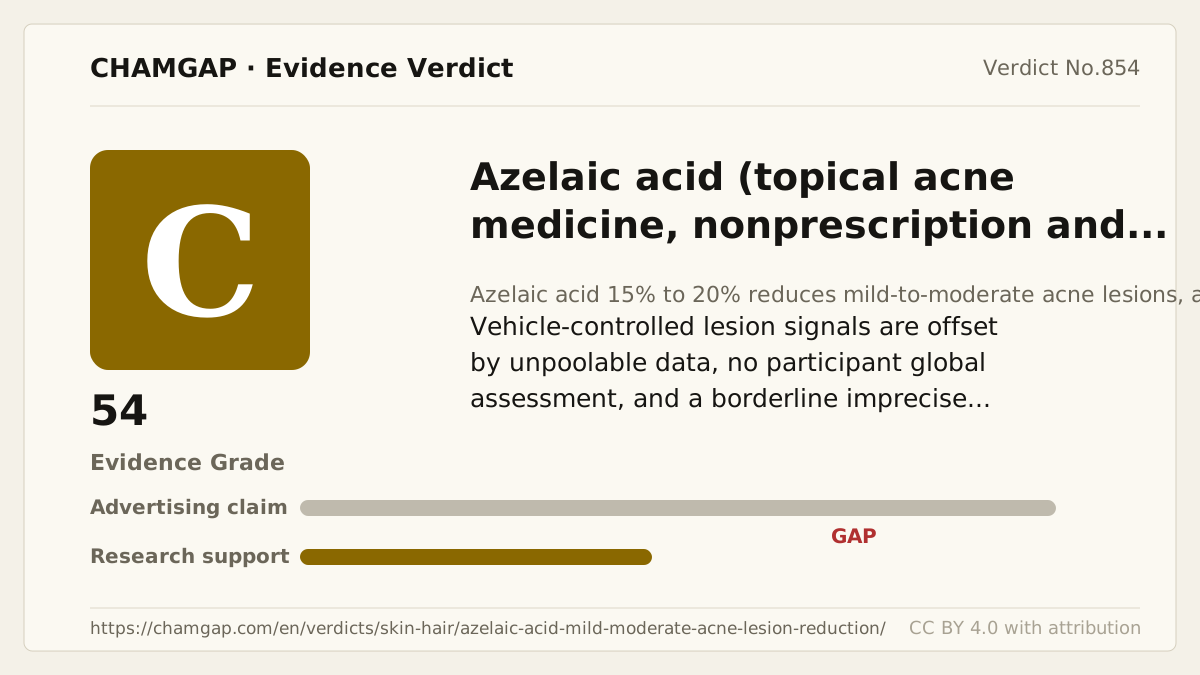
[Chamgap] Azelaic acid x reduced lesions in mild-to-moderate acne — Evidence Grade C·54. 4 cited sources checked. Source: https://chamgap.com/en/verdicts/skin-hair/azelaic-acid-mild-moderate-acne-lesion-reduction/ · CC BY 4.0CC BY 4.0 — free to use with attribution; do not distort grades, numbers, or verdict meaning.
What this document does and does not do
Chamgap is an information source. It reports what research has and has not confirmed; it does not tell readers what to take or buy. That decision belongs to readers and, when needed, medical or legal professionals. This verdict reflects literature available up to the search date and may change as new research appears. Nothing here is medical advice.