
Autologous platelet-rich plasma,
does it really help with Increased hair density and hair count in men and women with androgenetic alopecia?
research showsAutologous PRP injections are rated C because randomized trials provide a positive signal for increased hair density and count in men and women with androgenetic alopecia. A 2024 meta-analysis of 10 trials and 555 treatment units found a mean density advantage of 25.09 hairs/cm² over control. The effect was larger in trials with fewer than 30 participants, however, and blood collection, centrifugation, platelet concentration, leukocyte content, activation, and injection schedules varied substantially. Independent replication of long-term durability and an optimal protocol is also lacking, preventing a B grade. Injection pain, bleeding, swelling, itching, and rare infection are safety issues separate from efficacy.
ads claimMarketing can turn an average short-term density signal into claims of universally safe regeneration, permanent regrowth after a few sessions, or superiority of a clinic-specific PRP method. Permanent maintenance, efficacy for every type of hair loss, and superiority of a particular device or kit have not been established.
Useful facts when choosing a product
- PRP is a medical procedure in which a patient's blood is collected, centrifuged, and the platelet-concentrated plasma layer is injected into the scalp. It is not equivalent to an oral supplement or a standardized finished medicine.
- Studies differ in platelet concentration, leukocyte inclusion, activation method, injection volume, number of sessions, and spacing, so the name PRP does not guarantee the same exposure.
- Even when effective, PRP does not remove the cause of androgenetic alopecia or prove permanent hair retention. Use with standard treatments and maintenance procedures require separate decisions.
- The most common adverse effects are pain, tenderness, minor bleeding, swelling, and itching at blood-draw or scalp-injection sites. Poor sterile technique can cause infection, and anticoagulant use or platelet and bleeding disorders require clinical assessment before treatment.
Chamgap Semantic Classification Code
Candidate index · review held
P.autologous-platelet-rich-plasma.procedural.hair-density-and-hair-count-and-women-with-androgenetic-alopecia.increase.placeboProcedures, devices and tests > Autologous platelet-rich plasma > Procedural > hair density and hair count and women with androgenetic alopecia > Increase claim > Placebo
An automated migration candidate, not an issued permanent code; exact claim scope remains under review. This machine-generated migration candidate helps retrieval but is not a permanent assignment. The original verdict ID and URL remain authoritative.
What the research actually shows
Li and colleagues pooled 10 randomized trials with 555 treatment units and found significantly greater hair density with PRP, but not greater hair diameter; effects were larger in trials enrolling fewer than 30 participants. Papakonstantinou and colleagues reviewed 11 randomized trials and reported improvements in follicle number, thickness, and density while calling for protocol optimization. Evans and colleagues included 30 studies and 687 patients, including 10 randomized trials, and found higher density and thickness while emphasizing the need for low-risk-of-bias trials and investigation of between-study variation. All three syntheses point in a positive direction, but small individual samples and preparation and administration heterogeneity remain central limitations.
Why this is classified as C (53)
Meta-analyses of randomized trials provide a genuinely positive hair-density and count signal. Individual trials are small, effects were greater in studies with fewer than 30 participants, and PRP preparation and dosing protocols are highly heterogeneous. Long-term durability and large standardized independent replication are lacking, yielding C with 53 points. Injection-related harms remain independent safety considerations.
Counterpoint. After a dermatologic diagnosis, PRP may be considered as an adjunct for patients who do not tolerate standard treatment or want an additional procedure. The kit and preparation method, expected number of sessions, concomitant treatment, cost, and infection-control process should be reviewed beforehand.
Rejudgment record. New verdict — Accepted positive randomized meta-analytic evidence for hair density and count, but applied C because individual trials were small, effects were larger in small samples, PRP preparation and dosing were highly heterogeneous, and long-term independent replication was lacking
Sub-claim grades by effect
This ingredient is marketed for several effects. A single overall grade blends strong and weak claims together, so each effect is graded separately here. The overall grade reflects the strongest disconfirming or core claim.
| Effect (sub-claim) | Grade | Basis |
|---|---|---|
| Increased hair density in androgenetic alopecia | C | Randomized meta-analyses are positive, but individual trials are small and show small-study effects and substantial protocol heterogeneity. |
| Increased hair count in androgenetic alopecia | C | A follicle and hair-count signal exists, but measurement and treatment methods vary and long-term replication is limited. |
| Equivalent hair-growth efficacy across different PRP preparation and administration methods | D | Platelet concentration, leukocyte content, activation, session number, and spacing are nonstandardized, so equivalence across protocols is unproven. |
Cross-check — AI research and Codex final gate
Evidence Table
| Study | Design | Sample | Funding | Endpoint | Result | Weight |
|---|---|---|---|---|---|---|
| Li M et al. 2024 | Meta-analysis of randomized PRP trials for androgenetic alopecia | 10 trials and 555 treatment units | Meta-analysis; authors reported no conflicts of interest | Hair density and hair diameter | Hair density MD was 25.09 hairs/cm² (95% CI 9.03 to 41.15), while diameter SMD was 0.57 (95% CI -0.23 to 1.38); density effects were larger in trials with fewer than 30 participants. | Key positive synthesis with a small-study caution |
| Papakonstantinou M et al. 2023 | Systematic review and meta-analysis of clinical trials | 11 included randomized trials | No financial support reported | Follicle number, hair thickness, hair density, and patient satisfaction | PRP significantly increased follicle number, thickness, and density versus placebo; adverse effects were mainly temporary local pain, bleeding, and itching. | Supportive positive evidence requiring protocol optimization |
| Evans AG et al. 2022 | Systematic review and meta-analysis of randomized trials | 30 studies and 687 patients; 10 randomized trials | Inadequately reported | Hair density, thickness, and adverse effects | Reported increased density and thickness but called for low-risk-of-bias trials to address study variability and optimize protocols. | Consistent direction with confirmed heterogeneity |
Receipt — 3 References
All 3 cited sources were verified for existence at the original page (as of 2026-07-22).
Final verification and publication gate: Codex · Evidence date: 2026-07-22 · Corrections: none
Cite this verdict
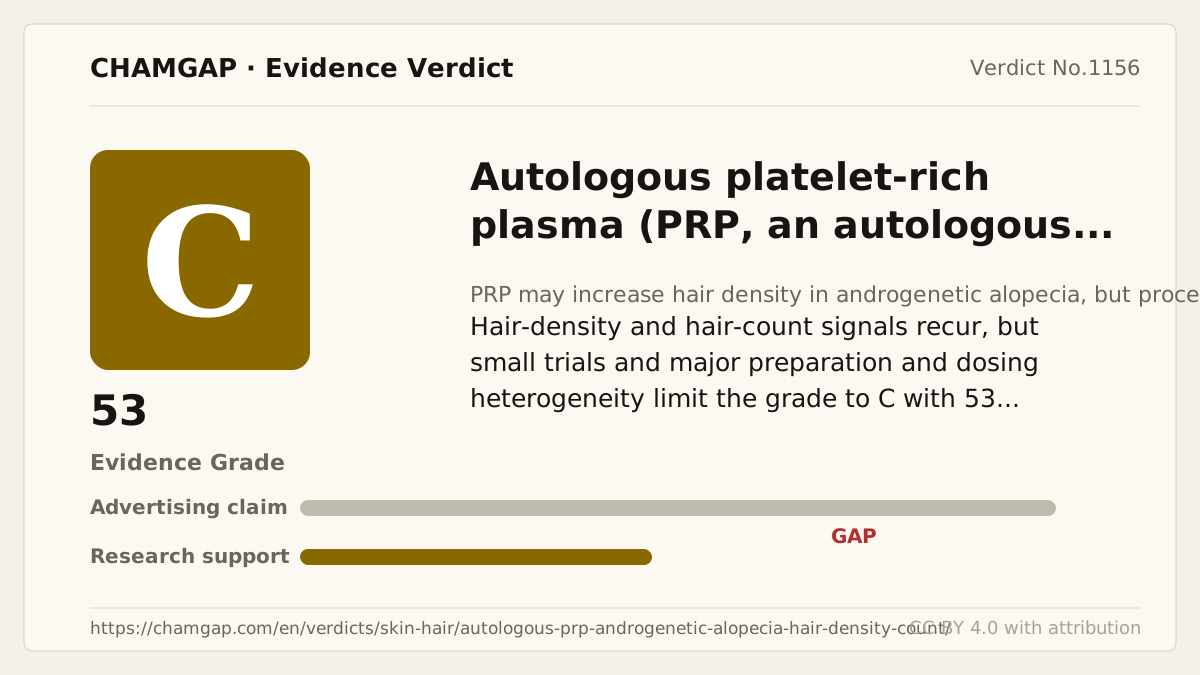
[Chamgap] Autologous platelet-rich plasma x increased hair density and count in androgenetic alopecia — Evidence Grade C·53. 3 cited sources checked. Source: https://chamgap.com/en/verdicts/skin-hair/autologous-prp-androgenetic-alopecia-hair-density-count/ · CC BY 4.0CC BY 4.0 — free to use with attribution; do not distort grades, numbers, or verdict meaning.
What this document does and does not do
Chamgap is an information source. It reports what research has and has not confirmed; it does not tell readers what to take or buy. That decision belongs to readers and, when needed, medical or legal professionals. This verdict reflects literature available up to the search date and may change as new research appears. Nothing here is medical advice.