
Abrocitinib,
does it really help with Improvement of skin lesions and itch in moderate-to-severe atopic dermatitis?
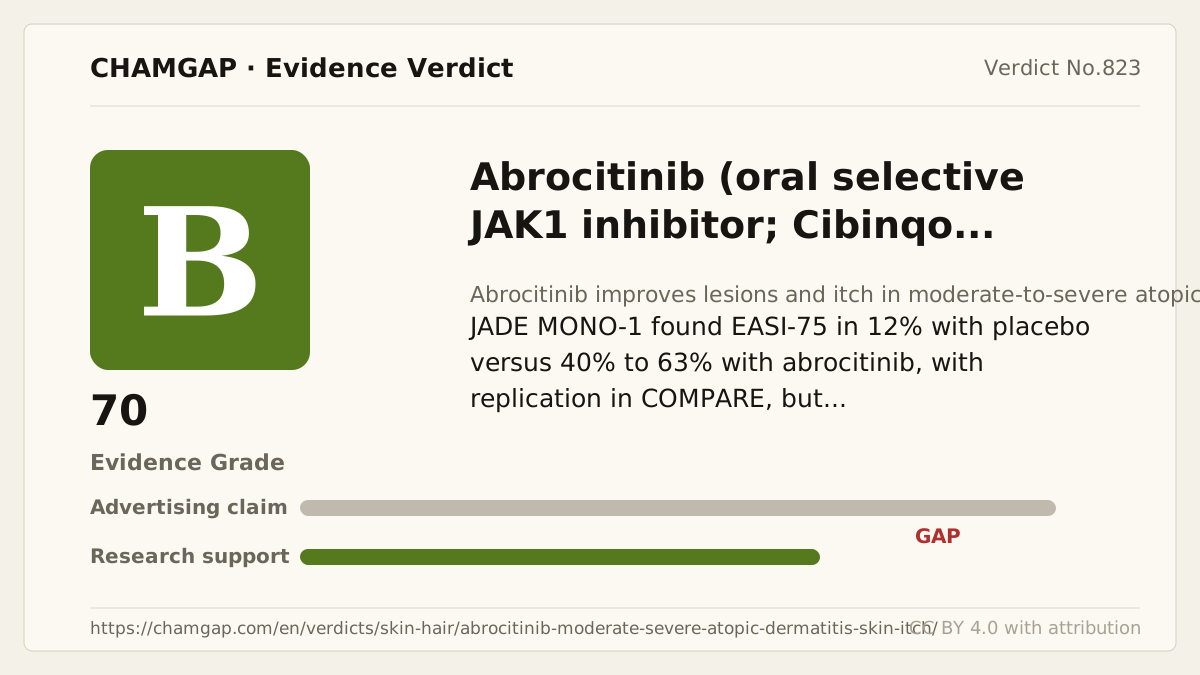
research showsAbrocitinib is rated B because it improves skin lesions and itch in moderate-to-severe atopic dermatitis requiring systemic therapy. In JADE MONO-1, week-12 EASI-75 was 40% with 100 mg, 63% with 200 mg, and 12% with placebo; JADE MONO-2 and background-topical-therapy JADE COMPARE replicated the result. These are direct clinical outcomes for skin signs and patient itch, but pivotal trials were Pfizer-sponsored and long-term comparative confirmation is limited. JAK warnings for serious infection, herpes zoster, thrombosis, and cardiovascular events and laboratory monitoring are separated under safety rather than used to deny efficacy.
ads claimPromotion can turn a response to an oral medicine into an atopic-dermatitis cure or permanent end of itch, extending 12-to-16-week response rates into lifelong remission. This is systemic therapy for moderate-to-severe disease, with ongoing assessment of response, laboratory tests, infection, and individual risk.
Useful facts when choosing a product
- Abrocitinib is a once-daily oral prescription medicine. A clinician selects among authorized doses according to age, risk factors, kidney function, and response.
- Tuberculosis, hepatitis, other infection risks, and vaccination status are assessed before treatment, and blood counts, lipids, liver tests, and other label-directed monitoring are performed during treatment.
- Nausea, headache, acne, upper respiratory infection, and herpes zoster can occur, and serious infection requires prompt assessment.
- JAK inhibitor labeling warns about mortality, malignancy, major cardiovascular events, and thrombosis. Older age, smoking history, and cardiovascular, cancer, or thrombotic risk require individualized consideration of alternatives.
Chamgap Semantic Classification Code
Candidate index · review held
M.abrocitinib.oral.skin-lesions-and-itch-in-moderate-to-severe-atopic-dermatitis.improve.MULTIMedicinal interventions > Abrocitinib > Oral > skin lesions and itch in moderate-to-severe atopic dermatitis > Improvement claim > Multiple: primary unresolved
An automated migration candidate, not an issued permanent code; exact claim scope remains under review. This machine-generated migration candidate helps retrieval but is not a permanent assignment. The original verdict ID and URL remain authoritative.
What the research actually shows
JADE MONO-1 randomized 387 participants for 12 weeks and found EASI-75 in 12% with placebo, 40% with 100 mg, and 63% with 200 mg. JADE MONO-2 replicated EASI-75 at 10% versus 45% and 61% and also improved itch response. In 838 JADE COMPARE participants receiving background topical therapy, week-12 EASI-75 was 27.1% with placebo, 58.7% with abrocitinib 100 mg, 70.3% with 200 mg, and 58.1% with dupilumab. All were Pfizer-sponsored phase 3 trials.
Why this is classified as B (70)
JADE MONO-1 found week-12 EASI-75 in 12% with placebo versus 40% to 63% with abrocitinib, and JADE MONO-2 and COMPARE replicated lesion and itch improvement. Despite the large effect, Pfizer-centered evidence, limited independent long-term confirmation, and parity with dupilumab B76 yield B with 70 points. JAK warnings are handled separately under safety.
Counterpoint. Treatment choice should integrate age, infection history, pregnancy plans, smoking, cardiovascular, thrombotic, and cancer risk, and response to existing biologics. Evidence does not support casual extension to mild atopic dermatitis.
Rejudgment record. New verdict — Accepted the large EASI-75 effect of 12% with placebo versus 40% to 63% with abrocitinib in JADE MONO-1 and replication in JADE MONO-2 and COMPARE while accounting for Pfizer sponsorship, short controlled periods, limited independent long-term confirmation, and parity with dupilumab B76, with JAK risks separated under safety
Sub-claim grades by effect
This ingredient is marketed for several effects. A single overall grade blends strong and weak claims together, so each effect is graded separately here. The overall grade reflects the strongest disconfirming or core claim.
| Effect (sub-claim) | Grade | Basis |
|---|---|---|
| Improvement in EASI and IGA skin lesions in moderate-to-severe atopic dermatitis | B | Multiple JADE randomized phase 3 trials repeatedly improved outcomes versus placebo, but evidence is concentrated in manufacturer sponsorship. |
| Improvement in itch in moderate-to-severe atopic dermatitis | B | Peak Pruritus NRS response consistently improved in monotherapy and combination trials. |
| The same net benefit in mild atopic dermatitis or nonspecific itch | ? | Direct human efficacy literature for this extension was not identified. |
Cross-check — AI research and Codex final gate
Evidence Table
| Study | Design | Sample | Funding | Endpoint | Result | Weight |
|---|---|---|---|---|---|---|
| Simpson EL et al. JADE MONO-1 2020 | Multicenter randomized double-blind placebo-controlled phase 3 monotherapy trial | 387 participants aged at least 12 years with moderate-to-severe atopic dermatitis | Sponsored by Pfizer | Week-12 IGA response and EASI-75; itch response | EASI-75 was 12% with placebo, 40% with 100 mg, and 63% with 200 mg; p<0.0001 for both doses. | Pivotal direct monotherapy evidence |
| Bieber T et al. JADE COMPARE 2021 | Randomized double-blind double-dummy phase 3 placebo- and dupilumab-controlled trial | 838 adults receiving background topical therapy | Sponsored by Pfizer | Week-12 IGA response and EASI-75; early itch response | EASI-75 was 27.1% with placebo, 58.7% with 100 mg, 70.3% with 200 mg, and 58.1% with dupilumab. | Combination and active-comparator confirmation |
Receipt — 3 References
All 3 cited sources were verified for existence at the original page (as of 2026-07-20).
Final verification and publication gate: Codex · Evidence date: 2026-07-20 · Corrections: none
Cite this verdict
[Chamgap] Abrocitinib x improvement of skin lesions and itch in moderate-to-severe atopic dermatitis — Evidence Grade B·70. 3 cited sources checked. Source: https://chamgap.com/en/verdicts/skin-hair/abrocitinib-moderate-severe-atopic-dermatitis-skin-itch/ · CC BY 4.0CC BY 4.0 — free to use with attribution; do not distort grades, numbers, or verdict meaning.
What this document does and does not do
Chamgap is an information source. It reports what research has and has not confirmed; it does not tell readers what to take or buy. That decision belongs to readers and, when needed, medical or legal professionals. This verdict reflects literature available up to the search date and may change as new research appears. Nothing here is medical advice.