
Single invitation to PSA screening,
does it really help with Reduction in prostate-cancer mortality among average-risk men?
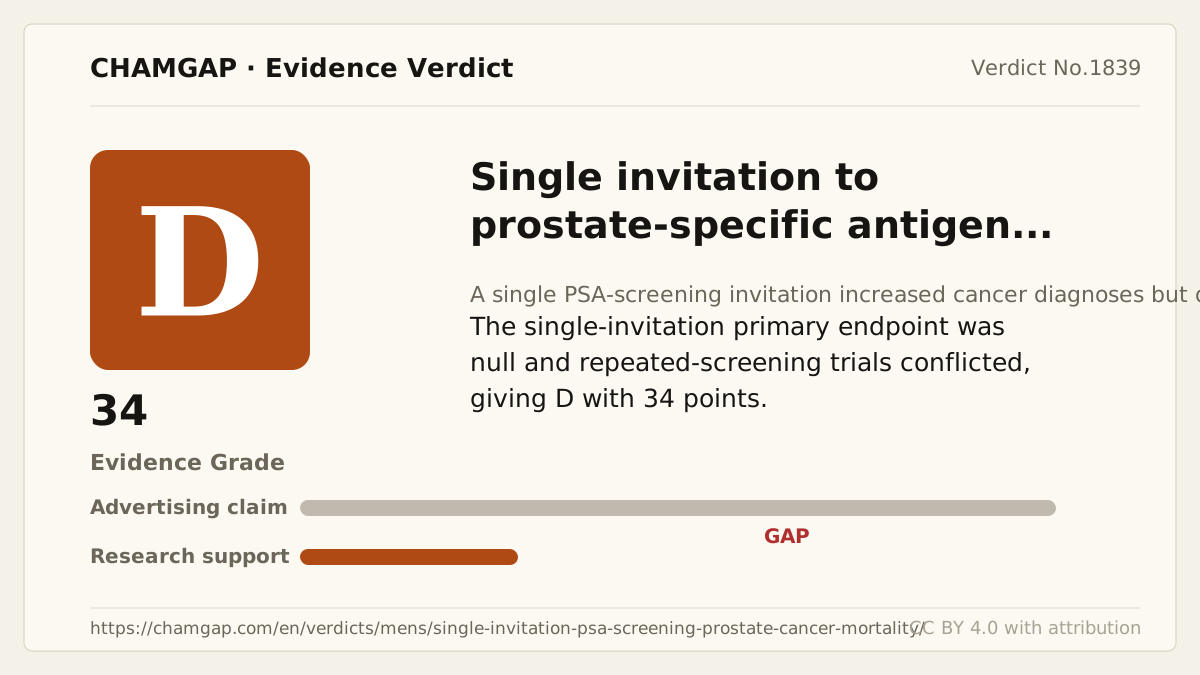
research showsA single invitation to PSA screening missed the prespecified 10-year prostate-cancer mortality primary endpoint in CAP, yielding D. Among 415,357 cluster-randomized men, 408,825 were analyzed; deaths were 549 versus 647, RR 0.96 (95% CI 0.85 to 1.08), P=0.50. The 2024 15-year secondary analysis showed a small prostate-cancer mortality signal, RR 0.92 (0.85 to 0.99), P=0.03, but all-cause mortality remained null, RR 0.97 (0.94 to 1.01), P=0.11. ERSPC was positive and PLCO null, giving R0; the secondary analysis does not reverse the failed primary endpoint, so the grade remains D.
ads claimDetecting more cancers with PSA must not be equated with extending life. CAP increased diagnoses from 3.6% to 4.3% but did not reduce 10-year prostate-cancer or all-cause mortality.
Useful facts when choosing a product
- Forty percent of invited CAP participants attended the clinic and 36% actually received PSA testing; the analysis estimates the intention-to-invite effect.
- Verdict 1291, which is A with 92 points, concerns lung-cancer mortality after low-dose chest CT in high-risk smokers; verdict 1474, which is A with 90 points, concerns abdominal-aortic-aneurysm mortality after ultrasound screening. Verdict 1720, which is D with 22 points, concerns ovarian-cancer mortality after CA-125 plus transvaginal ultrasound. Screening grades differ because mortality trial results differ.
- Verdict 1214, which is C with 58 points, concerns finasteride chemoprevention of prostate-cancer diagnoses rather than PSA screening.
Chamgap Semantic Classification Code
Candidate index · review held
P.single-invitation-to-prostate-specific-antigen-screening.diagnostic.prostate-cancer-mortality-among-average-risk-men.reduce.UNKProcedures, devices and tests > Single invitation to prostate-specific antigen screening > Diagnostic or screening > prostate-cancer mortality among average-risk men > Reduction claim > Unknown
An automated migration candidate, not an issued permanent code; exact claim scope remains under review. This machine-generated migration candidate helps retrieval but is not a permanent assignment. The original verdict ID and URL remain authoritative.
What the research actually shows
CAP cluster-randomized 415,357 men across 573 practices and analyzed 408,825, including 189,386 invited and 219,439 controls. Only 36% of invited men received PSA testing. Ten-year prostate-cancer mortality failed with RR 0.96 and P=0.50; all-cause mortality was RR 0.99. The 2024 15-year secondary analysis found cumulative prostate-cancer mortality of 0.69% versus 0.78%, RR 0.92 (0.85 to 0.99), P=0.03, while all-cause mortality was null, RR 0.97 (0.94 to 1.01), P=0.11. ERSPC randomized 182,160 and analyzed a core-age group of 162,388, succeeding at 11 years with RR 0.79 (0.68 to 0.91), P=0.001. PLCO randomized and analyzed 76,693, failing at 13 years with RR 1.09 (0.87 to 1.36), with extensive control-arm PSA contamination. Different-intensity strategies produced conflicting results, so replication is R0.
Why this is classified as D (34)
The prespecified CAP primary endpoint failed among 408,825 analyzed men with RR 0.96 and P=0.50. Positive ERSPC and null PLCO results create R0, and CAP CI 0.85 to 1.08 leaves meaningful benefit possible, giving C0 and D with 34 points.
Counterpoint. Overdiagnosis and complications from biopsy, surgery, or radiotherapy are harms separate from mortality efficacy. Age, family history, ancestry, life expectancy, and preferences belong in shared decision-making.
Rejudgment record. Cross-check applied — Failure of the CAP 10-year prostate-cancer mortality primary endpoint, a small positive 15-year secondary signal with null all-cause mortality, conflict between ERSPC and PLCO, and an interval retaining meaningful possible benefit
| Endpoint | H | Hard endpoint - actual events such as death |
| Replication | R0 | Trials conflict in direction |
| Independence | I2 | Decisive evidence is publicly or non-profit funded |
| Effect size | E0 | Null |
| Precision | C0 | The confidence interval leaves room for benefit |
Stored derived and displayed grades match; this is not a current recalculation or validity check (D).
Sub-claim grades by effect
This ingredient is marketed for several effects. A single overall grade blends strong and weak claims together, so each effect is graded separately here. The overall grade reflects the strongest disconfirming or core claim.
| Effect (sub-claim) | Grade | Basis |
|---|---|---|
| Reduction in 10-year prostate-cancer mortality from one PSA invitation | D | The CAP primary endpoint failed with RR 0.96 and P=0.50. |
| Reduction in prostate-cancer mortality from repeated PSA screening | C | ERSPC was positive and PLCO was null, producing conflict. |
| Reduction in all-cause mortality from invitation to PSA screening | D | CAP all-cause mortality was null with RR 0.99 and P=0.49. |
Cross-check — AI research and Codex final gate
Evidence Table
| Study | Design | Sample | Funding | Endpoint | Result | Weight |
|---|---|---|---|---|---|---|
| Martin RM et al. 2018 CAP | Primary-care cluster-randomized single-invitation controlled trial | 415,357 randomized; 408,825 analyzed (189,386 invited and 219,439 control) | Public and nonprofit funding from Cancer Research UK, the United Kingdom Department of Health, and NIHR | Prostate-cancer-specific mortality at median 10 years | 549 versus 647 deaths, RR 0.96 (0.85 to 1.08), P=0.50; the primary endpoint failed, and all-cause mortality RR was 0.99 (0.94 to 1.03). | Decisive direct single-invitation trial |
| Martin RM et al. 2024 CAP 15-year analysis | Prespecified 15-year secondary analysis of CAP randomization | Original CAP cluster-randomized cohort; 1,199 versus 1,451 prostate-cancer deaths | Public and nonprofit funding including Cancer Research UK and NIHR | Fifteen-year secondary analysis of prostate-cancer-specific and all-cause mortality | Prostate-cancer mortality 0.69% versus 0.78%, RR 0.92 (0.85 to 0.99), P=0.03, absolute difference -0.09%; all-cause mortality was null, RR 0.97 (0.94 to 1.01), P=0.11. | Secondary analysis showing a small long-term signal; it does not replace the failed 10-year primary endpoint |
| Schroder FH et al. 2012 ERSPC | Multinational randomized repeated-PSA screening trial | 182,160 randomized; 162,388 in the core-age primary mortality analysis | Predominantly European public and nonprofit cancer-research funding across centers | Prostate-cancer mortality at 11 years | Core-age RR 0.79 (0.68 to 0.91), P=0.001, a positive result; no all-cause mortality reduction. | Positive repeated-screening trial |
| Andriole GL et al. 2012 PLCO | Randomized annual PSA and digital-rectal-examination screening trial | 76,693 randomized and analyzed (38,343 screening and 38,350 usual care) | Public United States NCI and NIH funding | Prostate-cancer mortality through 13 years | RR 1.09 (0.87 to 1.36), a null result, with extensive opportunistic screening in controls. | Null repeated-screening trial |
Receipt — 4 References
All 4 cited sources were verified for existence at the original page (as of 2026-07-24).
Final verification and publication gate: Codex · Evidence date: 2026-07-24 · Corrections: none
Cite this verdict
[Chamgap] Single invitation to PSA screening x reduction in prostate-cancer mortality — Evidence Grade D·34. 4 cited sources checked. Source: https://chamgap.com/en/verdicts/mens/single-invitation-psa-screening-prostate-cancer-mortality/ · CC BY 4.0CC BY 4.0 — free to use with attribution; do not distort grades, numbers, or verdict meaning.
What this document does and does not do
Chamgap is an information source. It reports what research has and has not confirmed; it does not tell readers what to take or buy. That decision belongs to readers and, when needed, medical or legal professionals. This verdict reflects literature available up to the search date and may change as new research appears. Nothing here is medical advice.