
PSA-based active monitoring for PSA-detected localized prostate cancer,
does it really help with Fifteen-year prostate-cancer mortality versus surgery or radiotherapy?
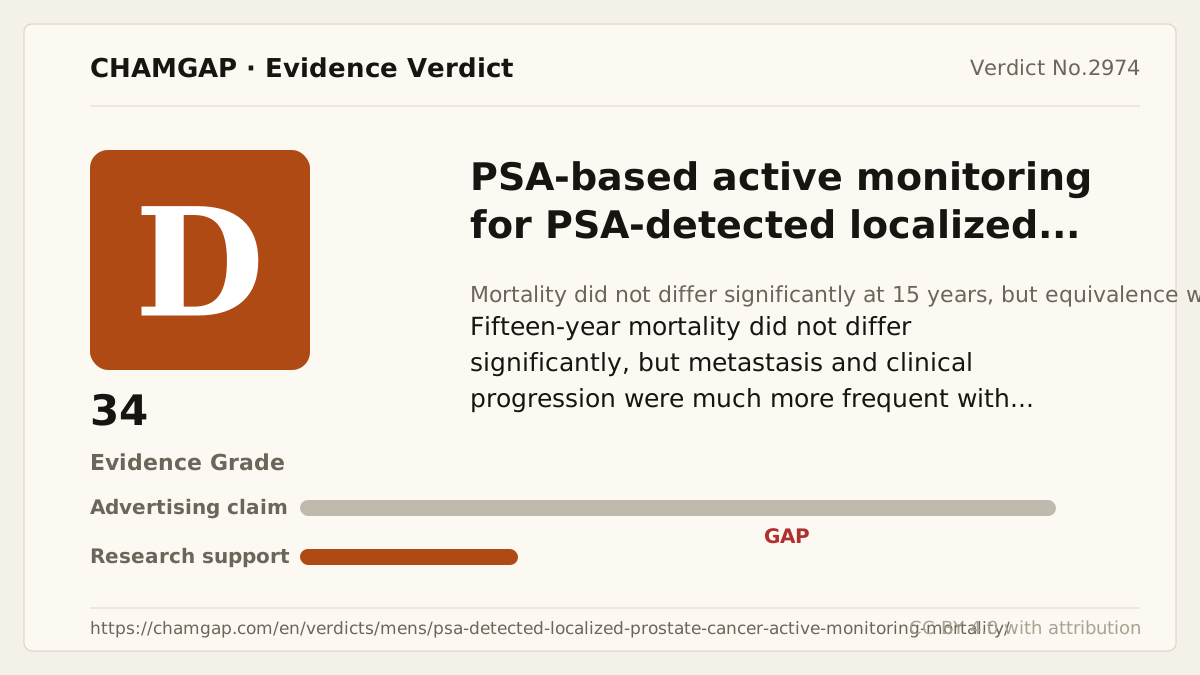
research showsGrade D. Prostate-cancer deaths were 17/545 (3.1%) with monitoring, 12/553 (2.2%) with surgery, and 16/545 (2.9%) with radiotherapy, overall P=.53. This was not a noninferiority trial, so it did not prove the strategies equivalent.
ads claimA nonsignificant mortality comparison cannot be rewritten as proof that watching gives the same outcomes. Monitoring carried more metastasis and progression, and many participants later crossed to radical treatment.
Useful facts when choosing a product
- Median follow-up was 15 years, range 11 to 21.
- At 10 years deaths were 8/5/4 and metastases 33/13/16; at 15 years they accumulated to 17/12/16 and 51/26/27.
- The 15-year paper reported no new treatment complications after the 10-year analysis.
Chamgap Semantic Classification Code
Candidate index · review held
UNK.psa-based-active-monitoring.UNK.fifteen-year-prostate-cancer-mortality.compare.UNKUnknown > PSA-based active monitoring > Unknown > Fifteen-year prostate-cancer mortality > Comparative claim > Unknown
An automated migration candidate, not an issued permanent code; exact claim scope remains under review. This machine-generated migration candidate helps retrieval but is not a permanent assignment. The original verdict ID and URL remain authoritative.
What the research actually shows
ProtecT randomized 1,643 men aged 50 to 69 to monitoring, 545, surgery, 553, or radiotherapy, 545, and followed them for a median 15 years. The NIHR HTA Programme was the main funder, NIHR and MRC supported follow-up, and the University of Oxford sponsored the trial.
Axis 6 B0 evidence ① Allocation concealment: "Treatment allocation was performed centrally by computer." ② Masking: Treatment could not be masked, but the primary cause of death was "adjudicated by an independent cause-of-death committee." ③ Analysis population and missing data: "We ... compare[d] ... on an intention-to-treat basis." Follow-up was complete for 1,610/1,643 (98%). ④ Prespecified primary endpoint: "The primary outcome was definite or probable prostate cancer mortality" — matches ISRCTN20141297 · NCT02044172
Why this is classified as D (34)
A clean long-term randomized trial had a null mortality primary endpoint but was not designed to establish equivalence, while metastasis and progression were higher with monitoring, giving D with 34 points.
Counterpoint. Surgery affected continence and erectile function, while radiotherapy affected bowel and sexual function; these harms matter in treatment choice.
Rejudgment record. Cross-check applied — Null 15-year prostate-cancer mortality superiority comparison and higher metastasis and progression with monitoring
| Endpoint | H | Hard endpoint - actual events such as death |
| Replication | R1 | Single confirmatory trial |
| Independence | I2 | Decisive evidence is publicly or non-profit funded |
| Effect size | E0 | Null |
| Precision | C0 | The confidence interval leaves room for benefit |
Stored derived and displayed grades match; this is not a current recalculation or validity check (D).
Sub-claim grades by effect
This ingredient is marketed for several effects. A single overall grade blends strong and weak claims together, so each effect is graded separately here. The overall grade reflects the strongest disconfirming or core claim.
| Effect (sub-claim) | Grade | Basis |
|---|---|---|
| Significant difference in 15-year prostate-cancer mortality | D | Overall P=.53. |
| Equivalent metastasis and clinical progression | D | Both were clearly higher with monitoring. |
Cross-check — AI research and Codex final gate
Evidence Table
| Study | Design | Sample | Funding | Endpoint | Result | Weight |
|---|---|---|---|---|---|---|
| Hamdy FC et al. 2023 ProtecT 15-year follow-up | Three-arm randomized superiority comparison with long-term follow-up | 1,643 randomized (545/553/545), follow-up complete for 1,610 | Public NIHR HTA Programme, NIHR, and MRC funding | Death from prostate cancer adjudicated by an independent cause-of-death committee | 17/545 (3.1%) vs 12/553 (2.2%) vs 16/545 (2.9%); overall P=.53 | Pivotal 15-year hard-outcome trial |
Receipt — 2 References
All 2 cited sources were verified for existence at the original page (as of 2026-08-26).
Final verification and publication gate: Codex · Evidence date: 2026-08-26 · Corrections: none
Cite this verdict
[Chamgap] No Benefit of Active Monitoring for 15-Year Mortality in PSA-Detected Localized Prostate Cancer — Evidence Grade D·34. 2 cited sources checked. Source: https://chamgap.com/en/verdicts/mens/psa-detected-localized-prostate-cancer-active-monitoring-mortality/ · CC BY 4.0CC BY 4.0 — free to use with attribution; do not distort grades, numbers, or verdict meaning.
What this document does and does not do
Chamgap is an information source. It reports what research has and has not confirmed; it does not tell readers what to take or buy. That decision belongs to readers and, when needed, medical or legal professionals. This verdict reflects literature available up to the search date and may change as new research appears. Nothing here is medical advice.