
Cooked tomato products,
does it really help with PSA reduction in men with prostate cancer?
research showsThe grade is D with 30 points. Seventy-nine preoperative prostate-cancer patients were randomized to three groups, but only 75 entered the PSA analysis. The overall three-week comparison was null at P=0.416; the favorable result came only from a post hoc subgroup of 41 intermediate-risk patients.
ads claimLycopene content and improved availability after cooking are food properties. They do not establish PSA reduction, and the direct full-group comparison was null.
Useful facts when choosing a product
- HPLC analysis showed that the study foods supplied 30 mg of lycopene per day. This measurement is separate from whether PSA changed.
- Tomato originated in the Americas, reached Europe in the sixteenth century and East Asia later, and is absent from the Donguibogam and Bencao Gangmu.
- Verdict 384 is C with 50 points for a tomato nutrient complex and ultraviolet skin response, while verdict 763 is C with 44 points for Fruitflow and platelet aggregation. Both use different interventions and indications.
Chamgap Semantic Classification Code
Candidate index · review held
F.cooked-tomato-products.food.psa-reduction-with-prostate-cancer.reduce.UNKFoods and beverages > Cooked tomato products > Food consumption > PSA reduction with prostate cancer > Reduction claim > Unknown
An automated migration candidate, not an issued permanent code; exact claim scope remains under review. This machine-generated migration candidate helps retrieval but is not a permanent assignment. The original verdict ID and URL remain authoritative.
What the research actually shows
Randomization assigned 27 participants to control, 27 to tomato, and 25 to tomato plus selenium and omega-3, for 79 total. PSA analyses included 24, 26, and 25 participants, respectively, for 75 total. The current NCT00433797 record lists serum PSA as the sole primary outcome and molecular, oxidative, and inflammatory measures as secondary outcomes. The record was updated after the trial ended, however, so the primary outcome in the original 2007 registration could not be verified. Funding came from the University of Oslo, Oslo University Hospital, the Norwegian Cancer Society, and the Research Council of Norway, with no identified tomato-industry or food-company funding.
Why this is classified as D (30)
The full randomized PSA comparison was null in one small, short trial, while the positive result was confined to a post hoc subgroup and confidence intervals were absent. This yields D with 30 points.
Counterpoint. Absent confidence intervals leave some room for meaningful PSA reduction, but the most direct evidence is a null full-group result.
Rejudgment record. Cross-check applied — Null full randomized PSA comparison, post hoc subgroup positivity, and a small short trial
| Endpoint | S | Surrogate marker - laboratory or imaging measures |
| Replication | R1 | Single confirmatory trial |
| Independence | I2 | Decisive evidence is publicly or non-profit funded |
| Effect size | E0 | Null |
| Precision | CX | No pooled confidence interval could be confirmed |
Stored derived and displayed grades match; this is not a current recalculation or validity check (D).
Sub-claim grades by effect
This ingredient is marketed for several effects. A single overall grade blends strong and weak claims together, so each effect is graded separately here. The overall grade reflects the strongest disconfirming or core claim.
| Effect (sub-claim) | Grade | Basis |
|---|---|---|
| PSA reduction with cooked tomato products | D | The full randomized comparison had P=0.416. |
Cross-check — AI research and Codex final gate
Evidence Table
| Study | Design | Sample | Funding | Endpoint | Result | Weight |
|---|---|---|---|---|---|---|
| Paur et al. 2017 | Three-arm randomized three-week preoperative trial | 79 randomized; 75 analyzed for PSA | University of Oslo, Oslo University Hospital, Norwegian Cancer Society, and Research Council of Norway | Three-week change in PSA | Median +0.41 vs 0.00 vs +0.14 micrograms/L; overall P=0.416; between-group CI not reported | Null overall comparison with positivity only in a post hoc subgroup |
Receipt — 2 References
Of 2 cited sources, 1 had limited original-page access (blocked or summary-only) and were verified via index/summary, marked partial; the rest were verified at the original page. As of 2026-08-02.
Final verification and publication gate: Codex · Evidence date: 2026-08-02 · Corrections: none
Cite this verdict
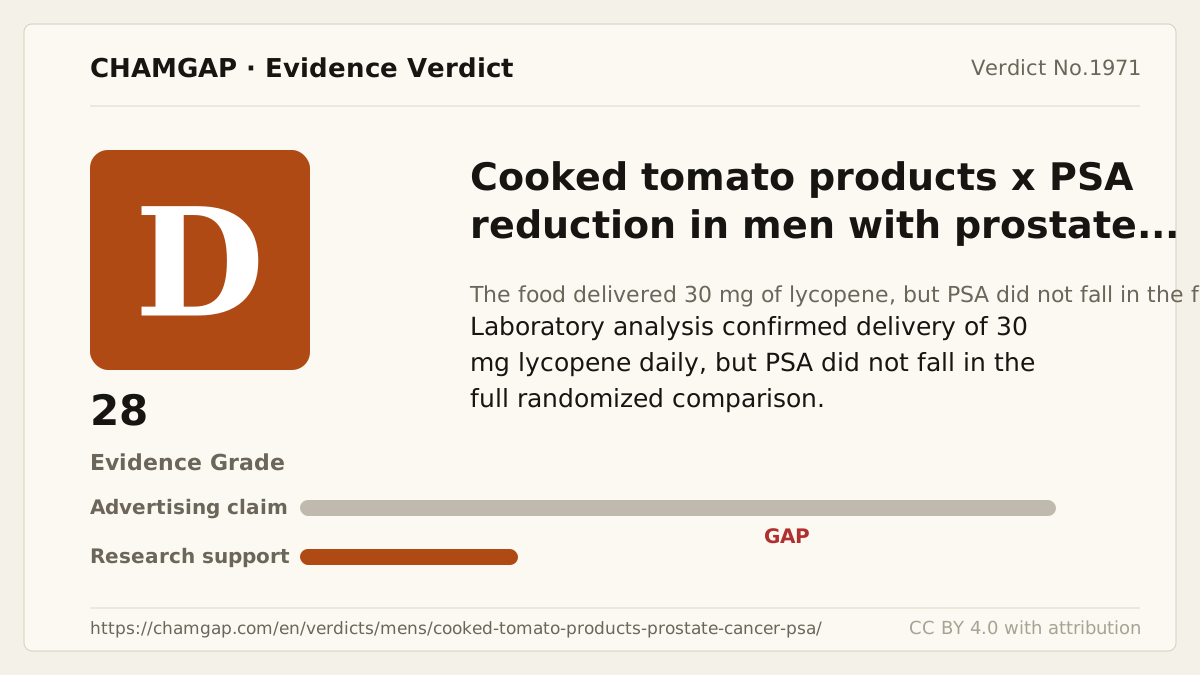
[Chamgap] Cooked tomato products x PSA reduction in prostate cancer — Evidence Grade D·30. 2 cited sources checked. Source: https://chamgap.com/en/verdicts/mens/cooked-tomato-products-prostate-cancer-psa/ · CC BY 4.0CC BY 4.0 — free to use with attribution; do not distort grades, numbers, or verdict meaning.
What this document does and does not do
Chamgap is an information source. It reports what research has and has not confirmed; it does not tell readers what to take or buy. That decision belongs to readers and, when needed, medical or legal professionals. This verdict reflects literature available up to the search date and may change as new research appears. Nothing here is medical advice.