
Ashwagandha root extract,
does it really help with Improved serum testosterone and sexual-function scores in adult men with low desire but normal testosterone?
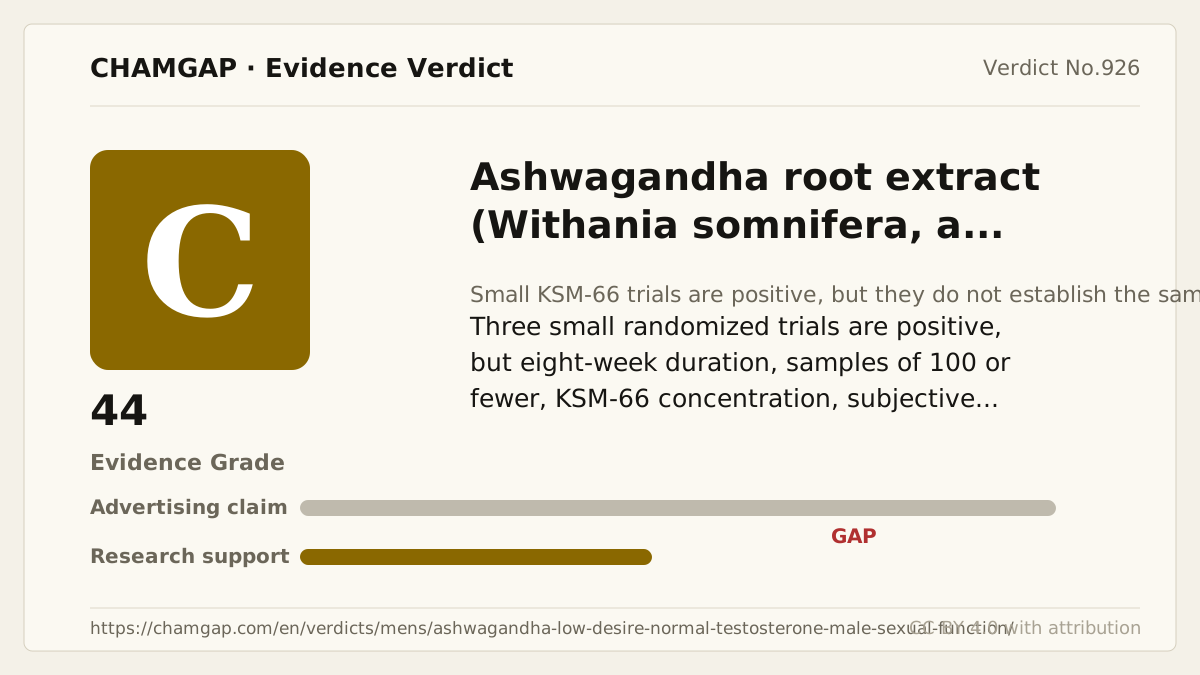
research showsAshwagandha root extract is rated C because it may raise serum testosterone and improve sexual-function scores in men with low desire but normal testosterone. The pivotal 2022 KSM-66 trial followed 50 healthy men for eight weeks and reported an increase of about 66.5 ng/dL versus placebo plus improvement on the subjective DISF-M questionnaire. Trials of 100 men in 2025 and 76 men in 2026 were also positive, but all lasted eight weeks, enrolled no more than 100 participants, and concentrated on the same KSM-66 branded ingredient. Some authors of the pivotal trial received clinical consultation fees from a pharmaceutical company, while the extract and placebo were supplied by another company, and a normal-range testosterone increase is a surrogate. These limitations yield C with 44 points. This efficacy axis is distinct from stress verdict 035 and the Shoden sleep verdict 408.
ads claimMarketing expands short-term changes within the normal testosterone range and questionnaire scores into proven testosterone boosting, erectile-dysfunction treatment, and muscle gain. The trials concern eight-week outcomes in otherwise healthy men with low desire or sexual-function concerns and do not establish treatment of clinical hypogonadism or replacement of phosphodiesterase-5 inhibitors.
Useful facts when choosing a product
- The direct positive trials generally used 300 mg of KSM-66 root extract twice daily, totaling 600 mg/day for eight weeks.
- Ashwagandha products vary in plant part, withanolide content, analytical method, and batch quality, so KSM-66 results cannot automatically be transferred to an arbitrary product.
- Gastrointestinal upset and drowsiness can occur, and thyroid function may be affected; people with thyroid disease or thyroid medicines should consult a clinician.
- Rare but clinically apparent liver injury has been reported, and use during pregnancy should be avoided. Jaundice, dark urine, or severe itching warrants discontinuation and medical evaluation.
Chamgap Semantic Classification Code
Candidate index · review held
S.ashwagandha-root-extract.UNK.serum-testosterone-and-sexual-function-scores-with-low-desire-but-normal-testosterone.improve.placeboSupplements and nutraceuticals > Ashwagandha root extract > Unknown > serum testosterone and sexual-function scores with low desire but normal testosterone > Improvement claim > Placebo
An automated migration candidate, not an issued permanent code; exact claim scope remains under review. This machine-generated migration candidate helps retrieval but is not a permanent assignment. The original verdict ID and URL remain authoritative.
What the research actually shows
Chauhan and colleagues in 2022 randomized 50 healthy men with low desire and baseline testosterone within the reference range to KSM-66 at 300 mg twice daily or placebo. After eight weeks, total DISF-M and testosterone improved versus placebo, but this was a single-center exploratory trial with a subjective primary endpoint. Some authors received clinical consultation fees from Shri Kartikeya Pharma, and Ixoreal BioMed supplied the KSM-66 extract and placebo capsules. Mutha and colleagues in 2025 randomized 100 healthy men to the same 600-mg daily regimen and reported improvements in SDI-2, the orgasmic-function and sexual-desire domains of IIEF, and sexual satisfaction; efficacy analysis included 93 participants and the manufacturer supplied the extract. Khanna and colleagues in 2026 reported positive SDI-2, satisfying-sexual-event, and IIEF results in 76 men, again after eight weeks of KSM-66. These studies address a different population, product, and outcome axis from stress verdict 035 and Shoden sleep verdict 408.
Why this is classified as C (44)
One direct trial in men with low desire and normal testosterone and two later sexual-function trials point in the same direction. The pivotal study was an eight-week trial of 50 healthy men centered on a subjective questionnaire, and all trials enrolled no more than 100 participants and concentrated on KSM-66. Clinical consultation fees to some authors, company-supplied extract and placebo, and a normal-range testosterone surrogate further limit confidence, yielding C with 44 points. Gastrointestinal, thyroid, liver, and pregnancy cautions are safety issues independent of efficacy.
Counterpoint. A healthy man whose low desire accompanies stress or poor sleep may notice a short-term improvement. Persistent low desire or erectile difficulty calls for assessment of depression, anxiety, medicines, relationship factors, diabetes, vascular disease, and genuine hypogonadism.
Rejudgment record. Cross-check revision — Accepted the direct positive trial in men with low desire and normal testosterone and two subsequent sexual-function trials, but applied the rule ① and ②-b ceiling of C because all were eight-week studies of no more than 100 participants centered on the KSM-66 branded ingredient and normal-range hormonal surrogates or subjective scales
Sub-claim grades by effect
This ingredient is marketed for several effects. A single overall grade blends strong and weak claims together, so each effect is graded separately here. The overall grade reflects the strongest disconfirming or core claim.
| Effect (sub-claim) | Grade | Basis |
|---|---|---|
| Increase in serum testosterone within the normal range | C | A direct 50-man trial found an increase of about 66.5 ng/dL versus placebo, but it was an eight-week branded-ingredient surrogate outcome. |
| Improvement in male sexual-function questionnaire scores | C | DISF-M and IIEF signals were reported across three small randomized trials, but the evidence centers on subjective scales and short follow-up. |
| Improvement in sexual desire and satisfying sexual events | C | Later KSM-66 trials improved SDI-2 and sexual-event measures, but all lasted eight weeks and enrolled no more than 100 participants. |
Cross-check — AI research and Codex final gate
Evidence Table
| Study | Design | Sample | Funding | Endpoint | Result | Weight |
|---|---|---|---|---|---|---|
| Chauhan S et al. 2022 | Randomized double-blind placebo-controlled exploratory trial | 50 healthy men with low sexual desire | The KSM-66 manufacturer Ixoreal supplied active and placebo capsules; Shri Kartikeya Pharma paid recruitment-related clinical consultation fees to some authors | Total and domain DISF-M scores, serum testosterone and prolactin, and SF-36 | After eight weeks, total DISF-M and serum testosterone within the reference range improved versus placebo, while prolactin and SF-36 did not improve significantly. | Key direct evidence from a small branded-ingredient trial |
| Mutha AS et al. 2025 | Prospective randomized double-blind placebo-controlled trial | 100 healthy men; 93 in the efficacy analysis | No specific grant reported; Ixoreal supplied the KSM-66 ingredient | SDI-2, IIEF, satisfying sexual events, SF-12, sex hormones, and semen measures | After eight weeks, SDI-2, the orgasmic-function and sexual-desire IIEF domains, and sexual satisfaction improved versus placebo, but this was a short questionnaire-heavy trial in healthy men. | Confirmatory positive but small branded-ingredient evidence |
| Khanna A et al. 2026 | Prospective randomized double-blind placebo-controlled parallel trial | 76 healthy men reporting sexual-function concerns | Reported no financial support or commercial conflict; the study ingredient was KSM-66 | SDI-2, satisfying sexual events, IIEF, SF-12, testosterone, and semen measures | After eight weeks, SDI-2, satisfying sexual events, and IIEF improved versus placebo, but this was a small single-center trial of the same branded ingredient. | Current confirmatory evidence with limited replication breadth |
Receipt — 4 References
All 4 cited sources were verified for existence at the original page (as of 2026-07-21).
Final verification and publication gate: Codex · Evidence date: 2026-07-21 · Corrections: none
Cite this verdict
[Chamgap] Ashwagandha root extract x improved sexual function in men with normal testosterone — Evidence Grade C·44. 4 cited sources checked. Source: https://chamgap.com/en/verdicts/mens/ashwagandha-low-desire-normal-testosterone-male-sexual-function/ · CC BY 4.0CC BY 4.0 — free to use with attribution; do not distort grades, numbers, or verdict meaning.
What this document does and does not do
Chamgap is an information source. It reports what research has and has not confirmed; it does not tell readers what to take or buy. That decision belongs to readers and, when needed, medical or legal professionals. This verdict reflects literature available up to the search date and may change as new research appears. Nothing here is medical advice.