
Rifaximin,
does it really help with Reduced recurrence of hepatic encephalopathy and related hospitalization in patients with cirrhosis?
research showsThe claim that rifaximin reduces recurrence of hepatic encephalopathy and related hospitalization in cirrhosis is rated B. In a 299-person double-blind trial, 550 mg twice daily reduced six-month recurrence with HR 0.42 and hepatic-encephalopathy-related hospitalization with HR 0.50, meeting direct clinical endpoints, and international and Korean guidelines support recurrence prevention. More than 90% of participants, however, received concomitant lactulose, so attribution is primarily to add-on therapy, and the pivotal international evidence used the 550-mg tablet regimen. Korean Normix is supplied as a 200-mg formulation with different labeled dosing, so identical effectiveness cannot automatically be assigned to every local low-strength regimen. Rifaximin differs in ingredient and mechanism from L-ornithine L-aspartate in verdict 559.
ads claimLiver-health promotion can portray removal of gut toxins as liver restoration or suggest that rifaximin alone completely prevents encephalopathy. The strongest evidence concerns secondary prevention in people with cirrhosis and recurrent overt hepatic encephalopathy as part of standard therapy, especially as an addition to lactulose.
Useful facts when choosing a product
- Rifaximin is a minimally absorbed prescription antibiotic that acts mainly in the gut and is used in hepatic encephalopathy to reduce the burden of intestinal bacteria involved in ammonia generation.
- The pivotal international recurrence trial and Xifaxan labeling used a 550-mg tablet twice daily, whereas Korean Normix is distributed as a 200-mg tablet, so tablet counts should not be improvised without checking indication-specific prescribing and total daily dose.
- More than 90% of participants in the pivotal recurrence trial used lactulose, so the findings should not be interpreted as evidence for stopping lactulose and substituting rifaximin without medical direction.
- Nausea, abdominal pain, edema, and dizziness can occur; systemic exposure can rise in severe hepatic impairment, and antibiotic-associated Clostridioides difficile infection and resistance also require consideration.
Chamgap Semantic Classification Code
Candidate index · review held
M.rifaximin.UNK.recurrence-of-hepatic-encephalopathy-and-related-hospitalization-with-cirrhosis.reduce.MULTIMedicinal interventions > Rifaximin > Unknown > recurrence of hepatic encephalopathy and related hospitalization with cirrhosis > Reduction claim > Multiple: primary unresolved
An automated migration candidate, not an issued permanent code; exact claim scope remains under review. This machine-generated migration candidate helps retrieval but is not a permanent assignment. The original verdict ID and URL remain authoritative.
What the research actually shows
The 2010 trial by Bass and colleagues randomized 299 patients with at least two recent episodes of overt hepatic encephalopathy who were in remission to rifaximin 550 mg twice daily or placebo. Both recurrence and related hospitalization fell significantly, but more than 90% continued lactulose. The 2023 Cochrane review synthesized 41 trials and 4,545 participants, finding signals for benefit versus placebo or no treatment and additional benefit when rifaximin was added to a nonabsorbable disaccharide, while certainty ranged from very low to moderate by outcome. The 2014 AASLD/EASL guideline and 2020 KASL guideline support add-on rifaximin for recurrence prevention. Korean Normix is distributed as a 200-mg tablet and its product dosing differs from the international Xifaxan 550-mg twice-daily recurrence regimen, so prescribers must verify indication and total daily dose. L-ornithine L-aspartate in verdict 559 targets ammonia metabolism and is different from the gut-bacterial antibiotic mechanism of rifaximin.
Why this is classified as B (76)
The 299-person double-blind trial showed direct clinical benefit for recurrence, HR 0.42, and related hospitalization, HR 0.50, with support from guidelines and later syntheses. The pivotal trial was manufacturer-sponsored, more than 90% used lactulose, and the international 550-mg regimen differs from the Korean 200-mg formulation and dosing, yielding B with 76 points. Antibiotic adverse effects, increased exposure in severe liver disease, and resistance remain separate safety concerns.
Counterpoint. For recurrent overt hepatic encephalopathy, clinician-supervised rifaximin with lactulose fits the evidence and guidelines. Acute mental-status change still requires urgent identification and treatment of infection, bleeding, constipation, electrolyte disturbance, and other precipitants rather than simply adding medication.
Rejudgment record. New verdict — Accepted direct recurrence and related-hospitalization endpoints in the 299-person double-blind trial and support from international and Korean guidelines, while applying limitations from manufacturer sponsorship, lactulose use in more than 90%, and differences between the international 550-mg regimen and Korean 200-mg formulation and dosing
Sub-claim grades by effect
This ingredient is marketed for several effects. A single overall grade blends strong and weak claims together, so each effect is graded separately here. The overall grade reflects the strongest disconfirming or core claim.
| Effect (sub-claim) | Grade | Basis |
|---|---|---|
| Reduced recurrence of hepatic encephalopathy and related hospitalization | B | Direct clinical endpoints in a 299-person trial and guidelines support the claim, but the pivotal trial was manufacturer-sponsored and more than 90% used lactulose. |
| Additional benefit over lactulose alone | B | The pivotal trial and meta-analysis support add-on benefit, with attribution constraints and outcome-specific certainty limitations. |
| Equivalent recurrence and hospitalization reduction with the Korean 200-mg formulation | ? | No direct human efficacy literature links the international 550-mg twice-daily outcomes unchanged to each dosing regimen of the Korean 200-mg formulation. |
Cross-check — AI research and Codex final gate
Evidence Table
| Study | Design | Sample | Funding | Endpoint | Result | Weight |
|---|---|---|---|---|---|---|
| Bass NM et al. 2010 | Multicenter randomized double-blind placebo-controlled trial | 299 patients in remission from recurrent hepatic encephalopathy | Supported by Salix Pharmaceuticals | Time to breakthrough hepatic encephalopathy and first hepatic-encephalopathy-related hospitalization over six months | Recurrence was 22.1% versus 45.9%, HR 0.42, and related hospitalization was 13.6% versus 22.6%, HR 0.50. | Pivotal direct-clinical-endpoint trial with lactulose use above 90% |
| Zacharias HD et al. 2023 Cochrane review | Systematic review and meta-analysis of randomized trials | Forty-one trials and 4,545 participants | Academic Cochrane review with public and academic support | Prevention and treatment of hepatic encephalopathy, mortality, serious adverse events, quality of life, and hospital stay | Benefit signals appeared versus placebo or no treatment and as add-on to nonabsorbable disaccharides, but certainty ranged from very low to moderate by outcome. | Later synthesis with certainty limitations |
| Vilstrup H et al. 2014 AASLD/EASL guideline | Systematic evidence review and joint clinical practice guideline | Full evidence base for prevention and treatment of hepatic encephalopathy | AASLD and EASL professional societies | Prevention of recurrent overt hepatic encephalopathy and standard therapy | Recommended rifaximin added to lactulose as effective therapy for recurrence prevention. | Guideline evidence defining population and co-therapy |
Receipt — 5 References
All 5 cited sources were verified for existence at the original page (as of 2026-07-19).
Final verification and publication gate: Codex · Evidence date: 2026-07-19 · Corrections: none
Cite this verdict
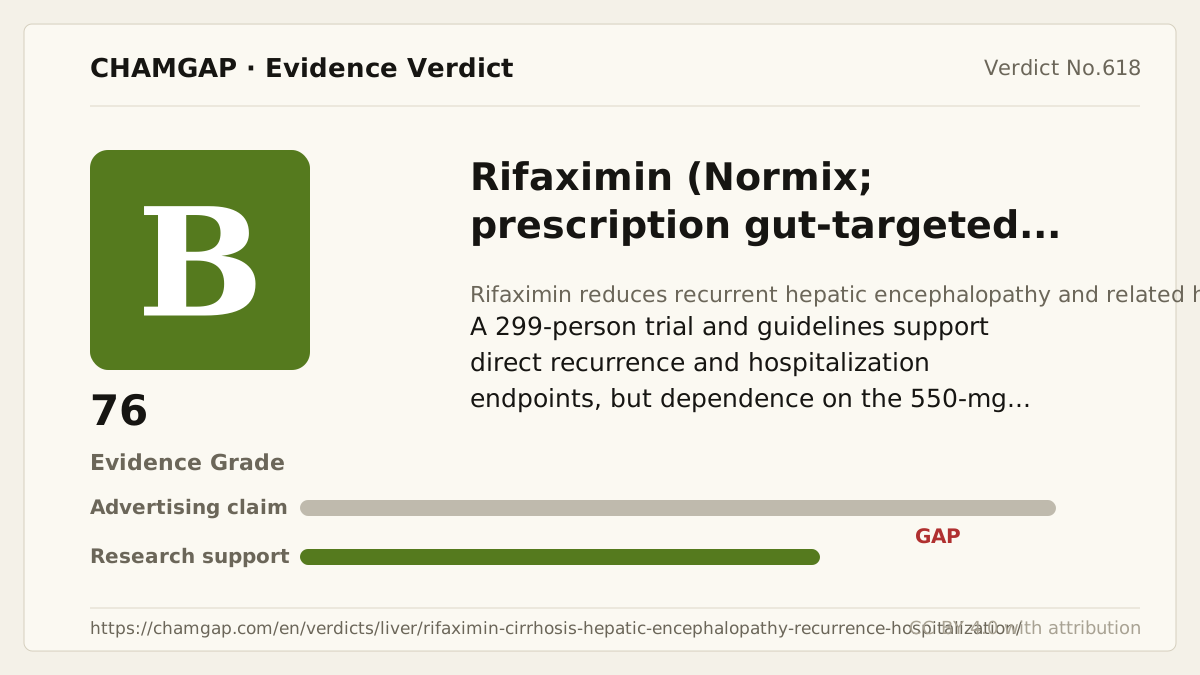
[Chamgap] Rifaximin x reduced hepatic-encephalopathy recurrence and related hospitalization — Evidence Grade B·76. 5 cited sources checked. Source: https://chamgap.com/en/verdicts/liver/rifaximin-cirrhosis-hepatic-encephalopathy-recurrence-hospitalization/ · CC BY 4.0CC BY 4.0 — free to use with attribution; do not distort grades, numbers, or verdict meaning.
What this document does and does not do
Chamgap is an information source. It reports what research has and has not confirmed; it does not tell readers what to take or buy. That decision belongs to readers and, when needed, medical or legal professionals. This verdict reflects literature available up to the search date and may change as new research appears. Nothing here is medical advice.