
Whole chilies and sweet peppers,
does it really help with Lower odds of prevalent sarcopenia?
research showsThe grade is C with 54 points. This single observational study was neither a randomized trial nor a prospective cohort. In a cross-sectional analysis of 2,451 people, odds ratios were 0.60 for chilies and 0.66 for sweet peppers, but conventional conversions were only about 0.28 and 0.23, below a medium effect. Exposure and disease were measured at the same time, so temporality and causal efficacy remain unknown.
ads claimThese odds ratios cannot be read as preventive effects. Prospective studies establishing temporality or trials assigning whole peppers are needed to separate reverse causation and residual confounding.
Useful facts when choosing a product
- The paper cited capsaicin concentrations of 2.919 to 5.838 mg/g in the finger-shaped chilies commonly eaten in China and capsiate at 1.67 plus or minus 2.9 micrograms/g in Chinese sweet pepper. It also noted variation by growing conditions and fruit maturity.
- The presence of capsaicinoids and capsinoids is a measurable composition fact, not clinical evidence of sarcopenia prevention.
- Chilies and bell peppers are cultivated forms of Capsicum annuum, native to the Americas. They reached Joseon around the Imjin War era; earlier East Asian 「椒」 referred to Zanthoxylum or Piper, not chili pepper.
- Verdict 594 is C with 43 points for Dangjo-pepper powder and postprandial glucose, while verdict 1448 is D with 31 points for capsaicin and weight. Both differ from whole peppers and sarcopenia.
Chamgap Semantic Classification Code
Candidate index · review held
F.whole-chilies-and-sweet-peppers.oral.odds-of-prevalent-sarcopenia.reduce.noneFoods and beverages > Whole chilies and sweet peppers > Oral > odds of prevalent sarcopenia > Reduction claim > No intervention
An automated migration candidate, not an issued permanent code; exact claim scope remains under review. This machine-generated migration candidate helps retrieval but is not a permanent assignment. The original verdict ID and URL remain authoritative.
What the research actually shows
Among 2,698 TCLSIH examinees, 247 lacking food-frequency, muscle-mass, grip-strength, or gait-speed data were excluded, leaving 2,451 people for cross-sectional analysis; 394 met Asian sarcopenia criteria. Compared with near-never intake, fully adjusted odds ratios at two to three or more times weekly were 0.60 (95% CI 0.39 to 0.90) for chilies and 0.66 (0.45 to 0.95) for sweet peppers. Questionnaire validity coefficients were 0.34 and 0.42, and reproducibility coefficients were 0.47 and 0.52. Trial registration does not apply to this noninterventional study, and no preregistered analysis plan was reported. Funding came from the National Natural Science Foundation of China and the National Key Research and Development Program, with no reported food-company or producer-group support.
Why this is classified as C (54)
This large publicly funded single observational study found 34% to 40% lower odds, but conventional conversions were only about 0.23 to 0.28. Cross-sectional reverse causation and low-to-moderate exposure validity further limit the result, yielding C with 54 points.
Counterpoint. The association's magnitude and shared direction across pepper types are worth attention, but prevention requires prospective replication and intervention evidence.
Rejudgment record. Cross-check applied — A significant association in a publicly funded 2,451-person cross-sectional analysis cannot establish temporality or exclude reverse causation and residual confounding
| Endpoint | H | Hard endpoint - actual events such as death |
| Replication | R1 | Single confirmatory trial |
| Independence | I2 | Decisive evidence is publicly or non-profit funded |
| Effect size | E~ | Statistically positive but below the threshold |
Stored derived and displayed grades match; this is not a current recalculation or validity check (C).
Sub-claim grades by effect
This ingredient is marketed for several effects. A single overall grade blends strong and weak claims together, so each effect is graded separately here. The overall grade reflects the strongest disconfirming or core claim.
| Effect (sub-claim) | Grade | Basis |
|---|---|---|
| Chilies and sweet peppers contain capsaicinoids and capsinoids | C | This is a composition fact, not a graded clinical endpoint. |
| Eating whole chilies or sweet peppers prevents sarcopenia | C | A cross-sectional association was present, but temporality and causal efficacy were not established. |
Cross-check — AI research and Codex final gate
Evidence Table
| Study | Design | Sample | Funding | Endpoint | Result | Weight |
|---|---|---|---|---|---|---|
| Wang et al. 2021 | TCLSIH-based cross-sectional analysis; no preregistered analysis plan reported | 2,698 examined; 247 excluded; 2,451 analyzed; 394 with sarcopenia | National Natural Science Foundation of China and National Key Research and Development Program; no food-company or producer-group funding reported | Prevalent sarcopenia by Asian consensus criteria | At least two to three times weekly versus almost never: chili OR 0.60 (0.39 to 0.90), sweet pepper 0.66 (0.45 to 0.95) | Significant association in a large publicly funded sample, but cross-sectional and without temporality |
Receipt — 1 References
All 1 cited sources were verified for existence at the original page (as of 2026-08-02).
Final verification and publication gate: Codex · Evidence date: 2026-08-02 · Corrections: none
Cite this verdict
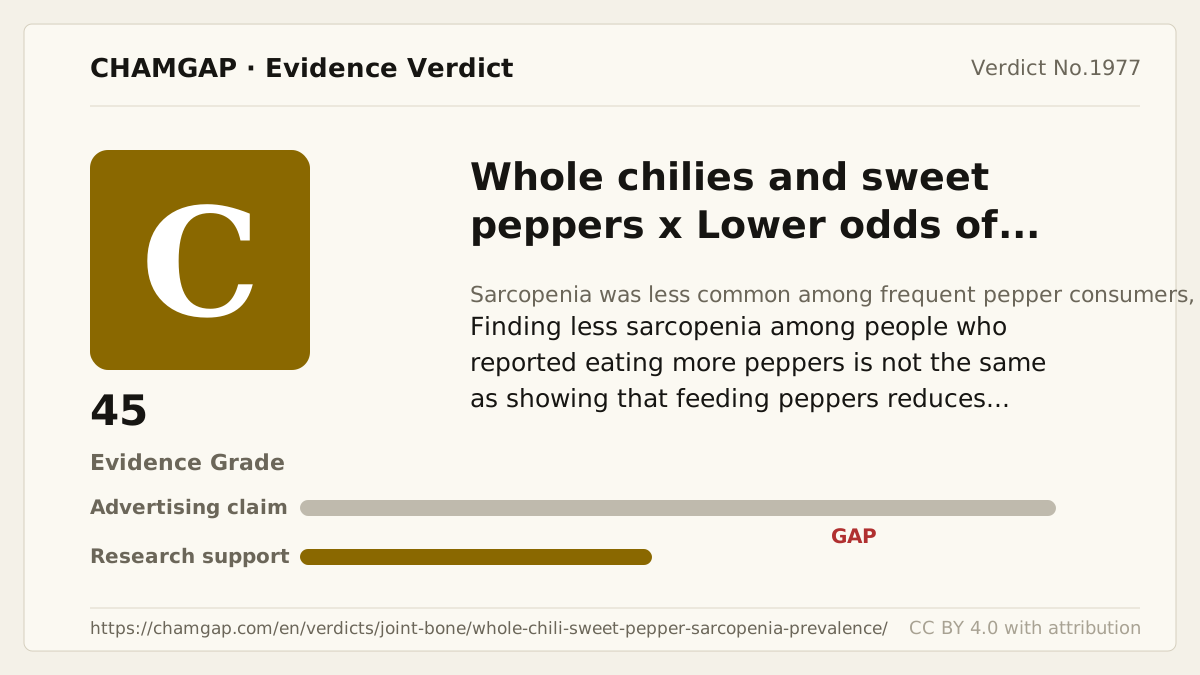
[Chamgap] Whole chilies and sweet peppers x sarcopenia prevalence — Evidence Grade C·54. 1 cited sources checked. Source: https://chamgap.com/en/verdicts/joint-bone/whole-chili-sweet-pepper-sarcopenia-prevalence/ · CC BY 4.0CC BY 4.0 — free to use with attribution; do not distort grades, numbers, or verdict meaning.
What this document does and does not do
Chamgap is an information source. It reports what research has and has not confirmed; it does not tell readers what to take or buy. That decision belongs to readers and, when needed, medical or legal professionals. This verdict reflects literature available up to the search date and may change as new research appears. Nothing here is medical advice.