
Vitamin D3,
does it really help with Improved pain and function and reduced cartilage loss in symptomatic knee osteoarthritis?
research showsVitamin D3 is rated F for improving pain and function or slowing structural progression in symptomatic knee osteoarthritis. The two-year Jin 2016 multicenter trial of 413 participants was null for its coprimary outcomes of WOMAC pain and MRI tibial cartilage-volume loss. The three-year Arden VIDEO trial of 474 participants was null for joint space, pain, and function, and the separate two-year McAlindon 2013 trial of 146 participants was also null for pain and cartilage-volume loss. These three independent randomized trials repeatedly refuted early observational and small-trial signals, and the 2019 American College of Rheumatology and Arthritis Foundation guideline conditionally recommends against vitamin D in knee, hip, and hand osteoarthritis. Repeated refutation plus a guideline recommendation against use meets the boundary rule for F with 18 points. This verdict applies only to efficacy for treating knee osteoarthritis, not correction of laboratory-confirmed vitamin D deficiency or general bone health. Hypercalcemia from excess intake is recorded separately under safety.
ads claimMarketing argues that a bone vitamin must also preserve worn knee cartilage, merging deficiency correction with a disease-modifying osteoarthritis effect. In long-term trials, serum vitamin D increased while clinical pain, function, MRI cartilage, and radiographic joint-space outcomes did not improve.
Useful facts when choosing a product
- Knee-osteoarthritis trials evaluated different D3 regimens, including 800 IU daily, approximately 2,000 IU daily adjusted to a serum target, and 50,000 IU monthly for two to three years, without consistent improvement in pain or structural progression.
- Correcting laboratory-confirmed vitamin D deficiency is a separate bone-health purpose from treating osteoarthritis pain or cartilage loss, and this verdict does not oppose appropriate deficiency treatment.
- Vitamin D is fat soluble, so total intake can accumulate across multivitamins and calcium products, and long-term high doses require clinical attention to dose, serum calcium, and kidney status.
- Vitamin D3 is not a disease-modifying substitute for exercise therapy, weight management, topical or oral analgesic treatment, or orthopedic assessment when needed.
Chamgap Semantic Classification Code
Candidate index · review held
UNK.vitamin-d3.UNK.pain-and-function-and-reduced-cartilage-loss-in-symptomatic-knee-osteoarthritis.reduce.placeboUnknown > Vitamin D3 (cholecalciferol) > Unknown > pain and function and reduced cartilage loss in symptomatic knee osteoarthritis > Reduction claim > Placebo
An automated migration candidate, not an issued permanent code; exact claim scope remains under review. This machine-generated migration candidate helps retrieval but is not a permanent assignment. The original verdict ID and URL remain authoritative.
What the research actually shows
Jin and colleagues randomized 413 patients with symptomatic knee osteoarthritis and serum 25(OH)D of 12.5 to 60 nmol/L to monthly 50,000 IU of vitamin D3 or placebo for two years. Serum 25(OH)D rose more with treatment, but both prespecified coprimary outcomes, WOMAC pain and change in MRI tibial cartilage volume, were null; cartilage defects and bone-marrow lesions also did not improve. The VIDEO trial by Arden and colleagues assigned 474 people with radiographic knee osteoarthritis to 800 IU daily or placebo for three years and found no benefit for medial joint-space narrowing, WOMAC pain, function, stiffness, or the Get Up and Go test. The two-year 146-participant trial by McAlindon and colleagues also found no reduction in pain or MRI cartilage-volume loss despite targeted increases in 25(OH)D. These three independent randomized trials repeatedly refuted early observational and small-trial signals, and the 2019 guideline by Kolasinski and colleagues conditionally recommends against vitamin D in knee, hip, and hand osteoarthritis.
Why this is classified as F (18)
The 413-participant Jin 2016 trial, the 474-participant Arden VIDEO trial, and the 146-participant McAlindon 2013 trial repeatedly refuted early observational and small-trial signals across direct long-term pain, function, cartilage, and joint-space outcomes. The American College of Rheumatology and Arthritis Foundation guideline conditionally recommends against vitamin D in knee, hip, and hand osteoarthritis. The boundary rule for repeated refutation plus a guideline recommendation against use gives F with 18 points. F applies only to efficacy for treating knee osteoarthritis; laboratory-confirmed deficiency correction, general bone health, and toxicity from excess intake are separate.
Counterpoint. A deficiency can be corrected for general bone and muscle health. When the goal is knee pain or function, supplementation should not delay validated exercise, weight-management, or analgesic treatment on the expectation of an osteoarthritis benefit.
Rejudgment record. Cross-verification incorporated — Assigned F because the 413-participant Jin 2016 trial, the 474-participant Arden VIDEO trial, and the 146-participant McAlindon 2013 trial repeatedly refuted early observational and small-trial signals across WOMAC pain and function, MRI cartilage-volume loss, and radiographic joint-space narrowing, while the American College of Rheumatology and Arthritis Foundation guideline conditionally recommends against vitamin D in knee, hip, and hand osteoarthritis; this meets the boundary rule for repeated refutation plus a guideline recommendation against use
Sub-claim grades by effect
This ingredient is marketed for several effects. A single overall grade blends strong and weak claims together, so each effect is graded separately here. The overall grade reflects the strongest disconfirming or core claim.
| Effect (sub-claim) | Grade | Basis |
|---|---|---|
| Improved pain and function in symptomatic knee osteoarthritis | F | Three independent trials by Jin, Arden, and McAlindon repeatedly refuted pain and function efficacy, and the American College of Rheumatology and Arthritis Foundation guideline conditionally recommends against use. This F applies only to efficacy for treating knee osteoarthritis, not correction of laboratory-confirmed vitamin D deficiency or general bone health. |
| Reduced cartilage-volume loss in symptomatic knee osteoarthritis | F | The Jin and McAlindon trials did not improve MRI cartilage-volume loss, within the repeated refutation across three independent trials and the conditional recommendation against use in the American College of Rheumatology and Arthritis Foundation guideline. This F applies only to efficacy for treating knee osteoarthritis, not correction of laboratory-confirmed vitamin D deficiency or general bone health. |
| Reduced joint-space narrowing in symptomatic knee osteoarthritis | F | The three-year primary medial joint-space outcome in VIDEO was null, within the repeated refutation across three independent trials and the conditional recommendation against use in the American College of Rheumatology and Arthritis Foundation guideline. This F applies only to efficacy for treating knee osteoarthritis, not correction of laboratory-confirmed vitamin D deficiency or general bone health. |
Cross-check — AI research and Codex final gate
Evidence Table
| Study | Design | Sample | Funding | Endpoint | Result | Weight |
|---|---|---|---|---|---|---|
| Jin X et al. 2016 | Multicenter randomized double-blind placebo-controlled clinical trial | 413 patients with symptomatic knee osteoarthritis and low vitamin D | Australian National Health and Medical Research Council and other public and academic support | Coprimary two-year outcomes of WOMAC pain and change in MRI tibial cartilage volume | Monthly 50,000 IU of D3 raised 25(OH)D but provided no significant benefit for pain, cartilage volume, cartilage defects, or bone-marrow lesions. | Large pivotal direct null randomized trial |
| Arden NK et al. 2016 VIDEO | Three-year double-blind randomized placebo-controlled clinical trial | 474 patients with radiographic knee osteoarthritis | Public and charitable research support including Arthritis Research UK and NIHR | Medial joint-space narrowing; WOMAC pain, function, and stiffness; and Get Up and Go | Eight hundred IU daily did not reduce joint-space narrowing, pain, stiffness, or functional loss, with no interaction by baseline vitamin D. | Large independent long-term null randomized trial |
| McAlindon TE et al. 2013 | Two-year randomized double-blind placebo-controlled clinical trial | 146 patients with symptomatic knee osteoarthritis | Public research support including the United States NIH | Knee pain and MRI cartilage-volume loss | Vitamin D supplementation raised 25(OH)D but did not reduce knee pain or cartilage-volume loss. | Independent direct null support |
| Kolasinski et al. 2020 ACR/AF guideline | 2019 evidence-based clinical practice guideline from the American College of Rheumatology and Arthritis Foundation | Systematic evidence review and GRADE consensus for interventions in knee, hip, and hand osteoarthritis | Collaborative guideline from the American College of Rheumatology and Arthritis Foundation | Recommendation on vitamin D treatment in knee, hip, and hand osteoarthritis | Vitamin D was conditionally recommended against because effects were small or absent across trials and pooled results were null. | Guideline recommendation against use supporting the F boundary rule |
| Wang T et al. 2025 | Post hoc effect-modification analysis of the Jin 2016 randomized trial by baseline 25(OH)D | Baseline-concentration subgroups from the original 413-participant trial | Reanalysis of data from the original publicly funded Australian NHMRC trial | Pain, function, and cartilage changes by a data-derived 25(OH)D cutoff of 43 nmol/L | A pain and function signal was reported at 43 nmol/L or below, but this was a post hoc subgroup analysis and the parent trial's prespecified coprimary outcomes were null. | Hypothesis-generating post hoc subgroup signal |
Receipt — 5 References
All 5 cited sources were verified for existence at the original page (as of 2026-07-21).
Final verification and publication gate: Codex · Evidence date: 2026-07-21 · Corrections: none
Cite this verdict
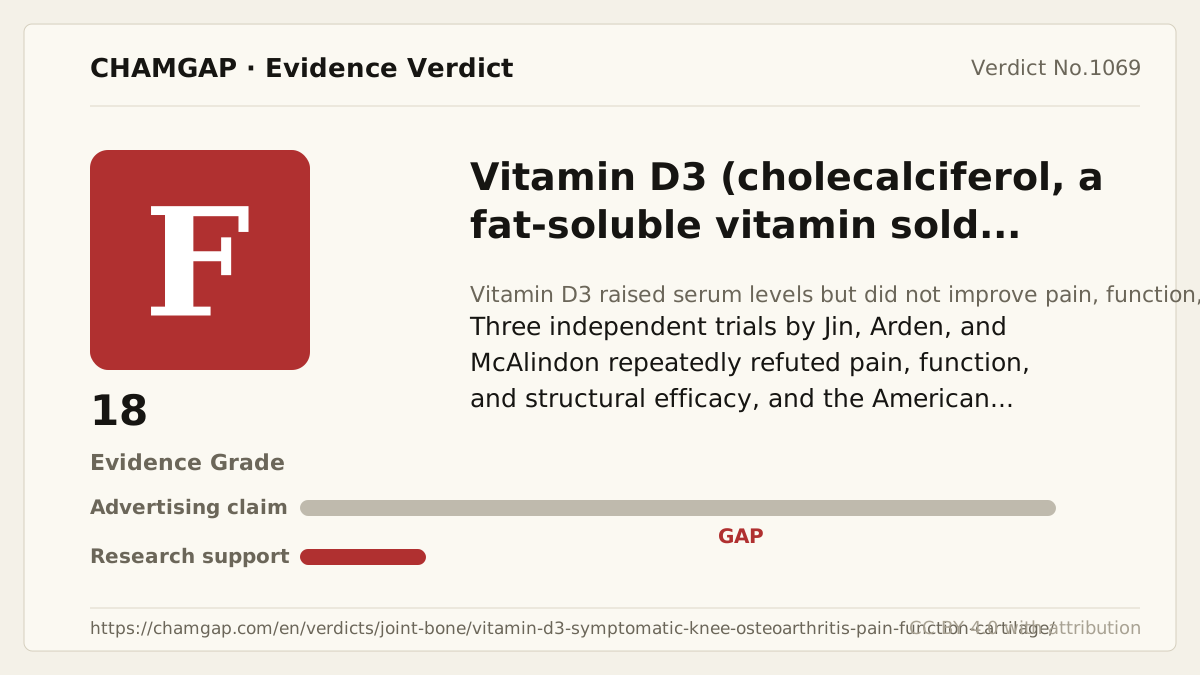
[Chamgap] Vitamin D3 x improved pain, function, and cartilage loss in symptomatic knee osteoarthritis — Evidence Grade F·18. 5 cited sources checked. Source: https://chamgap.com/en/verdicts/joint-bone/vitamin-d3-symptomatic-knee-osteoarthritis-pain-function-cartilage/ · CC BY 4.0CC BY 4.0 — free to use with attribution; do not distort grades, numbers, or verdict meaning.
What this document does and does not do
Chamgap is an information source. It reports what research has and has not confirmed; it does not tell readers what to take or buy. That decision belongs to readers and, when needed, medical or legal professionals. This verdict reflects literature available up to the search date and may change as new research appears. Nothing here is medical advice.