
Upadacitinib,
does it really help with Improvement in remission, pain, and physical function in rheumatoid arthritis inadequately responsive to prior antirheumatic therapy?
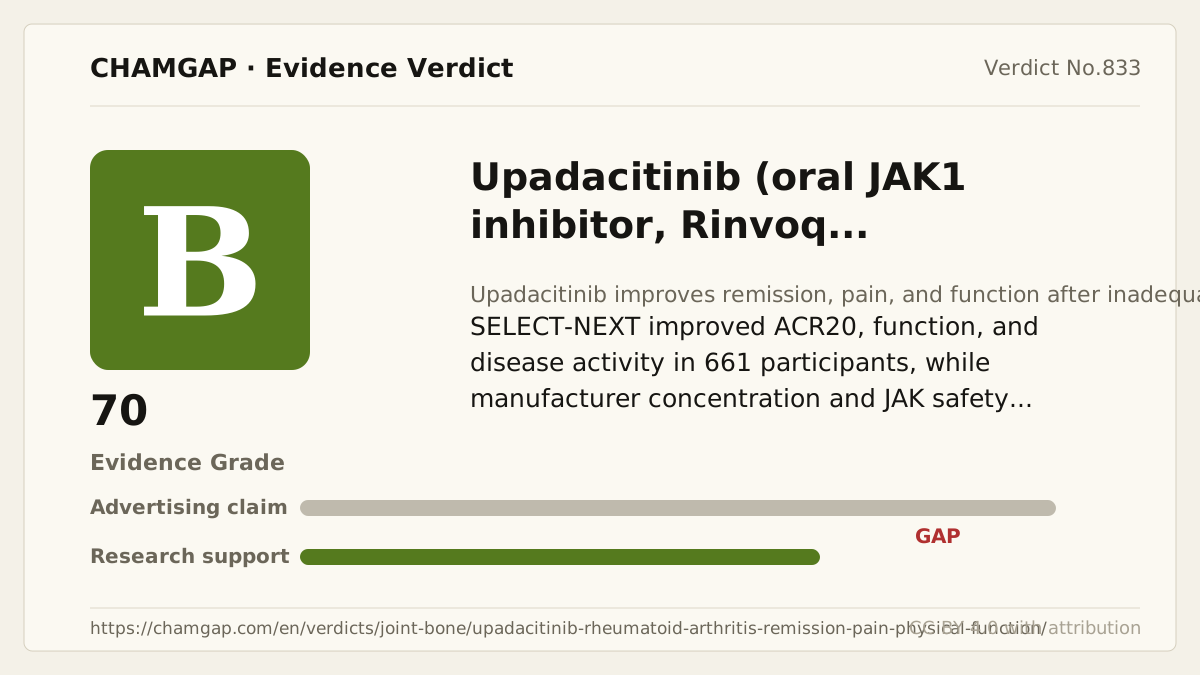
research showsUpadacitinib receives B with 70 points for improving remission, pain, and physical function in rheumatoid arthritis inadequately responsive to prior antirheumatic drugs. In 661 SELECT-NEXT participants, week-12 ACR20 responses were 64% with 15 mg, 66% with 30 mg, and 36% with placebo; DAS28-CRP low disease activity occurred in 48%, 48%, and 17%. Function and disease activity also improved, but pivotal evidence is concentrated in a manufacturer-funded program and major JAK-inhibitor warnings for serious infection, cardiovascular events, thrombosis, malignancy, and death require strong separate consideration.
ads claimClaims of worry-free complete remission because of JAK1 selectivity, or of eliminating pain and therefore completely preventing joint damage, overreach. Short-term remission, symptom, and function benefits are established, but they do not prove durable remission in everyone, complete structural protection, or absence of class safety risks.
Useful facts when choosing a product
- Rinvoq is a once-daily extended-release prescription tablet; the rheumatoid-arthritis dose and combination regimen follow the national label and specialist prescription.
- Screening for tuberculosis, hepatitis, and other infection risks and monitoring of blood counts, liver function, and lipids are required before and during therapy; live vaccines should be avoided.
- Herpes zoster and serious infections can occur, and boxed warnings cover thrombosis, major cardiovascular events, malignancy, and death with JAK inhibitors.
- Symptom improvement does not guarantee complete arrest of structural joint damage. Disease activity, function, imaging, and adverse effects should all guide continuation.
Chamgap Semantic Classification Code
Candidate index · review held
M.upadacitinib.oral.remission-pain-and-physical-function-in-rheumatoid-arthritis-inadequately-responsive-to-prior-antirheumatic-therapy.improve.MULTIMedicinal interventions > Upadacitinib > Oral > remission, pain, and physical function in rheumatoid arthritis inadequately responsive to prior antirheumatic therapy > Improvement claim > Multiple: primary unresolved
An automated migration candidate, not an issued permanent code; exact claim scope remains under review. This machine-generated migration candidate helps retrieval but is not a permanent assignment. The original verdict ID and URL remain authoritative.
What the research actually shows
Burmester and colleagues randomized 661 conventional-drug inadequate responders in SELECT-NEXT to upadacitinib 15 mg, 30 mg, or placebo while background therapy continued. At week 12, ACR20 responses were 64%, 66%, and 36%, and DAS28-CRP at or below 3.2 occurred in 48%, 48%, and 17%. Smolen and colleagues randomized 648 methotrexate inadequate responders in SELECT-MONOTHERAPY to switch to upadacitinib or continue methotrexate; week-14 ACR20 responses were 68% with 15 mg, 71% with 30 mg, and 41% with methotrexate. The SELECT program also improved pain, HAQ-DI function, and remission, but was manufacturer-led throughout; safety signals were evaluated separately from efficacy.
Why this is classified as B (70)
In 661 SELECT-NEXT participants, week-12 ACR20 was 64% with 15 mg, 66% with 30 mg, and 36% with placebo, with improved function and disease activity. Direct clinical benefit is replicated across phase 3 trials, but concentration in AbbVie-funded studies, some composite and subjective outcomes, limited independent long-term comparisons, and major JAK-class safety warnings give B with 70 points. Boxed warnings remain strongly emphasized under separate safety.
Counterpoint. For patients with moderate or severe disease inadequately responsive to other disease-modifying drugs, rapid symptom and function improvement and a higher chance of remission can be meaningful.
Rejudgment record. New verdict — Accepted SELECT-NEXT week-12 ACR20 of 64% and 66% versus 36% with placebo in 661 participants plus improved function and disease activity, while accounting for concentration in AbbVie-funded studies, some composite and subjective outcomes, limited independent long-term comparison, and major JAK-class safety warnings
Sub-claim grades by effect
This ingredient is marketed for several effects. A single overall grade blends strong and weak claims together, so each effect is graded separately here. The overall grade reflects the strongest disconfirming or core claim.
| Effect (sub-claim) | Grade | Basis |
|---|---|---|
| Remission or low disease activity in rheumatoid arthritis | B | Several phase 3 trials showed higher remission or low-disease-activity rates on DAS28-CRP and stricter indices. |
| Improvement in pain and physical function | B | Pain and HAQ-DI improved versus placebo or continued methotrexate, although some measures are subjective. |
| Inhibition of structural joint damage progression | C | Radiographic-progression signals exist, but their scope and independent confirmation are more limited than for symptoms and function. |
Cross-check — AI research and Codex final gate
Evidence Table
| Study | Design | Sample | Funding | Endpoint | Result | Weight |
|---|---|---|---|---|---|---|
| Burmester GR et al. 2018, SELECT-NEXT | Multicenter randomized double-blind placebo-controlled phase 3 trial | 661 patients with rheumatoid arthritis inadequately responsive to conventional synthetic disease-modifying drugs | AbbVie | Week-12 ACR20, DAS28-CRP low disease activity or remission, pain, and HAQ-DI | ACR20 was 64% with 15 mg, 66% with 30 mg, and 36% with placebo; low disease activity was 48%, 48%, and 17%. | Core placebo-controlled direct clinical efficacy |
| Smolen JS et al. 2019, SELECT-MONOTHERAPY | Randomized double-blind active-controlled phase 3 trial | 648 patients inadequately responsive to methotrexate | AbbVie | Week-14 ACR20, DAS28-CRP low disease activity or remission, and function | ACR20 was 68% with 15 mg, 71% with 30 mg, and 41% with continued methotrexate, favoring upadacitinib. | Replication in another inadequate-response setting |
| Cohen SB et al. 2021 | Integrated safety analysis of the SELECT phase 3 program | Five phase 3 trials with 3,834 upadacitinib-exposed patients | AbbVie | Serious infection, herpes zoster, thrombosis, cardiovascular events, and malignancy | Herpes zoster and selected laboratory abnormalities were notable, supporting the need for long-term harm surveillance. | Safety context kept separate from efficacy |
Receipt — 3 References
All 3 cited sources were verified for existence at the original page (as of 2026-07-20).
Final verification and publication gate: Codex · Evidence date: 2026-07-20 · Corrections: none
Cite this verdict
[Chamgap] Upadacitinib x remission, pain, and physical-function improvement in treatment-refractory rheumatoid arthritis — Evidence Grade B·70. 3 cited sources checked. Source: https://chamgap.com/en/verdicts/joint-bone/upadacitinib-rheumatoid-arthritis-remission-pain-physical-function/ · CC BY 4.0CC BY 4.0 — free to use with attribution; do not distort grades, numbers, or verdict meaning.
What this document does and does not do
Chamgap is an information source. It reports what research has and has not confirmed; it does not tell readers what to take or buy. That decision belongs to readers and, when needed, medical or legal professionals. This verdict reflects literature available up to the search date and may change as new research appears. Nothing here is medical advice.