
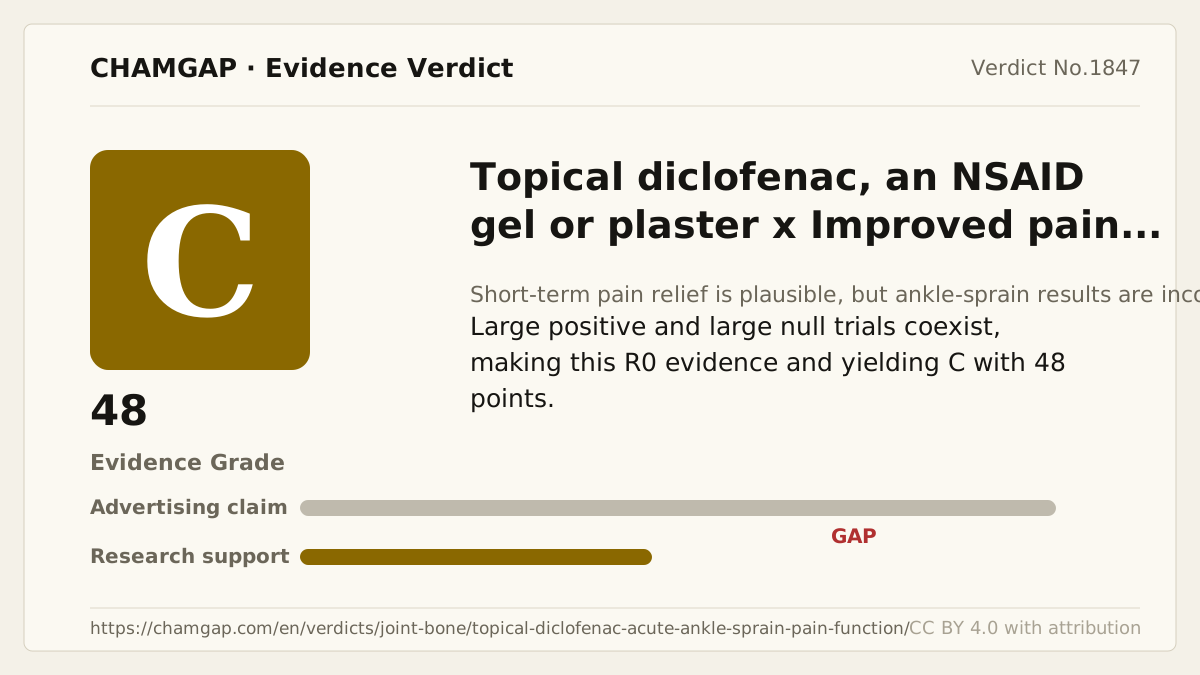
Topical diclofenac,
does it really help with Improved pain and function in acute ankle sprain?
research showsTopical diclofenac produced large movement-pain reductions in some placebo-controlled ankle-sprain trials, but a separate 385-person trial found that diclofenac alone failed the primary endpoint. It is rated C.
ads claimMarketing can turn short-term pain relief into faster healing of the sprain itself. Trials mainly measured short-term pain, swelling, and function, against substantial natural recovery.
Useful facts when choosing a product
- The key positive trial randomized and analyzed 205; the null trial randomized 385.
- Gel concentration, diclofenac salt, coingredients, and dosing frequency varied, so products are not automatically interchangeable.
Chamgap Semantic Classification Code
Candidate index · review held
UNK.diclofenac.topical-skin.pain-and-function-in-acute-ankle-sprain.improve.MULTIUnknown > diclofenac > Topical skin > pain and function in acute ankle sprain > Improvement claim > Multiple: primary unresolved
An automated migration candidate, not an issued permanent code; exact claim scope remains under review. This machine-generated migration candidate helps retrieval but is not a permanent assignment. The original verdict ID and URL remain authoritative.
What the research actually shows
The Predel and Giannetti trial randomized and analyzed 205 people by intention to treat; movement-pain reduction at 72 hours was 57 mm versus 21 mm, so the primary endpoint succeeded. A separate 242-person trial also succeeded at day 5, with reductions of 49.1 and 49.7 mm versus 25.4 mm for placebo. That 25.4-mm placebo improvement quantifies substantial natural recovery. In contrast, a GSK trial randomized 385, with 112 assigned to diclofenac alone and 75 to placebo, and found no significant difference in 24-to-72-hour pain AUC, so its primary endpoint failed. Cochrane included 61 trials and 8,386 participants assessed at about seven days. Overall diclofenac comprised 10 trials and 2,050 participants: 800 of 1,074 versus 461 of 976, RR 1.6 (1.5 to 1.7), NNT 3.7 (3.2 to 4.3). The Flector-patch subgroup separately comprised four trials and 1,030 participants with NNT 4.7. verdict 670, which is B with 79 points, concerns the same drug in knee osteoarthritis, a different indication whose evidence was not transferred. For the same acute-ankle-sprain indication, verdict 1770, which is D with 24 points, concerns therapeutic ultrasound; diclofenac has stronger positive placebo-controlled evidence but lacks consistency.
Why this is classified as C (50)
P, R0, I0, E+, and B1 derive C with 50 points because of inconsistency, manufacturer-only decisive trials, and duration under 12 weeks.
Counterpoint. Short-term use can be reasonable for a mild sprain with intact skin, while inability to bear weight or instability requires separate assessment.
Rejudgment record. Cross-check applied — Clinically large positive pain trials coexist with a separate large failed primary endpoint, under manufacturer funding and short treatment
| Endpoint | P | Symptom or function itself is the target - including patient reports and performance tests |
| Replication | R0 | Trials conflict in direction |
| Independence | I0 | Evidence comes only from manufacturer studies |
| Effect size | E+ | Meets the clinically important threshold |
Stored derived and displayed grades match; this is not a current recalculation or validity check (C).
Sub-claim grades by effect
This ingredient is marketed for several effects. A single overall grade blends strong and weak claims together, so each effect is graded separately here. The overall grade reflects the strongest disconfirming or core claim.
| Effect (sub-claim) | Grade | Basis |
|---|---|---|
| Reduction in movement pain at 72 hours | C | One 205-person trial was strongly positive, but a separate large trial was null. |
| Recovery of ankle function | C | Positive short-term signals lack consistency across formulations. |
| At least 50% relief of acute pain | C | The acute-injury pooled NNT is favorable, but direct ankle-sprain trials conflict. |
Cross-check — AI research and Codex final gate
Evidence Table
| Study | Design | Sample | Funding | Endpoint | Result | Weight |
|---|---|---|---|---|---|---|
| Predel HG and Giannetti B. 2013 | Seven-day randomized double-blind placebo-controlled trial | 205 randomized and analyzed by intention to treat (102/103) | Product-development context with manufacturer involvement reported | Reduction in 100-mm VAS pain on movement at 72 hours | 57 mm versus 21 mm, P<0.0001; primary endpoint succeeded | Key positive trial |
| Lai PM et al. 2017 | Randomized double-blind placebo- and active-controlled trial | 385 randomized; 112 diclofenac-alone and 75 placebo | Manufacturer sponsorship by GlaxoSmithKline Consumer Healthcare with employee authors | Area under the curve for movement pain from 24 to 72 hours | No significant difference between diclofenac alone and placebo; primary endpoint failed | Contradictory large null trial |
| Derry S et al. Cochrane, 2015 | Systematic review of randomized double-blind trials | 61 studies and 8,386 participants; 1,074 analyzed for diclofenac clinical success | Cochrane and academic work; authors reported no relevant conflicts | At least 50% pain relief or clinical success around seven days | Overall diclofenac, 10 trials and 2,050 participants: 800/1,074 versus 461/976, RR 1.6 (1.5 to 1.7), NNT 3.7 (3.2 to 4.3); Flector, four trials and 1,030 participants, NNT 4.7 | Broad confirmatory acute-injury evidence |
Receipt — 3 References
All 3 cited sources were verified for existence at the original page (as of 2026-07-24).
Final verification and publication gate: Codex · Evidence date: 2026-07-24 · Corrections: none
Cite this verdict
[Chamgap] Topical diclofenac x pain and function in acute ankle sprain — Evidence Grade C·50. 3 cited sources checked. Source: https://chamgap.com/en/verdicts/joint-bone/topical-diclofenac-acute-ankle-sprain-pain-function/ · CC BY 4.0CC BY 4.0 — free to use with attribution; do not distort grades, numbers, or verdict meaning.
What this document does and does not do
Chamgap is an information source. It reports what research has and has not confirmed; it does not tell readers what to take or buy. That decision belongs to readers and, when needed, medical or legal professionals. This verdict reflects literature available up to the search date and may change as new research appears. Nothing here is medical advice.