
Therapeutic ultrasound,
does it really help with Additional pain and function improvement when added to exercise and heat for rotator cuff disease?
research showsTherapeutic ultrasound earns D with 30 points because reliable added benefit for noncalcific rotator-cuff disease remains unsupported. The pooled Constant-Murley between-group difference was -0.26 points (95% CI -3.84 to 3.32), I-squared 0%, from only two trials and 60 participants.
ads claimWarmth during treatment or within-group recovery should not be presented as a specific ultrasound effect. The relevant estimate subtracts common exercise, heat, and natural recovery.
Useful facts when choosing a product
- The pooled Constant-Murley estimate was -0.26 points (95% CI -3.84 to 3.32), I-squared 0%, from two trials and 60 participants.
- Analan 2015 included only 22 participants, 11 per group.
- Verdicts 1728, 1746, and 1770 concern low back pain, knee osteoarthritis, and acute ankle sprain, respectively.
Chamgap Semantic Classification Code
Candidate index · review held
P.therapeutic-ultrasound.UNK.additional-pain-and-function-improvement-when-added-to-exercise-and-heat-for-rotator-cuff-disease.improve.MULTIProcedures, devices and tests > Therapeutic ultrasound > Unknown > Additional pain and function improvement when added to exercise and heat for rotator cuff disease > Improvement claim > Multiple: primary unresolved
An automated migration candidate, not an issued permanent code; exact claim scope remains under review. This machine-generated migration candidate helps retrieval but is not a permanent assignment. The original verdict ID and URL remain authoritative.
What the research actually shows
Desmeules et al. 2015 pooled ultrasound added to exercise in two trials and 60 participants: Constant-Murley between-group difference -0.26 points (95% CI -3.84 to 3.32), I-squared 0%. The confidence interval exists, but the evidence is too small for a definitive conclusion. Verdict 1728 is D with 28 points for chronic nonspecific low back pain, verdict 1746 is C with 42 points for knee osteoarthritis, and verdict 1770 is D with 24 points for acute ankle sprain; all are different indications.
Why this is classified as D (30)
Repeated null direction is limited by small trials, unavailable confidence intervals in some studies, and a pooled estimate from only two trials and 60 participants, giving D with 30 points without definitive refutation.
Counterpoint. Calcific tendinitis and different ultrasound protocols require separate claim-specific assessment.
Rejudgment record. Cross-check applied — Repeated null direction in small trials plus a pooled estimate from two trials and 60 participants, insufficient for precise definitive refutation
| Endpoint | P | Symptom or function itself is the target - including patient reports and performance tests |
| Replication | RX | Repeatedly refuted in the same indication |
| Independence | I2 | Decisive evidence is publicly or non-profit funded |
| Effect size | E0 | Null |
| Precision | C0 | The confidence interval leaves room for benefit |
Stored derived and displayed grades match; this is not a current recalculation or validity check (D).
Sub-claim grades by effect
This ingredient is marketed for several effects. A single overall grade blends strong and weak claims together, so each effect is graded separately here. The overall grade reflects the strongest disconfirming or core claim.
| Effect (sub-claim) | Grade | Basis |
|---|---|---|
| Additional shoulder-pain reduction beyond exercise | D | The between-group comparison versus sham was null. |
| Additional shoulder-function improvement beyond exercise | D | Between-group UCLA and Constant-Murley differences were null. |
| Additional rotator-cuff strength improvement | D | No additional effect was found for isokinetic strength. |
Cross-check — AI research and Codex final gate
Evidence Table
| Study | Design | Sample | Funding | Endpoint | Result | Weight |
|---|---|---|---|---|---|---|
| Analan PD et al. 2015 | Randomized double-blind sham-ultrasound-controlled trial | 22 randomized and 22 analyzed | Funding source not reported; conducted by university-hospital investigators | Between-group add-on effects on VAS pain, UCLA and Constant-Murley function, and isokinetic strength | Primary efficacy failed, with P>0.05 for all between-group comparisons | Direct null small trial |
| Page MJ et al. 2016 | Cochrane systematic review of randomized trials | 47 electrotherapy trials and 2,388 participants; ultrasound comparisons came from a small number of single trials | Public Australian NHMRC and academic support; funding of included trials was incompletely reported | Pain, function, quality of life, and treatment success | Clinical benefit from adding ultrasound to other physical therapy was uncertain or absent | Low-certainty repeated evidence |
| Desmeules F et al. 2015 | Systematic review and meta-analysis | Two Constant-Murley trials and 60 participants | As reported in the article | Constant-Murley function with ultrasound added to exercise | Between-group difference -0.26 points (95% CI -3.84 to 3.32), I-squared 0% | Existing but small pooled estimate |
| Desmeules F et al. 2015 | Systematic review and meta-analysis | Two Constant-Murley trials and 60 participants | As reported in the article | Constant-Murley function with ultrasound added to exercise | Between-group difference -0.26 points (95% CI -3.84 to 3.32), I-squared 0% | Existing but small pooled estimate |
Receipt — 4 References
All 4 cited sources were verified for existence at the original page (as of 2026-07-24).
Final verification and publication gate: Codex · Evidence date: 2026-07-24 · Corrections: none
Cite this verdict
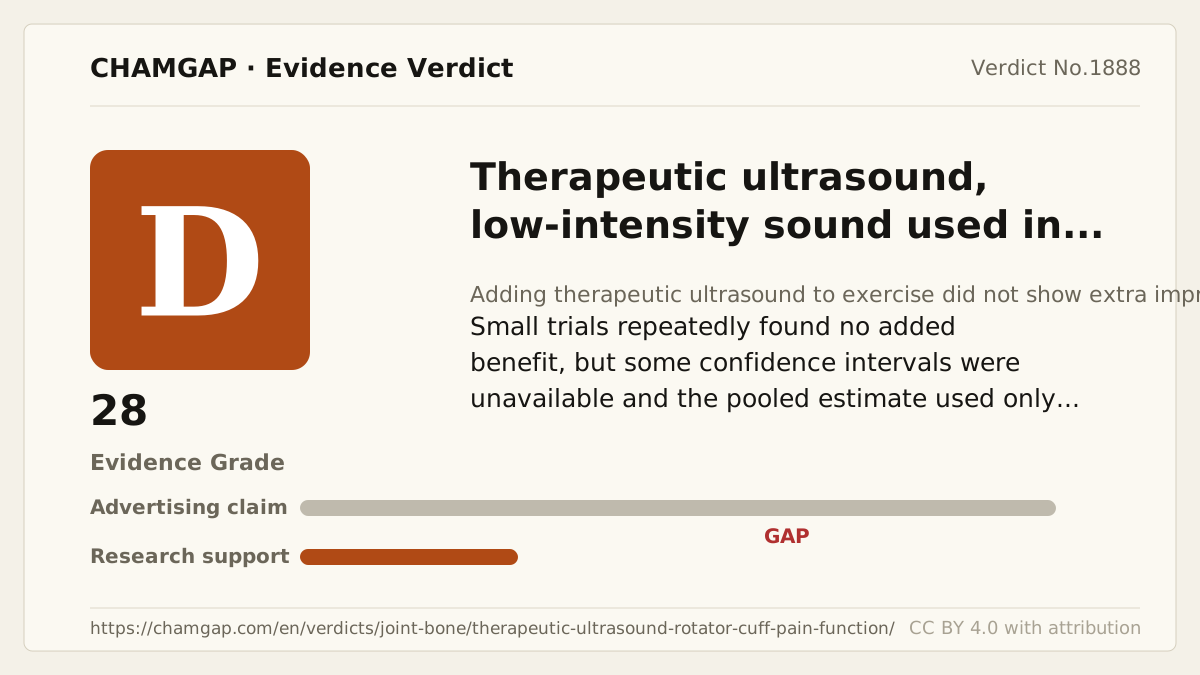
[Chamgap] Therapeutic ultrasound x rotator-cuff pain and function — Evidence Grade D·30. 4 cited sources checked. Source: https://chamgap.com/en/verdicts/joint-bone/therapeutic-ultrasound-rotator-cuff-pain-function/ · CC BY 4.0CC BY 4.0 — free to use with attribution; do not distort grades, numbers, or verdict meaning.
What this document does and does not do
Chamgap is an information source. It reports what research has and has not confirmed; it does not tell readers what to take or buy. That decision belongs to readers and, when needed, medical or legal professionals. This verdict reflects literature available up to the search date and may change as new research appears. Nothing here is medical advice.