
Therapeutic ultrasound,
does it really help with Reduction of pain and swelling and acceleration of functional recovery after acute ankle sprain?
research showsTherapeutic ultrasound is rated D for acute ankle sprain because five sham-controlled trials were repeatedly null but did not exclude a small or moderate benefit. In the six-trial, 606-participant van den Bekerom 2011 review, Cochrane 2011(6):CD001250, one-week improvement across three trials and 341 participants had RR 1.04 (95% CI 0.92 to 1.17) and RD 3% (-6 to 12); function across two trials and 187 participants had RR 1.09 (0.92 to 1.30) and RD 6% (-6 to 19). Upper bounds of 12% and 19% do not exclude benefit, giving D with 24 points. Evidence was not borrowed from verdict 1728, which is D with 28 points, or verdict 1746, which is C with 42 points, because they concern the same device at different body sites.
ads claimThe explanation that sound energy stimulates deep tissue and shortens swelling and recovery is plausible-sounding, but sham-controlled human trials in acute ankle sprain repeatedly found no clinical benefit.
Useful facts when choosing a product
- This is a physical-therapy energy device that delivers high-frequency acoustic energy, not diagnostic ultrasound.
- Initial assessment should consider fracture, ability to bear weight, severe focal tenderness, and instability.
- Ultrasound should not replace protection, progressive weight bearing, and exercise rehabilitation.
Chamgap Semantic Classification Code
Candidate index · review held
P.therapeutic-ultrasound.device.pain-and-swelling-and-acceleration-of-functional-recovery-after-acute-ankle-sprain.reduce.shamProcedures, devices and tests > Therapeutic ultrasound > Device delivered > pain and swelling and acceleration of functional recovery after acute ankle sprain > Reduction claim > Sham procedure or device
An automated migration candidate, not an issued permanent code; exact claim scope remains under review. This machine-generated migration candidate helps retrieval but is not a permanent assignment. The original verdict ID and URL remain authoritative.
What the research actually shows
Nyanzi 1999 (Clin Rehabil 13(1):16-22) was a 58-person double-blind sham-ultrasound randomized trial. Pain, swelling, range of motion, and weight bearing were all null, and no single explicit primary endpoint was clear. It had NHS and academic support with no manufacturer funding reported. Van den Bekerom 2011, Cochrane 2011(6):CD001250, reviewed six trials and 606 participants, including five sham-controlled trials. One-week improvement in three trials and 341 participants had RR 1.04 (95% CI 0.92 to 1.17), RD 3% (-6 to 12); function in two trials and 187 participants had RR 1.09 (0.92 to 1.30), RD 6% (-6 to 19).
Why this is classified as D (24)
Five sham-controlled trials were repeatedly null, but one-week improvement RD 3% (-6 to 12) and function RD 6% (-6 to 19) do not exclude a small or moderate benefit. This supports D with 24 points rather than F.
Counterpoint. When recovery is delayed or weight bearing remains difficult, reassessment for fracture or major ligament injury matters more than repeating ultrasound.
Rejudgment record. Cross-check applied — Nyanzi's 58-person double-blind sham-ultrasound trial and five sham-controlled trials were repeatedly null, but one-week improvement RD -6% to 12% and function RD -6% to 19% did not exclude small or moderate benefit, supporting D rather than F
Sub-claim grades by effect
This ingredient is marketed for several effects. A single overall grade blends strong and weak claims together, so each effect is graded separately here. The overall grade reflects the strongest disconfirming or core claim.
| Effect (sub-claim) | Grade | Basis |
|---|---|---|
| Pain reduction after acute ankle sprain | D | Results were repeatedly null, but confidence intervals did not exclude possible benefit. |
| Swelling reduction after acute ankle sprain | D | Benefit over sham was unconfirmed and precision was limited. |
| Recovery of weight bearing and walking function | D | Function had RR 1.09 and RD 6%, with an interval from -6% to 19%. |
Cross-check — AI research and Codex final gate
Evidence Table
| Study | Design | Sample | Funding | Endpoint | Result | Weight |
|---|---|---|---|---|---|---|
| Nyanzi CS et al. 1999 | Randomized double-blind sham-controlled trial | 58 randomized; 58 in the actual analysis | Academic research at Southampton University Hospitals Trust NHS; no manufacturer funding reported | No single prespecified primary endpoint; pain, swelling, range of motion, and weight-bearing outcome set | Day-14 pain was 0.9 versus 0.7, and no outcome significantly favored ultrasound; the outcome set failed. | Pivotal direct sham-controlled trial |
| van den Bekerom MPJ et al. 2011 Cochrane | Systematic review of randomized and quasi-randomized trials | Six trials and 606 participants; five sham-controlled trials | Academic Cochrane review; no manufacturer leadership reported | Overall improvement, pain, swelling, functional disability, and range of motion | Five sham trials were repeatedly null; one-week improvement in three trials and 341 participants had RR 1.04 (95% CI 0.92 to 1.17), RD 3% (-6 to 12), and function in two trials and 187 participants had RR 1.09 (0.92 to 1.30), RD 6% (-6 to 19). | Repeated verification in the same indication |
Receipt — 2 References
All 2 cited sources were verified for existence at the original page (as of 2026-07-24).
Final verification and publication gate: Codex · Evidence date: 2026-07-24 · Corrections: none
Cite this verdict
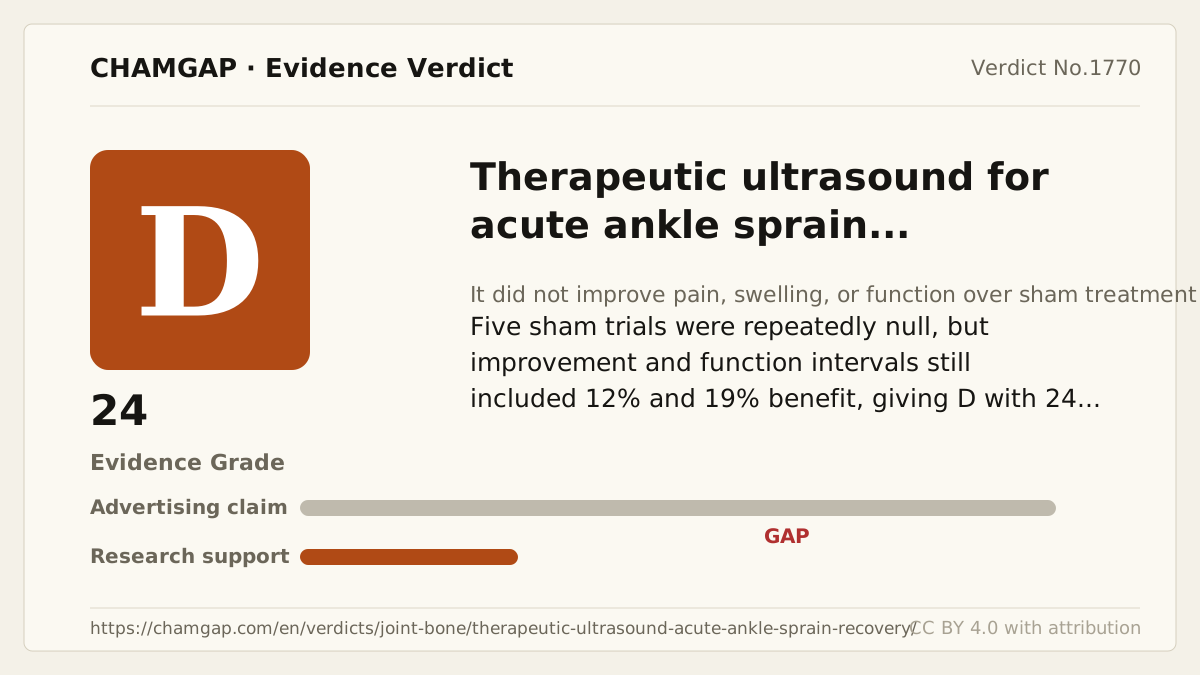
[Chamgap] Therapeutic ultrasound x acute ankle sprain — Evidence Grade D·24. 2 cited sources checked. Source: https://chamgap.com/en/verdicts/joint-bone/therapeutic-ultrasound-acute-ankle-sprain-recovery/ · CC BY 4.0CC BY 4.0 — free to use with attribution; do not distort grades, numbers, or verdict meaning.
What this document does and does not do
Chamgap is an information source. It reports what research has and has not confirmed; it does not tell readers what to take or buy. That decision belongs to readers and, when needed, medical or legal professionals. This verdict reflects literature available up to the search date and may change as new research appears. Nothing here is medical advice.