
Teriparatide,
does it really help with Prevention of new vertebral and nonvertebral fractures in patients with osteoporosis at high fracture risk?
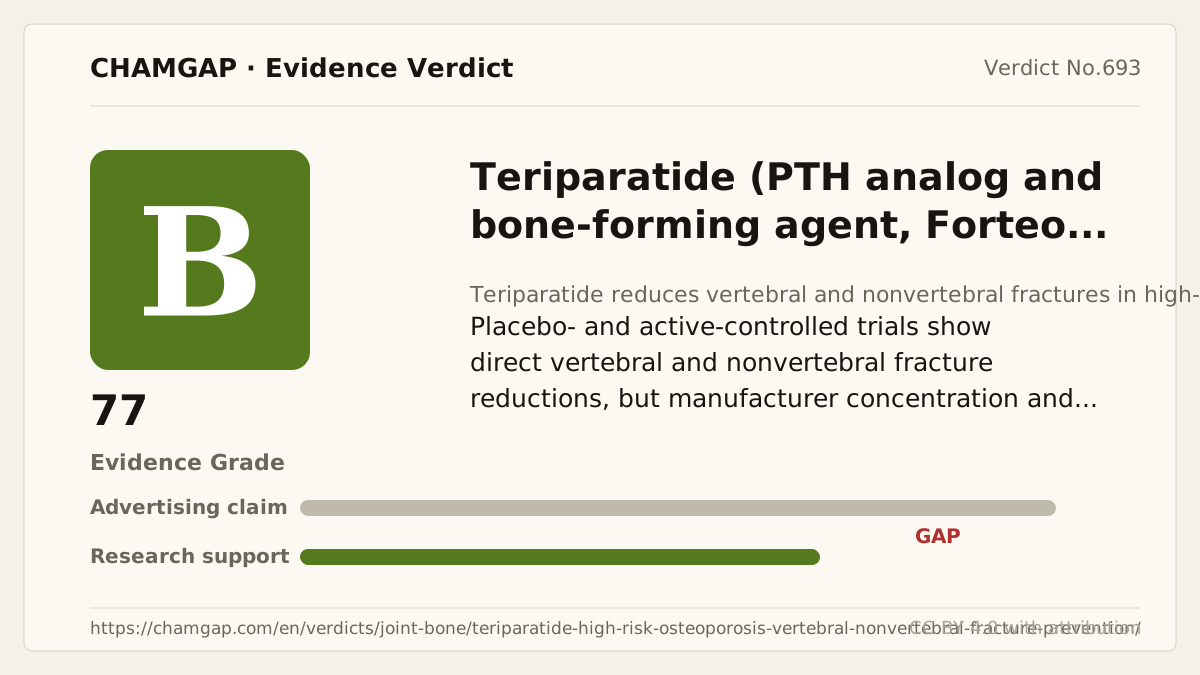
research showsTeriparatide is rated B because it reduces new vertebral and nonvertebral fractures in patients with osteoporosis at high fracture risk. In a 1,637-participant placebo-controlled fracture trial, 20 micrograms reduced new vertebral fractures from 14% to 5% and nonvertebral fragility fractures from 6% to 3%; in the 1,360-participant VERO trial, new vertebral fractures were also less frequent than with risedronate. Direct fracture endpoints are a strength, but pivotal funding is concentrated in the manufacturer and evidence for hip fracture and long-term clinical outcomes across broad populations is thinner. Hypercalcemia, the animal osteosarcoma signal, and the usual two-year treatment scope are separate safety issues.
ads claimMarketing can expand bone formation into prevention of every fracture or turn a bone-density gain into hip-fracture and lifetime protection. The demonstrated scope is reduced vertebral and some nonvertebral fractures during a limited course in high-risk patients, with a post-treatment sequential plan remaining important.
Useful facts when choosing a product
- Teriparatide is a PTH(1-34) analog that stimulates bone formation with intermittent dosing rather than acting as an antiresorptive and is usually injected subcutaneously at 20 micrograms once daily.
- Use is generally limited to about two cumulative years, with treatment beyond two years considered individually only when high fracture risk persists or returns.
- Bone gained during treatment can be lost after discontinuation, so sequential antiresorptive therapy such as a bisphosphonate or denosumab is commonly planned.
- Transient hypercalcemia, dizziness or orthostatic hypotension, and nausea can occur, and patients at increased baseline risk of osteosarcoma should avoid treatment.
Chamgap Semantic Classification Code
Candidate index · review held
M.teriparatide.UNK.new-vertebral-and-nonvertebral-fractures-with-osteoporosis-at-high-fracture-risk.prevent.MULTIMedicinal interventions > Teriparatide > Unknown > new vertebral and nonvertebral fractures with osteoporosis at high fracture risk > Occurrence-prevention claim > Multiple: primary unresolved
An automated migration candidate, not an issued permanent code; exact claim scope remains under review. This machine-generated migration candidate helps retrieval but is not a permanent assignment. The original verdict ID and URL remain authoritative.
What the research actually shows
Neer and colleagues randomized 1,637 postmenopausal women with prior vertebral fractures to teriparatide 20 or 40 micrograms or placebo. In the 20-microgram group, new morphometric vertebral fractures occurred in 5% versus 14% with placebo, and nonvertebral fragility fractures in 3% versus 6%. The VERO trial by Kendler and colleagues assigned 1,360 postmenopausal women with severe osteoporosis to teriparatide or risedronate for 24 months under double masking and double dummy; new morphometric vertebral fractures occurred in 5.4% versus 12.0%. Clinical fractures also declined, while the nonvertebral fragility-fracture difference was statistically uncertain. Bone mineral density supports the mechanism as a surrogate, but this verdict gives weight to observed fracture endpoints.
Why this is classified as B (77)
A 1,637-participant placebo-controlled trial showed new vertebral fractures of 5% versus 14% and nonvertebral fragility fractures of 3% versus 6%, while the 1,360-participant VERO trial showed new vertebral fractures of 5.4% versus 12.0% with risedronate. These direct fracture endpoints place the evidence near the top of B. Lilly funding of both pivotal trials, a nonsignificant VERO result for nonvertebral fragility fracture, HR 0.66 (95% CI 0.39 to 1.10), and thin hip-fracture evidence prevent A and support B with 77 points.
Counterpoint. This verdict concerns a bone-forming strategy for high-risk patients and is distinct from the antiresorptive or dual-action strategies of bisphosphonates, denosumab, and romosozumab. Fracture history, kidney function, calcium status, and feasibility of sequential therapy influence selection.
Rejudgment record. New verdict — Applied B after accepting direct reductions in new vertebral and nonvertebral fractures in a 1,637-participant placebo-controlled trial and the 1,360-participant active-controlled VERO trial, while accounting for manufacturer funding concentration, few hip fractures, and limited long-term clinical outcomes
Sub-claim grades by effect
This ingredient is marketed for several effects. A single overall grade blends strong and weak claims together, so each effect is graded separately here. The overall grade reflects the strongest disconfirming or core claim.
| Effect (sub-claim) | Grade | Basis |
|---|---|---|
| Prevention of new vertebral and nonvertebral fractures in high-risk osteoporosis | B | A placebo-controlled trial reduced vertebral and nonvertebral fractures, and an active-controlled trial showed vertebral-fracture superiority. |
| Hip-fracture prevention and long-term benefit in every patient | ? | Event counts and long-term follow-up do not provide human efficacy literature sufficient to establish this broad claim. |
| Increase in bone mineral density itself | ? | Bone mineral density is a surrogate kept separate from fracture outcomes and is not graded here as an independent efficacy claim. |
Cross-check — AI research and Codex final gate
Evidence Table
| Study | Design | Sample | Funding | Endpoint | Result | Weight |
|---|---|---|---|---|---|---|
| Neer RM et al. 2001 Fracture Prevention Trial | Multicenter randomized double-blind placebo-controlled fracture trial | 1,637 postmenopausal women with prior vertebral fractures | Funded by the manufacturer, Eli Lilly | New morphometric vertebral fractures and nonvertebral fragility fractures | The 20-microgram group had 5% versus 14% new vertebral fractures (RR 0.35) and 3% versus 6% nonvertebral fragility fractures (RR 0.47). | Pivotal placebo-controlled direct fracture evidence |
| Kendler DL et al. 2018 VERO | Multicenter randomized double-blind double-dummy risedronate-controlled trial | 1,360 postmenopausal women with severe osteoporosis | Funded by the manufacturer, Eli Lilly | New morphometric vertebral, clinical, and nonvertebral fragility fractures over 24 months | New morphometric vertebral fractures fell to 5.4% versus 12.0%, while the difference in nonvertebral fragility fractures was not significant. | Replicated active-controlled vertebral-fracture evidence |
Receipt — 2 References
All 2 cited sources were verified for existence at the original page (as of 2026-07-19).
Final verification and publication gate: Codex · Evidence date: 2026-07-19 · Corrections: none
Cite this verdict
[Chamgap] Teriparatide x prevention of new vertebral and nonvertebral fractures in high-risk osteoporosis — Evidence Grade B·77. 2 cited sources checked. Source: https://chamgap.com/en/verdicts/joint-bone/teriparatide-high-risk-osteoporosis-vertebral-nonvertebral-fracture-prevention/ · CC BY 4.0CC BY 4.0 — free to use with attribution; do not distort grades, numbers, or verdict meaning.
What this document does and does not do
Chamgap is an information source. It reports what research has and has not confirmed; it does not tell readers what to take or buy. That decision belongs to readers and, when needed, medical or legal professionals. This verdict reflects literature available up to the search date and may change as new research appears. Nothing here is medical advice.