
Alendronate,
does it really help with Prevention of vertebral, hip, and nonvertebral fractures in postmenopausal osteoporosis with a prior fragility fracture?
research showsAlendronate is rated B because direct clinical-endpoint evidence shows fewer vertebral, hip, and nonvertebral fractures in postmenopausal osteoporosis with a prior fragility fracture or similarly high risk. FIT reported large effects on clinical vertebral fracture (HR 0.45) and hip fracture (HR 0.49), but Merck researchers participated in the trial and development program, so FIT cannot be characterized as an independent large randomized trial. The 2025 Cochrane update found moderate-certainty evidence only for clinical vertebral fracture; evidence for nonvertebral, hip, and wrist fractures was low certainty, and several outcomes depended heavily on one trial. Fracture is a direct clinical endpoint, so C would be too low, while sponsor involvement and low certainty for several sites preclude A. The result is upper B with 79 points.
ads claimMarketing can convert a higher bone-density number into complete prevention of every fracture or a need for lifelong treatment. Benefits are clearest in people at high baseline risk, such as those with a prior fracture or very low bone density, and treatment beyond five years requires reassessment of hip density, interval fractures, age, and adverse-effect risk.
Useful facts when choosing a product
- Alendronate is an oral antiresorptive bisphosphonate prescription medicine. Common postmenopausal-osteoporosis regimens are 70 mg once weekly or 10 mg once daily, but the prescribed product label controls.
- The tablet is swallowed with plain water immediately after getting up, followed by at least 30 minutes without lying down, food, beverages, or other medicines. These instructions reduce poor absorption and esophageal irritation.
- Hypocalcemia should be corrected before treatment, and calcium, vitamin D, and renal status should be assessed. Oral therapy may be unsuitable with esophageal stricture or achalasia or when a person cannot remain upright for at least 30 minutes.
- Esophagitis and ulceration, hypocalcemia, and rare osteonecrosis of the jaw and atypical femoral fracture are reported. Thigh or groin pain and planned invasive dental work warrant clinical discussion, but these risks do not negate demonstrated fracture-prevention efficacy.
Chamgap Semantic Classification Code
Candidate index · review held
M.alendronate.UNK.vertebral-hip-and-nonvertebral-fractures-in-postmenopausal-osteoporosis-with-a-prior-fragility-fracture.prevent.placeboMedicinal interventions > Alendronate > Unknown > vertebral, hip, and nonvertebral fractures in postmenopausal osteoporosis with a prior fragility fracture > Occurrence-prevention claim > Placebo
An automated migration candidate, not an issued permanent code; exact claim scope remains under review. This machine-generated migration candidate helps retrieval but is not a permanent assignment. The original verdict ID and URL remain authoritative.
What the research actually shows
The FIT vertebral-fracture arm randomized 2,027 women recruited from 11 United States regions to alendronate or placebo and measured radiographically confirmed and clinical fractures over 36 months. Vertebral, overall clinical, hip, and wrist outcomes favored alendronate, but Merck researchers and the development program were involved. The 2025 Cochrane update found 119 eligible studies, 102 with usable data, including 40 placebo-controlled studies. Its best estimates in higher-risk secondary prevention were approximately 5% versus 2% for clinical vertebral fracture, 14% versus 11% for nonvertebral fracture, and 2% versus 1% for hip fracture, with low certainty outside clinical vertebral fracture. FLEX rerandomized 1,099 women after about five years of treatment; continuing to ten years did not reduce every nonvertebral-fracture outcome, so duration and a drug holiday depend on residual risk. Bone-density improvement supports the mechanism, but the B grade rests on fractures themselves.
Why this is classified as B (79)
B. FIT shows large direct effects on clinical vertebral fracture (HR 0.45) and hip fracture (HR 0.49), but Merck involvement in the trial and development program prevents characterization as an independent large randomized trial. In the 2025 Cochrane update, only clinical vertebral fracture had moderate-certainty evidence; nonvertebral, hip, and wrist evidence was low certainty, and several results were heavily influenced by one trial. Direct fracture endpoints keep the grade above C, while sponsor involvement and limited certainty cap it at B with 79 points. Harms remain separate under safety.
Counterpoint. Absolute benefit is greatest in high-risk patients with a prior fracture, but fall prevention, exercise, adequate protein, calcium and vitamin D, vision care, and medication review remain important. Continuation or a holiday should follow periodic reassessment of fracture risk.
Rejudgment record. Reassessment (cross-check reflected) — Applied upper B because FIT showed substantial direct fracture reductions but included Merck research and development-program involvement, while the 2025 Cochrane update rated only clinical vertebral fracture as moderate certainty and nonvertebral, hip, and wrist fractures as low certainty, with several estimates heavily influenced by one trial
Sub-claim grades by effect
This ingredient is marketed for several effects. A single overall grade blends strong and weak claims together, so each effect is graded separately here. The overall grade reflects the strongest disconfirming or core claim.
| Effect (sub-claim) | Grade | Basis |
|---|---|---|
| Prevention of fragility fractures (vertebral, hip, and nonvertebral) | B | FIT showed large direct effects for clinical vertebral fracture (HR 0.45) and hip fracture (HR 0.49), but sponsor involvement and low certainty for nonvertebral and hip outcomes limit confidence. |
| Persistence beyond five years and effects after discontinuation | C | Evidence for long-term persistence and drug holidays is limited. |
| Bone mineral density improvement as a surrogate | C | Bone mineral density is a surrogate and cannot be equated with fracture prevention. |
Cross-check — AI research and Codex final gate
Evidence Table
| Study | Design | Sample | Funding | Endpoint | Result | Weight |
|---|---|---|---|---|---|---|
| Black DM et al. Fracture Intervention Trial, 1996 | Multicenter randomized double-blind placebo-controlled trial | 2,027 postmenopausal women with an existing vertebral fracture | Supported by Merck Research Laboratories, with some authors affiliated | Morphometric and clinical vertebral, all clinical, hip, and wrist fractures | The RR was 0.53 for morphometric vertebral fracture, with HRs of 0.45 for clinical vertebral, 0.72 for all clinical, and 0.49 for hip fracture. | Pivotal large direct fracture endpoints |
| Wells GA et al. Cochrane review update, 2025 | Systematic review and meta-analysis | 119 eligible studies; 102 with usable data; 40 placebo-controlled | No dedicated funding | Clinical vertebral, nonvertebral, hip, and wrist fractures and harms | In secondary prevention, alendronate probably reduces clinical vertebral fractures and may reduce nonvertebral, hip, and wrist fractures. | Independent synthesis and replication evidence |
| Black DM et al. FLEX, 2006 | Randomized double-blind continuation-versus-discontinuation extension after five years | 1,099 postmenopausal women | Long-term extension of a Merck-supported program | Bone density and clinical, nonvertebral, and vertebral fractures | Continuation to ten years favored some clinical vertebral outcomes but did not further reduce all nonvertebral fractures, supporting individualized decisions after five years. | Scope limitation for long-term continuation and holidays |
Receipt — 4 References
All 4 cited sources were verified for existence at the original page (as of 2026-07-19).
Final verification and publication gate: Codex · Evidence date: 2026-07-19 · Corrections: none
Cite this verdict
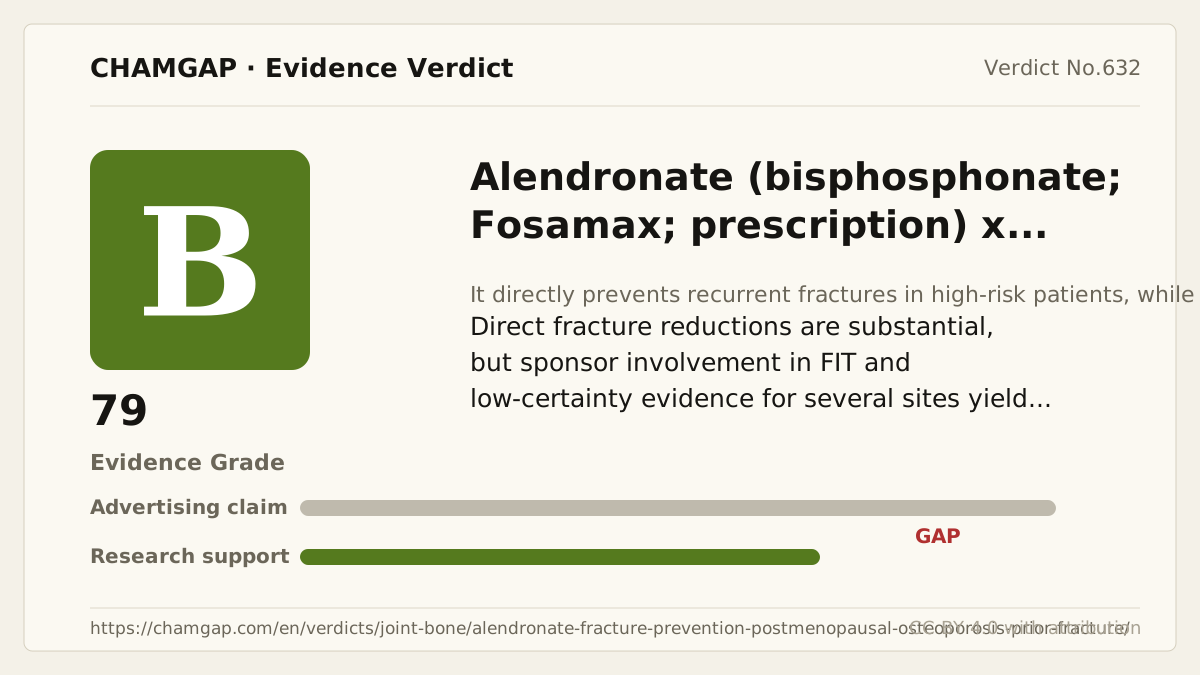
[Chamgap] Alendronate x prevention of recurrent fractures in postmenopausal osteoporosis — Evidence Grade B·79. 4 cited sources checked. Source: https://chamgap.com/en/verdicts/joint-bone/alendronate-fracture-prevention-postmenopausal-osteoporosis-prior-fracture/ · CC BY 4.0CC BY 4.0 — free to use with attribution; do not distort grades, numbers, or verdict meaning.
What this document does and does not do
Chamgap is an information source. It reports what research has and has not confirmed; it does not tell readers what to take or buy. That decision belongs to readers and, when needed, medical or legal professionals. This verdict reflects literature available up to the search date and may change as new research appears. Nothing here is medical advice.