
Otago Exercise Programme,
does it really help with Reduction of actual falls among community-dwelling older adults?
research showsThe Otago programme repeatedly reduces actual falls among community-dwelling older adults, yielding A. A 2001 trial randomized 240 and analyzed fall data from 233, meeting the primary endpoint with IRR 0.54. An individual-participant meta-analysis of four early trials and 1,016 people found IRR 0.65. An independent Canadian trial randomized 345 and analyzed fall data from 344, recording 236 versus 366 falls and IRR 0.64. Participant masking is impossible for exercise, but monthly calendars, telephone confirmation, and masked adjudication verified events, so masking was not counted as a bias defect.
ads claimMarketing can reduce the programme to a few balance movements that supposedly eliminate all falls and fractures. Evidence-based Otago uses trained physical therapists to prescribe and progress individualized strength, balance, and walking exercises with follow-up.
Useful facts when choosing a product
- Standard Otago includes five lower-limb strengthening exercises, eleven balance exercises, and walking, with progression prescribed by a physical therapist. The 2019 trial used four home visits in the first two months and one at month six, exercise three times weekly, and 30 minutes of walking twice weekly.
- Verdict 1812, which is A with 86 points, concerns a Tai Ji Quan programme in older adults at high risk of falling. Both receive A because actual fall events achieved H, R2, I2, E+, and B0; Otago differs as individualized home strength and balance training.
- Verdict 1557, which is C with 55 points, concerns balance and functional exercise for fall-related fractures. Fracture is rarer and its direct evidence is less precise than the all-fall-rate evidence here.
- Verdict 504, which is F with 5 points, concerns vitamin D3 for preventing falls in community-dwelling older adults and was repeatedly null. Vitamin evidence was not combined with exercise evidence.
Chamgap Semantic Classification Code
Candidate index · review held
X.otago-exercise-programme.behavioral.actual-falls.reduce.usual-careBehaviors, exposures and policies > Otago Exercise Programme > Behavioral delivery > actual falls > Reduction claim > Usual care
An automated migration candidate, not an issued permanent code; exact claim scope remains under review. This machine-generated migration candidate helps retrieval but is not a permanent assignment. The original verdict ID and URL remain authoritative.
What the research actually shows
Robertson 2001 randomized 240 community-dwelling adults aged at least 75 years, 121 to exercise and 119 to usual care. The actual fall-data analysis included 233, while 211 completed 12 months. The primary fall-rate endpoint, ascertained by home calendars and regular telephone contact, succeeded with IRR 0.54 (95% CI 0.32 to 0.90). An individual-participant synthesis of four controlled New Zealand trials and 1,016 people found IRR 0.65 (0.57 to 0.75) for falls and 0.65 (0.53 to 0.81) for fall injuries. Liu-Ambrose 2019 randomized 345 high-risk older adults after a recent fall and obtained fall data from 344. Monthly calendars, calls after missing or positive calendars, and masked adjudication identified 236 versus 366 falls, 1.4 versus 2.1 per person-year, IRR 0.64 (0.46 to 0.90), P=0.009, meeting the primary endpoint.
Why this is classified as A (86)
For the H endpoint of actual falls, four New Zealand trials and 1,016 people yielded IRR 0.65, while an independent Canadian trial randomized 345, analyzed 344, and yielded IRR 0.64. Public funding, masked event adjudication, and B0 give A with 86 points.
Counterpoint. Initial fall risk, strength, and gait should guide the difficulty level and the availability of stable support. Dizziness, syncope, new neurologic symptoms, or recurrent falls warrant cause-directed assessment alongside exercise.
Rejudgment record. Cross-check applied — Actual fall events confirmed by monthly calendars, calls, and masked adjudication declined substantially in publicly funded independent trials and a four-trial participant-level synthesis, giving H, R2, I2, E+, and B0
| Endpoint | H | Hard endpoint - actual events such as death |
| Replication | R2 | Independently replicated across trials |
| Independence | I2 | Decisive evidence is publicly or non-profit funded |
| Effect size | E+ | Meets the clinically important threshold |
Stored derived and displayed grades match; this is not a current recalculation or validity check (A).
Sub-claim grades by effect
This ingredient is marketed for several effects. A single overall grade blends strong and weak claims together, so each effect is graded separately here. The overall grade reflects the strongest disconfirming or core claim.
| Effect (sub-claim) | Grade | Basis |
|---|---|---|
| Reduction in 12-month fall rate among community-dwelling adults aged at least 75 years | A | The primary endpoint succeeded with IRR 0.54 among 240 randomized and 233 providing fall data. |
| Reduction of recurrent falls in high-risk older adults after a recent fall | A | An independent 345-person trial found total-fall IRR 0.64, although the proportion with at least one fall was unchanged. |
| Reduction of fall-related injuries with the Otago programme | B | The four-trial participant-level synthesis found IRR 0.65, but confirmation for fractures alone is less precise. |
Cross-check — AI research and Codex final gate
Evidence Table
| Study | Design | Sample | Funding | Endpoint | Result | Weight |
|---|---|---|---|---|---|---|
| Robertson MC et al. 2001 | Assessor-masked randomized usual-care-controlled trial | 240 randomized (121/119); 233 in the actual fall-data analysis; 211 completed 12 months | Public New Zealand Health Funding Authority Northern Division support; some investigators partly funded by the Accident Rehabilitation and Compensation Insurance Corporation | Twelve-month fall rate confirmed by home calendars and regular telephone contact | IRR 0.54 (95% CI 0.32 to 0.90), meeting the primary endpoint. | Pivotal event trial |
| Robertson MC et al. 2002 | Individual-participant meta-analysis of four controlled trials | Four trials and 1,016 community-dwelling older adults | New Zealand public health and injury-compensation research programs; not manufacturer-led | Number of falls and fall-related injuries | Fall IRR 0.65 (0.57 to 0.75) and fall-injury IRR 0.65 (0.53 to 0.81). | Multiple-trial pooled replication |
| Liu-Ambrose T et al. 2019 | Single-blind randomized usual-care-controlled trial | 345 randomized (173/172); actual fall-data analysis 344 (172/172); 296 completed the trial | Public and nonprofit support including the Canadian Institutes of Health Research, Vancouver Foundation, and Michael Smith Foundation | Total 12-month fall rate from monthly calendars, telephone confirmation, and masked adjudication | 236 versus 366 falls, 1.4 versus 2.1 per person-year, IRR 0.64 (0.46 to 0.90), P=0.009, meeting the primary endpoint. | Independent contemporary replication |
| Sherrington C et al. 2019 Cochrane review | Systematic review and meta-analysis of randomized exercise trials in community-dwelling older adults | Overall 108 randomized trials and 23,407 participants; 59 trials and 12,981 in the fall-rate analysis | Cochrane academic synthesis assessing trial-level funding and risk of bias | Rate of falls among community-dwelling older adults | Overall exercise rate ratio 0.77 (95% CI 0.71 to 0.83); balance and functional exercise rate ratio 0.76 (0.70 to 0.81). | Large independent pooled confirmation |
Receipt — 4 References
All 4 cited sources were verified for existence at the original page (as of 2026-07-24).
Final verification and publication gate: Codex · Evidence date: 2026-07-24 · Corrections: none
Cite this verdict
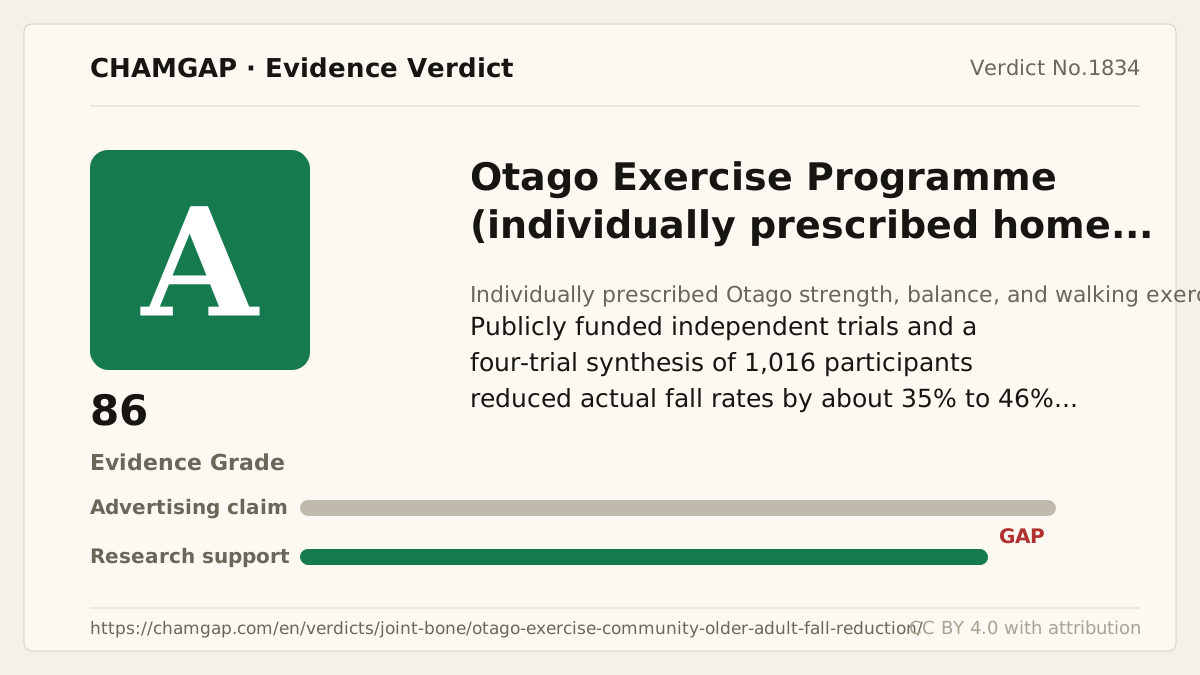
[Chamgap] Otago Exercise Programme x reduction of falls among community-dwelling older adults — Evidence Grade A·86. 4 cited sources checked. Source: https://chamgap.com/en/verdicts/joint-bone/otago-exercise-community-older-adult-fall-reduction/ · CC BY 4.0CC BY 4.0 — free to use with attribution; do not distort grades, numbers, or verdict meaning.
What this document does and does not do
Chamgap is an information source. It reports what research has and has not confirmed; it does not tell readers what to take or buy. That decision belongs to readers and, when needed, medical or legal professionals. This verdict reflects literature available up to the search date and may change as new research appears. Nothing here is medical advice.