
Tai chi,
does it really help with Improved pain and function in knee osteoarthritis?
research showsTai chi has favorable pain and function results in knee osteoarthritis but earns a C. There is no large confirmatory placebo- or wait-list-controlled trial. Direct evidence consists of a small 40-person attention-control randomized trial, while the 204-person trial was designed for noninferiority to physical therapy. A separate meta-analysis of 8 randomized trials and 407 participants found pain SMD -0.75 and function SMD -0.91, but every included trial was small.
ads claimMarketing can turn symptom relief into a claim of cartilage regeneration. Evidence supports pain and function improvement, not structural regrowth.
Useful facts when choosing a product
- The pivotal program used two 60-minute sessions weekly for 12 weeks.
- Movements should be adapted for pain flares or fall risk.
Chamgap Semantic Classification Code
Candidate index · review held
X.tai-chi-exercise-intervention.behavioral.pain-and-function-in-knee-osteoarthritis.improve.MULTIBehaviors, exposures and policies > Tai chi exercise intervention > Behavioral delivery > pain and function in knee osteoarthritis > Improvement claim > Multiple: primary unresolved
An automated migration candidate, not an issued permanent code; exact claim scope remains under review. This machine-generated migration candidate helps retrieval but is not a permanent assignment. The original verdict ID and URL remain authoritative.
What the research actually shows
Wang et al. 2009 provides direct evidence from a small 40-person attention-control randomized trial. The 204-person Wang et al. 2016 trial was designed for noninferiority to physical therapy. A separate meta-analysis of 8 randomized trials and 407 participants reported pain SMD -0.75 and function SMD -0.91 in a favorable direction, but all included trials were small.
Why this is classified as C (58)
No large placebo- or wait-list-controlled confirmatory trial exists; evidence consists of a small 40-person attention-control trial, a 204-person noninferiority trial against physical therapy, and an 8-trial, 407-person meta-analysis whose studies were all small, so rule 1-c supports C with 58 points.
Counterpoint. It is a useful non-drug option, but instructor quality, program content, and adherence can change results.
Rejudgment record. Cross-check applied — No large placebo- or wait-list-controlled confirmatory trial exists. Direct evidence is a small 40-person attention-control randomized trial, the 204-person trial was designed for noninferiority to physical therapy, and all studies in the 8-trial, 407-person meta-analysis were small, so rule 1-c applies.
Sub-claim grades by effect
This ingredient is marketed for several effects. A single overall grade blends strong and weak claims together, so each effect is graded separately here. The overall grade reflects the strongest disconfirming or core claim.
| Effect (sub-claim) | Grade | Basis |
|---|---|---|
| Improved knee pain | C | The direction is favorable, but direct and synthesized trials are small. |
| Improved physical function | C | The direction is favorable, but no large confirmatory trial exists. |
| Symptom improvement compared with physical therapy | C | The 204-person trial used a noninferiority design. |
Cross-check — AI research and Codex final gate
Evidence Table
| Study | Design | Sample | Funding | Endpoint | Result | Weight |
|---|---|---|---|---|---|---|
| Wang C et al. 2009 | Single-blind randomized attention-control trial | 40 randomized; all 40 analyzed by intention to treat at 12 weeks | Public funding from the United States NIH complementary-health program | Primary endpoint: 12-week change in WOMAC pain | Succeeded: between-group difference -118.8 of 500 mm, P=0.0005. | Pivotal attention-control evidence |
| Wang C et al. 2016 | Randomized single-blind active-control noninferiority trial | 204 randomized and 204 analyzed by intention to treat | Public funding from the United States NIH NCCIH | Primary endpoint: 12-week change in WOMAC pain | Both groups improved; the 24-point difference (95% CI -10 to 58) met noninferiority. | Larger active-control replication |
Receipt — 2 References
All 2 cited sources were verified for existence at the original page (as of 2026-07-24).
Final verification and publication gate: Codex · Evidence date: 2026-07-24 · Corrections: none
Cite this verdict
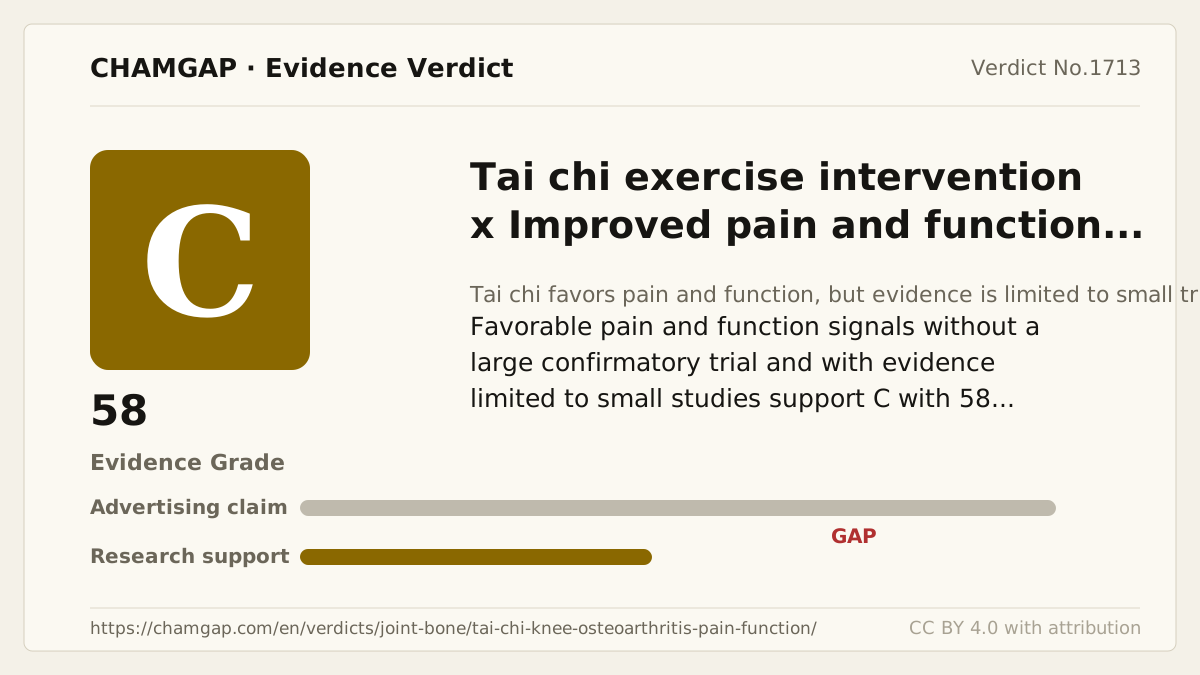
[Chamgap] Tai chi x improved knee osteoarthritis pain and function — Evidence Grade C·58. 2 cited sources checked. Source: https://chamgap.com/en/verdicts/joint-bone/tai-chi-knee-osteoarthritis-pain-function/ · CC BY 4.0CC BY 4.0 — free to use with attribution; do not distort grades, numbers, or verdict meaning.
What this document does and does not do
Chamgap is an information source. It reports what research has and has not confirmed; it does not tell readers what to take or buy. That decision belongs to readers and, when needed, medical or legal professionals. This verdict reflects literature available up to the search date and may change as new research appears. Nothing here is medical advice.