
Tai chi,
does it really help with Improvement in fibromyalgia symptom burden, pain, fatigue, sleep, and function?
research showsThe grade is C. In the 226-participant intention-to-treat trial, the prespecified 24-week FIQR primary outcome favored pooled tai chi over the active aerobic-exercise comparator by 5.5 points (95% CI 0.6 to 10.4, P=0.03). By week 52 the pooled benefit was smaller and some analyses were no longer significant. A six-trial synthesis was also positive, but unblinded subjective outcomes and small trials limit certainty, giving C with 56 points.
ads claimThe evidence does not mean every patient improves substantially or that tai chi replaces medical care. Existing verdict 1653 is B with 72 points for insomnia, verdict 1713 is C with 58 points for knee osteoarthritis, and verdict 1812 is A with 86 points for fall prevention; all address different indications.
Useful facts when choosing a product
- The pivotal comparison was tai chi versus aerobic exercise, not tai chi versus no care.
- All 226 randomized participants were included in intention-to-treat analyses, with 24-week FIQR change prespecified as primary.
- The 8.1-point FIQ threshold was developed for within-person change, not validated as a between-group mean-difference rule.
Chamgap Semantic Classification Code
Candidate index · review held
X.tai-chi.behavioral.fibromyalgia-symptom-burden-pain-fatigue-sleep-and-function.improve.MULTIBehaviors, exposures and policies > Tai chi > Behavioral delivery > fibromyalgia symptom burden, pain, fatigue, sleep, and function > Improvement claim > Multiple: primary unresolved
An automated migration candidate, not an issued permanent code; exact claim scope remains under review. This machine-generated migration candidate helps retrieval but is not a permanent assignment. The original verdict ID and URL remain authoritative.
What the research actually shows
Wang 2018 included all 226 randomized adults in intention-to-treat analyses, comparing 151 across four tai chi regimens with 75 assigned to active aerobic exercise. The 24-week FIQR difference favored tai chi by 5.5 points (95% CI 0.6 to 10.4, P=0.03). At week 52 the pooled advantage was smaller; only the most intensive 24-week twice-weekly regimen retained a significant FIQR difference of 11.1 points (2.7 to 19.6), P=0.01, while several other analyses were not significant. Cheng 2019 included six trials and 657 participants, reporting FIQ/FIQR SMD -0.61 (-0.90 to -0.31), but its education, wait-list, and usual-care controls must be distinguished from the active aerobic comparator.
Why this is classified as C (56)
Independent trials and meta-analysis showed a moderate positive direction, but unblinded self-reported outcomes and small-study dependence create two design limitations, giving C with 56 points.
Counterpoint. Tai chi remains a reasonable low-burden adjunct, while magnitude can vary by regimen and comparator.
Rejudgment record. Cross-check applied — Positive primary FIQR and independent pooled evidence limited by unblinded subjective outcomes and small trials
| Endpoint | P | Symptom or function itself is the target - including patient reports and performance tests |
| Replication | R2 | Independently replicated across trials |
| Independence | I2 | Decisive evidence is publicly or non-profit funded |
| Effect size | E+ | Meets the clinically important threshold |
Stored derived and displayed grades match; this is not a current recalculation or validity check (C).
Sub-claim grades by effect
This ingredient is marketed for several effects. A single overall grade blends strong and weak claims together, so each effect is graded separately here. The overall grade reflects the strongest disconfirming or core claim.
| Effect (sub-claim) | Grade | Basis |
|---|---|---|
| Improvement in overall symptom and functional burden | C | Primary FIQR and pooled FIQ/FIQR were positive, with overlapping design limitations. |
| Improvement in pain | C | Pooled SMD was -0.88, but the interval was wide and small-study dependence was substantial. |
| Improvement in sleep and fatigue | C | Pooled estimates were positive, but unblinded self-report and small samples remain limiting. |
Cross-check — AI research and Codex final gate
Evidence Table
| Study | Design | Sample | Funding | Endpoint | Result | Weight |
|---|---|---|---|---|---|---|
| Wang et al. 2018 | Randomized comparative-effectiveness trial of four tai chi regimens versus aerobic exercise | 226 randomized and analyzed by intention to treat, 151/75 | Public NIH support including NCCIH and NIAMS | Primary change in FIQR at week 24 | Pooled tai chi improved 5.5 points more (95% CI 0.6 to 10.4, P=0.03). | Largest independent ITT trial; unblinded self-report with active comparator |
| Cheng et al. 2019 meta-analysis | Systematic review and meta-analysis of randomized trials | Six trials and 657 participants | Component trials came from multiple independent teams, largely with public support | FIQ/FIQR, pain, sleep, and fatigue at 12 to 16 weeks | FIQ/FIQR SMD -0.61 (95% CI -0.90 to -0.31); pain -0.88 (-1.58 to -0.18). | Pooled independent replication limited by small subjective-outcome trials |
Receipt — 3 References
All 3 cited sources were verified for existence at the original page (as of 2026-08-01).
Final verification and publication gate: Codex · Evidence date: 2026-08-01 · Corrections: none
Cite this verdict
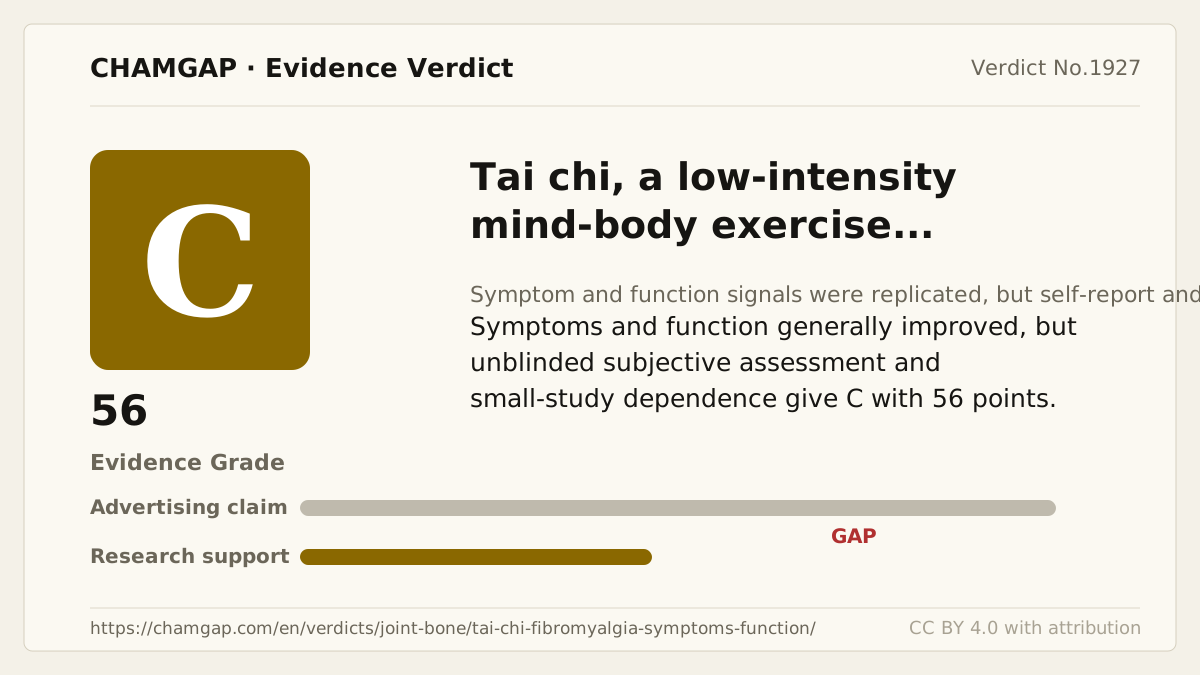
[Chamgap] Tai chi x fibromyalgia symptoms and function — Evidence Grade C·56. 3 cited sources checked. Source: https://chamgap.com/en/verdicts/joint-bone/tai-chi-fibromyalgia-symptoms-function/ · CC BY 4.0CC BY 4.0 — free to use with attribution; do not distort grades, numbers, or verdict meaning.
What this document does and does not do
Chamgap is an information source. It reports what research has and has not confirmed; it does not tell readers what to take or buy. That decision belongs to readers and, when needed, medical or legal professionals. This verdict reflects literature available up to the search date and may change as new research appears. Nothing here is medical advice.