
Supervised exercise therapy,
does it really help with Improved pain and disability in knee osteoarthritis?
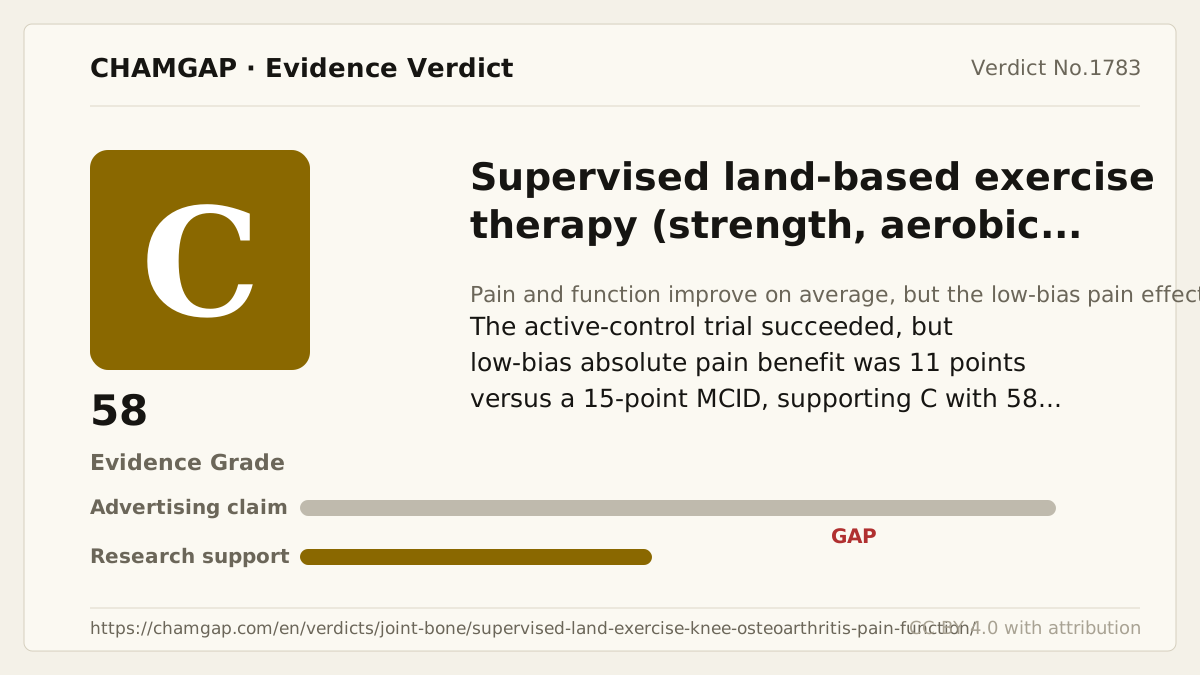
research showsThe grade is C. Deyle 2020 randomized 156 patients and included all 156 in the intention-to-treat analysis, meeting the one-year WOMAC primary endpoint, but the comparator was intra-articular glucocorticoid injection. That procedure is verdict 1678, which is D with 28 points, so beating it does not establish absolute benefit. In the Cochrane low-bias subset of 14 trials and 1,458 participants against placebo-like or no-treatment controls, pain improved by 11 points on a 100-point scale, below the review's 15-point pain MCID. Function approached its 10-point MCID, but the combined claim does not warrant B.
ads claimPromotion may translate superiority over injection into a large absolute pain benefit. Absolute effects depend on the comparator and program, and the low-bias average pain effect did not meet the MCID.
Useful facts when choosing a product
- The pivotal physical-therapy strategy used up to eight treatment sessions plus individualized home exercise and combined exercise, manual therapy, and education.
- Cochrane land-based programs varied across strengthening, aerobic, walking, and functional exercise.
- Intensity and movements should be modified for symptom flares, fall risk, cardiopulmonary disease, and acute joint inflammation.
Chamgap Semantic Classification Code
Candidate index · review held
X.supervised-land-based-exercise-therapy.behavioral.pain-and-disability-in-knee-osteoarthritis.improve.activeBehaviors, exposures and policies > Supervised land-based exercise therapy > Behavioral delivery > pain and disability in knee osteoarthritis > Improvement claim > Active comparator
An automated migration candidate, not an issued permanent code; exact claim scope remains under review. This machine-generated migration candidate helps retrieval but is not a permanent assignment. The original verdict ID and URL remain authoritative.
What the research actually shows
Deyle et al. assigned 78 patients to physical therapy and 78 to intra-articular glucocorticoid injection, analyzing all 156 at one year by intention to treat. The WOMAC primary endpoint succeeded, but an active comparator cannot resolve absolute benefit. In Fransen et al. 2015, the full pain-data set comprised 54 trials and 5,362 participants, while the main immediate post-treatment analysis comprised 44 trials and 3,537 participants. The low-bias pain estimate was statistically positive at 11 of 100 points but below the prespecified 15-point MCID. Symptoms are direct treatment targets rather than surrogates, yet clinical magnitude governs the ceiling.
Why this is classified as C (54)
A successful direct symptom endpoint and statistically positive synthesis place the evidence above D. Superiority to a weak active control is not absolute-effect evidence, and the low-bias pain effect of 11 points missed the 15-point MCID, yielding C with 54 points.
Counterpoint. Function can approach clinical importance and treatment-success reports prevent a null interpretation, but the pain MCID shortfall prevents promotion to B.
Rejudgment record. Cross-check applied — Did not treat superiority over a weak injection comparator as absolute benefit, prioritized the low-bias placebo-like and no-treatment Cochrane subset, and retained C because 11 pain points missed the prespecified 15-point MCID
| Endpoint | P | Symptom or function itself is the target - including patient reports and performance tests |
| Replication | R2 | Independently replicated across trials |
| Independence | I2 | Decisive evidence is publicly or non-profit funded |
| Effect size | E~ | Statistically positive but below the threshold |
Stored derived and displayed grades match; this is not a current recalculation or validity check (C).
Sub-claim grades by effect
This ingredient is marketed for several effects. A single overall grade blends strong and weak claims together, so each effect is graded separately here. The overall grade reflects the strongest disconfirming or core claim.
| Effect (sub-claim) | Grade | Basis |
|---|---|---|
| Reduced knee osteoarthritis pain | C | The low-bias absolute effect of 11 of 100 points was below the 15-point pain MCID. |
| Improved physical function | B | Functional benefit is near the review's 10-point MCID and is consistent across multiple trials. |
| Improved one-year composite WOMAC symptoms | C | The primary endpoint succeeded, but comparison with a weak injection control does not establish absolute benefit. |
Cross-check — AI research and Codex final gate
Evidence Table
| Study | Design | Sample | Funding | Endpoint | Result | Weight |
|---|---|---|---|---|---|---|
| Deyle GD et al. 2020 | Randomized active-controlled trial | 156 randomized; 156 in the actual intention-to-treat analysis | No external commercial study funding reported; conducted in the United States Military Health System | Primary endpoint of total WOMAC score at one year | The endpoint succeeded at 37.0 versus 55.8, adjusted difference 18.8, P=.008, but the comparator was intra-articular glucocorticoid injection. | Direct long-term comparative evidence with an absolute-effect limitation |
| Fransen M et al. 2015 Cochrane review | Systematic review and meta-analysis of land-based exercise trials | Full pain-data set of 54 trials and 5,362 participants; main immediate-effect analysis of 44 trials and 3,537 participants; 14 low-bias trials with 1,458 participants | Internal support from Australia's NHMRC; no external support and no known conflicts | Pain, physical function, and quality of life | Low-bias pain improvement of 11 of 100 points (95% CI 9 to 15) was below the review's 15-point pain MCID. | Key synthesis defining absolute effect and MCID |
Receipt — 2 References
All 2 cited sources were verified for existence at the original page (as of 2026-07-24).
Final verification and publication gate: Codex · Evidence date: 2026-07-24 · Corrections: none
Cite this verdict
[Chamgap] Supervised exercise therapy x pain and function in knee osteoarthritis — Evidence Grade C·54. 2 cited sources checked. Source: https://chamgap.com/en/verdicts/joint-bone/supervised-land-exercise-knee-osteoarthritis-pain-function/ · CC BY 4.0CC BY 4.0 — free to use with attribution; do not distort grades, numbers, or verdict meaning.
What this document does and does not do
Chamgap is an information source. It reports what research has and has not confirmed; it does not tell readers what to take or buy. That decision belongs to readers and, when needed, medical or legal professionals. This verdict reflects literature available up to the search date and may change as new research appears. Nothing here is medical advice.