
Static magnetic bracelet,
does it really help with Improved pain, stiffness, and function in knee or hip osteoarthritis?
research showsThe claim that static magnetic bracelets specifically improve pain, stiffness, and function in knee or hip osteoarthritis is rated F. An early trial of 194 people reported pain improvement with a standard magnet, but a manufacturing error affected the weak-magnet control and the investigators could not distinguish a specific effect from a nonspecific placebo effect. A later double-blind crossover trial of 45 people found no superiority over placebo for pain, stiffness, or function, and a meta-analysis of randomized trials found that pain reduction with static magnets did not differ from placebo. No reliable clinical evidence was identified for the separate circulation claim.
ads claimPermanent magnets are said to alter blood flow, oxygen delivery, or energy balance and thereby treat joint inflammation and cartilage problems. There is no evidence that the weak static field from a bracelet produces those systemic physiological or clinical effects.
Useful facts when choosing a product
- A static magnetic bracelet is a permanent-magnet accessory and is different from powered or pulsed electromagnetic-field medical devices.
- Field strength, pole arrangement, distance from skin, and wear time vary across products, and advertised specifications do not predict clinical efficacy.
- Wearing one is generally low risk, but skin irritation or pressure can occur, and reliance on it can delay validated exercise, weight-management, and medical treatment.
- People with pacemakers, implantable defibrillators, insulin pumps, or other magnet-sensitive devices should follow manufacturer separation distances and clinical advice.
Chamgap Semantic Classification Code
Candidate index · review held
UNK.static-magnetic-bracelet.UNK.pain-stiffness-and-function-in-knee-or-hip-osteoarthritis.improve.placeboUnknown > Static magnetic bracelet > Unknown > pain, stiffness, and function in knee or hip osteoarthritis > Improvement claim > Placebo
An automated migration candidate, not an issued permanent code; exact claim scope remains under review. This machine-generated migration candidate helps retrieval but is not a permanent assignment. The original verdict ID and URL remain authoritative.
What the research actually shows
Harlow 2004 assigned 194 people with hip or knee osteoarthritis to standard-strength, weak-magnet, or nonmagnetic bracelets for 12 weeks. A pain difference appeared between standard and dummy groups, but a manufacturing error in weak magnets prevented a complete strength-response comparison and left specific versus nonspecific effects uncertain. Richmond 2009 used a double-blind crossover in which 45 people wore four devices and found no specific magnetic-bracelet benefit for pain, WOMAC stiffness, function, or medication use. Pittler 2007 pooled nine visual-analog-scale randomized trials and found no clinically or statistically significant analgesic effect.
Why this is classified as F (10)
After an early positive trial with a control-device manufacturing error, a properly placebo-controlled crossover trial did not reproduce pain, stiffness, or function benefits, and a randomized-trial meta-analysis was null for pain. Repeated refutation yields F with 10 points; delayed treatment and device interference remain separate safety issues.
Counterpoint. A wearer can feel more comfortable, but expectation effects and symptom fluctuation must be separated from a specific static magnetic-field effect. Persistent pain warrants diagnosis and evidence-based care.
Rejudgment record. New verdict — Accounted for the weak-magnet manufacturing error and uncertainty between specific and placebo effects in the early positive trial, then treated the null pain, stiffness, and function findings in a later double-blind crossover and randomized-trial meta-analysis as repeated refutation
Sub-claim grades by effect
This ingredient is marketed for several effects. A single overall grade blends strong and weak claims together, so each effect is graded separately here. The overall grade reflects the strongest disconfirming or core claim.
| Effect (sub-claim) | Grade | Basis |
|---|---|---|
| Improved pain, stiffness, and function in knee or hip osteoarthritis | F | A specific effect over placebo was not reproduced in a masked crossover trial or meta-analysis. |
| Subjective improvement during unmasked use | D | Expectation, placebo effects, and symptom fluctuation cannot be separated from a static-field effect. |
| Improved circulation | ? | No reliable human efficacy literature was identified showing clinically meaningful circulation improvement from magnetic bracelets. |
Cross-check — AI research and Codex final gate
Evidence Table
| Study | Design | Sample | Funding | Endpoint | Result | Weight |
|---|---|---|---|---|---|---|
| Harlow T et al. 2004 | Randomized placebo-controlled three-arm trial | 194 people with hip or knee osteoarthritis | Supported by the United Kingdom Arthritis Research Campaign | Twelve-week WOMAC pain | A pain signal favored the standard magnet, but a weak-magnet manufacturing error prevented a conclusive distinction between specific and placebo effects. | Positive counterevidence limited by a control-device problem |
| Richmond SJ et al. 2009 | Randomized double-blind placebo-controlled crossover trial | 45 people with osteoarthritis | Supported by the Wolds Primary Care Research Network; devices were supplied without charge by a company | Pain, WOMAC stiffness and function, and medication use | The magnetic wrist strap was not significantly better than placebo. | Key masked nonreplication |
| Pittler MH et al. 2007 | Systematic review and meta-analysis of randomized trials | Nine placebo-controlled trials in the visual-analog-scale meta-analysis | Academic research | Pain reduction on a 100-mm visual analog scale | The weighted mean difference was 2.1 mm (95% CI -1.8 to 5.9; p=0.29), a null result. | Null synthesis of replicated trials |
Receipt — 3 References
All 3 cited sources were verified for existence at the original page (as of 2026-07-20).
Final verification and publication gate: Codex · Evidence date: 2026-07-20 · Corrections: none
Cite this verdict
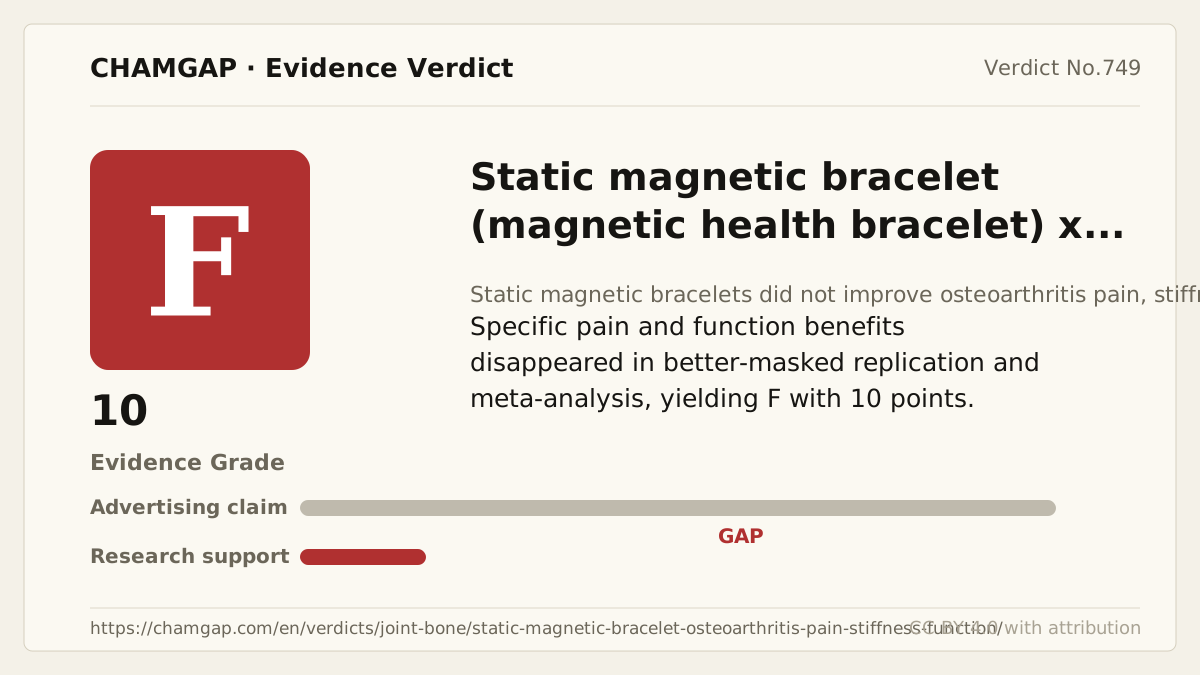
[Chamgap] Static magnetic bracelet x improved knee or hip osteoarthritis symptoms — Evidence Grade F·10. 3 cited sources checked. Source: https://chamgap.com/en/verdicts/joint-bone/static-magnetic-bracelet-osteoarthritis-pain-stiffness-function/ · CC BY 4.0CC BY 4.0 — free to use with attribution; do not distort grades, numbers, or verdict meaning.
What this document does and does not do
Chamgap is an information source. It reports what research has and has not confirmed; it does not tell readers what to take or buy. That decision belongs to readers and, when needed, medical or legal professionals. This verdict reflects literature available up to the search date and may change as new research appears. Nothing here is medical advice.