
Eyes-open single-leg standing for one minute per leg, three times daily, as a stand-alone exercise,
does it really help with Reduced cumulative falls over six months in high-risk adults?
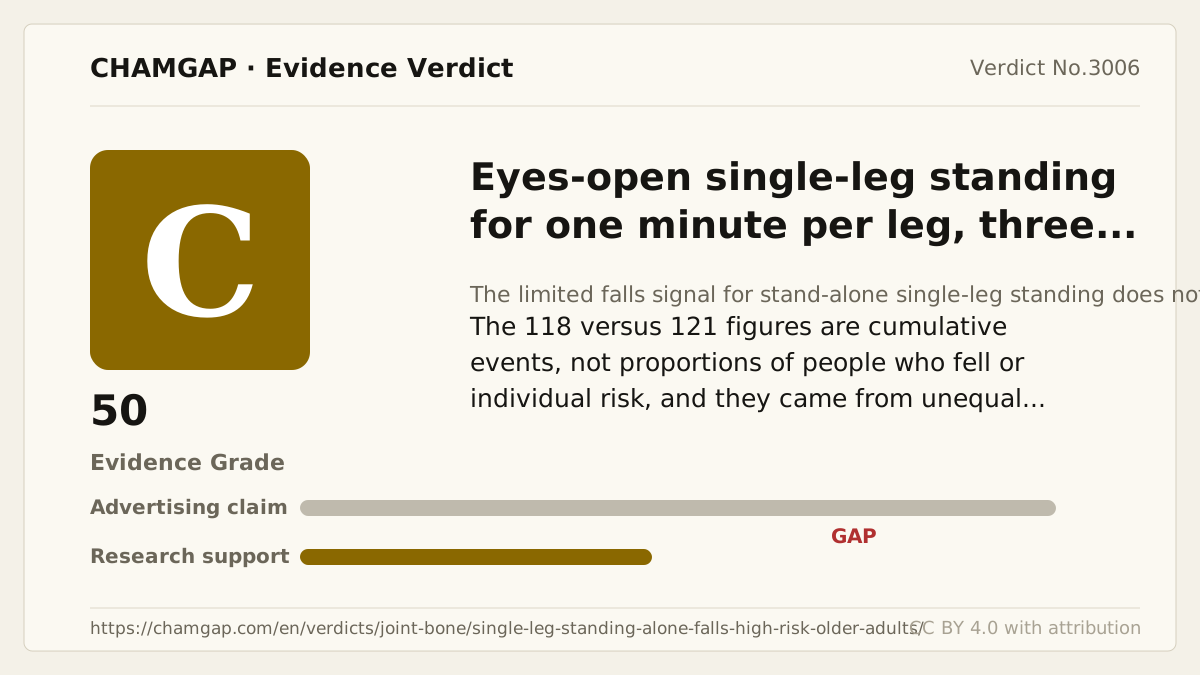
research showsGrade C with 50 points. In a trial with 553 randomized and 527 analyzed, cumulative six-month falls were reported as 118 with exercise and 121 with control, but these were event counts after excluding one recurrent faller from the exercise group. Hip fractures were one versus one, and overall BMD benefit was not reproduced, so the result does not establish fracture prevention or stronger bones.
ads claimThe statement that a few daily minutes of one-leg standing prevents fractures or raises bone density expands a limited falls analysis to null fracture and overall BMD outcomes.
Useful facts when choosing a product
- Unstable high-risk participants were allowed to hold a support bar.
- The 118 versus 121 figures were cumulative fall events, not numbers of fallers.
- Unlike broad balance-and-functional-exercise verdict 1557, this verdict is restricted to the stand-alone single-leg protocol.
Chamgap Semantic Classification Code
Permanent code issued
X.single-leg-standing.behavioral.falls-incidence.reduce.usual-careBehaviors, exposures and policies > Eyes-open single-leg standing for one minute per leg, three times daily, as a stand-alone exercise > Behavioral delivery > Reduced cumulative falls over six months in high-risk adults > Reduction claim > Usual care
Codex retrospectively verified the principal intervention, delivery, population, endpoint, and comparator from the existing reviewed verdict and issued a permanent semantic code. Secondary outcomes on the page are not transferred as separate claims. The code identifies the intervention and claim; it never contains the evidence grade, score, or safety result.
Exact Claim Classification
These independent facets prevent evidence from different forms, routes, populations, effects, and comparators from being mixed.
| Intervention class | X · Behavior, exposure, or policy |
|---|---|
| Canonical ingredient or intervention | Eyes-open single-leg standing for one minute per leg, three times daily, as a stand-alone exercise |
| Source or part used | Plant source not applicable; specified behavior or training |
| Formulation or processing | Eyes-open single-leg standing for one minute per leg, three times daily, as a stand-alone exercise |
| Route | Behavioral delivery |
| Dose | Eyes-open single-leg standing for one minute per leg, three times daily, as a stand-alone exercise |
| Duration | Six months |
| Population | 553 randomized and 527 analyzed, 315 exercise and 212 control |
| Effect or condition | Reduced cumulative falls over six months in high-risk adults |
| Primary endpoint | Cumulative falls and hip fractures |
| Comparator | Usual care |
| Duplicate-detection key | single-leg-standing|behavioral|553 randomized and 527 analyzed, 315 exercise and 212 control|falls-incidence|Six months |
What the research actually shows
Participants stood for one minute per leg three times daily versus no exercise; unstable participants could use a support bar. Evidence from multicomponent balance-and-strength programs was not transferred to this stand-alone exercise.
Why this is classified as C (50)
A hard-event H endpoint is a strength, but R1, I1, unverified effect size EX, and B1 exclusion analysis give C with 50 points.
Counterpoint. One hip fracture in each group and null overall hip BMD do not support extending the falls signal to fracture prevention or stronger bones.
Rejudgment record. Cross-check applied — Separated cumulative event counts from faller risk, fractures, and BMD; incorporated the recurrent-faller exclusion, unequal denominators, and erratum; distinguished the stand-alone prescription from broader verdict 1557
| Endpoint | H | Hard endpoint - actual events such as death |
| Replication | R1 | Single confirmatory trial |
| Independence | I1 | Mixed funding sources |
| Effect size | EX | The clinical size of the effect could not be judged |
Stored derived and displayed grades match; this is not a current recalculation or validity check (C).
Sub-claim grades by effect
This ingredient is marketed for several effects. A single overall grade blends strong and weak claims together, so each effect is graded separately here. The overall grade reflects the strongest disconfirming or core claim.
| Effect (sub-claim) | Grade | Basis |
|---|---|---|
| Reduced cumulative falls over six months | C | A direct event signal is limited by recurrent-faller exclusion and missing effect size and CI. |
| Prevention of hip fracture | D | The key trial was null with one event in each arm. |
| Increased overall hip BMD | D | The independent trial was null overall, with positive findings only in a small age subgroup. |
Cross-check — AI research and Codex final gate
Evidence Table
| Study | Design | Sample | Funding | Endpoint | Result | Weight |
|---|---|---|---|---|---|---|
| Sakamoto K et al. 2006 | Six-month randomized controlled trial | 553 randomized and 527 analyzed, 315 exercise and 212 control | Indexed as non-U.S. government support; specific funding and conflicts unverified | Cumulative falls and hip fractures | Falls 118 versus 121 after excluding one recurrent faller from exercise; fractures 1 versus 1 | Key direct event trial |
| Sakamoto K et al. 2013 | Randomized trial in balance-impaired adults aged at least 75 | 865 analyzed, 410 versus 455 | Specific funding and conflicts unverified; same investigator group as key trial | Fallers and fractures | Positive female faller subgroup; fractures null | Same-group support with erratum qualifier |
| Sakai A et al. 2010 | Randomized controlled trial in postmenopausal women | 94 randomized, 49 versus 45 | Specific funding and conflicts unverified | Six-month hip BMD | Overall hip BMD null; site-specific signals in a small age-70-plus subgroup | Contrary overall BMD evidence |
Receipt — 4 References
Of 4 cited sources, 2 had limited original-page access (blocked or summary-only) and were verified via index/summary, marked partial; the rest were verified at the original page. As of 2026-09-07.
Final verification and publication gate: Codex · Evidence date: 2026-09-07 · Corrections: none
Cite this verdict
[Chamgap] Stand-Alone Single-Leg Standing for Falls—An Exclusion-Sensitive Signal With Null Fracture and Overall BMD Results — Evidence Grade C·50. 4 cited sources checked. Source: https://chamgap.com/en/verdicts/joint-bone/single-leg-standing-alone-falls-high-risk-older-adults/ · CC BY 4.0CC BY 4.0 — free to use with attribution; do not distort grades, numbers, or verdict meaning.
What this document does and does not do
Chamgap is an information source. It reports what research has and has not confirmed; it does not tell readers what to take or buy. That decision belongs to readers and, when needed, medical or legal professionals. This verdict reflects literature available up to the search date and may change as new research appears. Nothing here is medical advice.