
Rhus toxicodendron 30C,
does it really help with Relief of joint pain, stiffness, and weather-related muscle pain?
research showsA 30C preparation is a 1:100 dilution repeated thirty times, leaving statistically no molecules of the starting material in a usual dose. Zero human trials test Rhus tox 30C; the n=36 crossover trial used the different 6X formulation and found no significant difference from placebo in VAS pain, so it cannot be transferred to 30C, and the verdict is ?.
ads claimMarketing matches rainy-day aching or stiffness that loosens with movement to a personalized 30C action. Pattern matching does not demonstrate active material, dose response, or clinical benefit beyond placebo.
Useful facts when choosing a product
- The 30C notation means thirty 1:100 dilutions, so the final dilution factor is 100^30=10^60 and the concentration ratio is 10^-60 (centesimal notation and arithmetic).
- The Avogadro constant is exactly 6.02214076×10^23 mol^-1. Even starting from 1 mol, the expected count at 30C is about 6.02×10^-37 molecules, so no source-material molecule is statistically expected in an ordinary dose (NIST SP 330, SI definition).
Chamgap Semantic Classification Code
Candidate index · review held
K.rhus-toxicodendron-30c-homeopathic-product.UNK.joint-pain-stiffness-and-weather-related-muscle-pain.relieve.placeboFolk and alternative interventions > Rhus toxicodendron 30C homeopathic product > Unknown > joint pain, stiffness, and weather-related muscle pain > Symptom-relief claim > Placebo
An automated migration candidate, not an issued permanent code; exact claim scope remains under review. This machine-generated migration candidate helps retrieval but is not a permanent assignment. The original verdict ID and URL remain authoritative.
What the research actually shows
Shipley 1983, PMID 6129459, tested Rhus tox 6X rather than 30C against fenoprofen and placebo in osteoarthritis; 6X did not differ significantly from placebo. Shang 2005 and Mathie 2017 are broad homeopathy meta-analyses, not direct Rhus tox 30C trials. The larger higher-quality group in Shang was compatible with placebo, and the musculoskeletal and muscle-soreness subgroups in Mathie showed no benefit beyond placebo. None supplies formulation-specific positive evidence for Rhus tox 30C.
Why this is classified as ?
Zero human trials test Rhus tox 30C for joint pain, stiffness, or muscle pain, so the grade is ?. The n=36 study used 6X and was not transferred, while the dilution calculation is a product fact.
Counterpoint. Personal improvement after a dose can be real as an experience without proving a product-specific effect. Depending on the cause, evidence-based options include exercise, physical therapy, weight management, analgesia, or rheumatologic evaluation.
Rejudgment record. New verdict — Separated the 30C dilution as a type-A fact and applied ? because zero human trials test 30C and the n=36 6X crossover trial uses a different formulation that cannot be transferred
Sub-claim grades by effect
This ingredient is marketed for several effects. A single overall grade blends strong and weak claims together, so each effect is graded separately here. The overall grade reflects the strongest disconfirming or core claim.
| Effect (sub-claim) | Grade | Basis |
|---|---|---|
| Relief of joint pain and stiffness | ? | Zero trials test 30C; the n=36 study used 6X and cannot be transferred. |
| Relief of weather-related muscle pain | ? | Zero human trials test 30C for weather-related muscle pain. |
Cross-check — AI research and Codex final gate
Evidence Table
| Study | Design | Sample | Funding | Endpoint | Result | Weight |
|---|---|---|---|---|---|---|
| Shipley M et al. 1983 | Randomized double-blind placebo-controlled crossover trial | Patients with hip or knee osteoarthritis; the exact number was not stated in the PubMed abstract | Inadequately reported | Pain, joint stiffness, and patient preference | Rhus tox 6X did not differ significantly from placebo; only fenoprofen was superior to placebo. | Direct refutation in the product family |
| Shang A et al. 2005 | Comparative meta-analysis of placebo-controlled trials | 110 homeopathy and 110 matched conventional-medicine trials; eight large high-quality homeopathy trials were pivotal | Specific funding was not adequately identified in the verified PubMed record | Clinical effect versus placebo and small-study bias | When restricted to larger higher-quality trials, homeopathy effects were compatible with placebo. | Broad repeated refutation of homeopathy |
| Mathie RT et al. 2017 | Systematic review and meta-analysis of non-individualized homeopathy trials | Fifty-four analyzable trials | Homeopathy-related support including the Homeopathy Research Institute | Placebo-controlled clinical effects by condition and category | The musculoskeletal subgroup was not effective: p=0.488 overall and p=0.762 in higher-quality trials. | Negative musculoskeletal synthesis despite favorable stakeholder context |
Receipt — 3 References
All 3 cited sources were verified for existence at the original page (as of 2026-07-20).
Final verification and publication gate: Codex · Evidence date: 2026-07-20 · Corrections: none
Cite this verdict
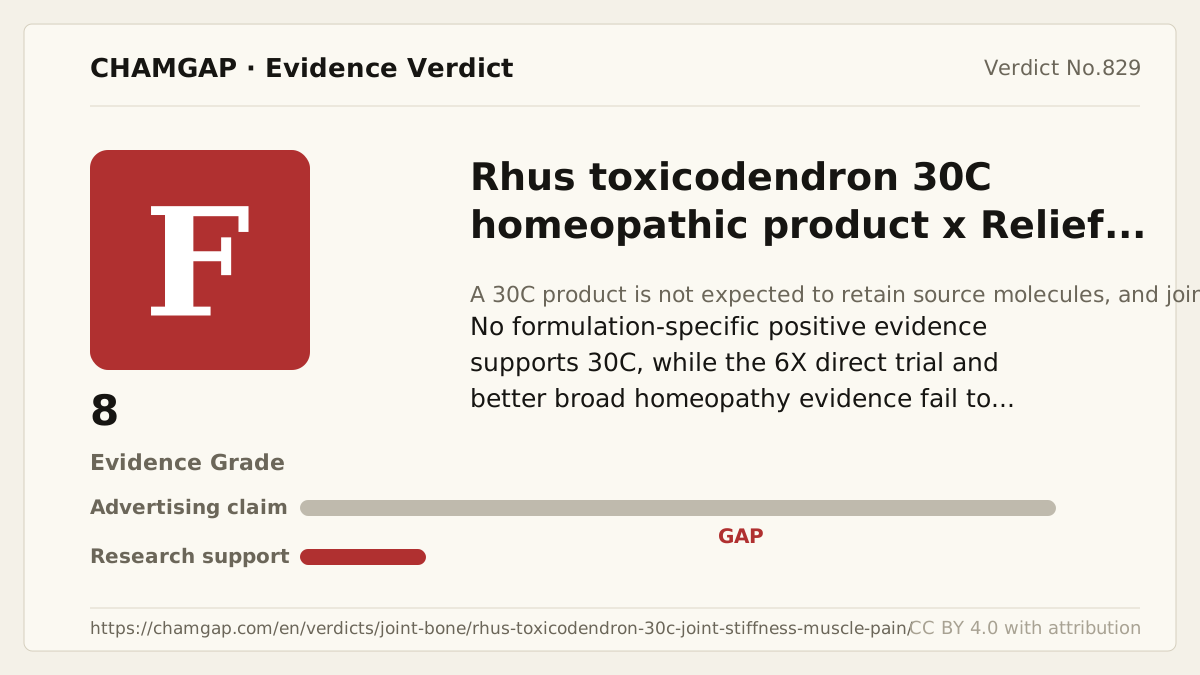
[Chamgap] Rhus toxicodendron 30C x relief of joint pain, stiffness, and muscle pain — Evidence Grade ?. 3 cited sources checked. Source: https://chamgap.com/en/verdicts/joint-bone/rhus-toxicodendron-30c-joint-stiffness-muscle-pain/ · CC BY 4.0CC BY 4.0 — free to use with attribution; do not distort grades, numbers, or verdict meaning.
What this document does and does not do
Chamgap is an information source. It reports what research has and has not confirmed; it does not tell readers what to take or buy. That decision belongs to readers and, when needed, medical or legal professionals. This verdict reflects literature available up to the search date and may change as new research appears. Nothing here is medical advice.