
Raloxifene,
does it really help with Reduced risk of new vertebral fractures in postmenopausal women with osteoporosis?
research showsRaloxifene is rated B because it reduces new vertebral fractures in postmenopausal women with osteoporosis. In the 7,705-participant randomized placebo-controlled MORE trial, three-year new vertebral-fracture rates were 10.1% with placebo, 6.6% with raloxifene 60 mg, and 5.4% with 120 mg, corresponding to relative risks of 0.7 and 0.5. The cumulative benefit persisted at four years, with a relative risk of 0.64 for 60 mg. This is a direct fracture outcome rather than a bone-density surrogate, but total nonvertebral fracture was not significantly reduced at three years, relative risk 0.9, or four years, relative risk 0.93, and hip-fracture prevention is not established. The result is therefore a site-limited B, aligned with ibandronate 922, and distinct from spectrum-wide A ratings for zoledronic acid 711 and risedronate 771. Venous thromboembolism, increased fatal stroke in women at high cardiovascular risk, and hot flashes are major safety issues separate from efficacy.
ads claimMarketing may say fracture prevention without identifying the skeletal site or may add reduced breast-cancer risk to imply broad health protection. The strongest bone claim is reduction of new vertebral fractures; hip and total nonvertebral fracture prevention remain unproven.
Useful facts when choosing a product
- Raloxifene is a prescription SERM used to prevent or treat postmenopausal osteoporosis, and a representative dose is 60 mg once daily with or without food.
- Calcium and vitamin D are supplemented when dietary intake is inadequate, and selection should compare vertebral and hip fracture risk, breast-cancer risk, and thrombotic and stroke risk.
- Current or past deep-vein thrombosis, pulmonary embolism, or retinal-vein thrombosis is a contraindication, and labeling directs discontinuation at least 72 hours before and during prolonged immobilization such as postsurgical recovery or bed rest.
- Hot flashes and leg cramps may occur. Raloxifene increases venous-thromboembolism risk, and increased fatal stroke must be considered in women with coronary disease or high risk of major coronary events.
Chamgap Semantic Classification Code
Candidate index · review held
M.raloxifene.UNK.risk-of-new-vertebral-fractures-with-osteoporosis.reduce.placeboMedicinal interventions > Raloxifene > Unknown > risk of new vertebral fractures with osteoporosis > Reduction claim > Placebo
An automated migration candidate, not an issued permanent code; exact claim scope remains under review. This machine-generated migration candidate helps retrieval but is not a permanent assignment. The original verdict ID and URL remain authoritative.
What the research actually shows
Ettinger and the MORE investigators assigned 7,705 postmenopausal women with osteoporosis to raloxifene 60 mg, 120 mg, or placebo, with calcium and vitamin D in all groups. Among 6,828 women with evaluable radiographs at three years, both doses significantly reduced new vertebral fractures, while nonvertebral fractures did not decrease. Delmas's four-year follow-up preserved the vertebral benefit but remained null for nonvertebral fracture. In 10,101 postmenopausal women at high cardiovascular risk in RUTH, clinical vertebral fractures decreased, but venous thromboembolism and fatal stroke increased, underscoring patient selection. The corpus boundary assigns B to site-limited direct vertebral efficacy such as ibandronate 922 and A to consistent hip and nonvertebral coverage with zoledronic acid 711 and risedronate 771.
Why this is classified as B (77)
MORE directly and consistently reduced new vertebral fractures over three to four years in 7,705 women. The same trial did not significantly reduce nonvertebral fractures, and hip-fracture prevention is not established, yielding a site-limited B with 77 points. This aligns with ibandronate 922 at B and remains distinct from spectrum-wide A ratings for zoledronic acid 711 and risedronate 771. Thromboembolism, fatal stroke, and hot flashes are separate safety judgments.
Counterpoint. A different osteoporosis medicine may be preferable when hip-fracture risk or thrombotic and stroke risk is high, so skeletal-site benefit and safety must be selected together.
Rejudgment record. New verdict — Direct reduction of new vertebral fractures in a large 7,705-participant randomized placebo-controlled trial with persistence at four years, balanced against unproven hip and total nonvertebral fracture reduction and aligned with the corpus B grade for site-limited ibandronate efficacy
Sub-claim grades by effect
This ingredient is marketed for several effects. A single overall grade blends strong and weak claims together, so each effect is graded separately here. The overall grade reflects the strongest disconfirming or core claim.
| Effect (sub-claim) | Grade | Basis |
|---|---|---|
| Reduced risk of new vertebral fractures in postmenopausal women with osteoporosis | B | A 7,705-participant trial significantly reduced the direct fracture endpoint at three years, with persistence at four years. |
| Reduced risk of hip fractures in postmenopausal women with osteoporosis | D | Hip-fracture prevention was not established in the large trials, so the vertebral result cannot be generalized. |
| Reduced risk of total nonvertebral fractures in postmenopausal women with osteoporosis | D | MORE was nonsignificant at both three years, relative risk 0.9, and four years, relative risk 0.93. |
Cross-check — AI research and Codex final gate
Evidence Table
| Study | Design | Sample | Funding | Endpoint | Result | Weight |
|---|---|---|---|---|---|---|
| Ettinger B et al.; MORE Investigators. 1999 | Multinational multicenter randomized blinded placebo-controlled trial | 7,705 postmenopausal women with osteoporosis; 6,828 with three-year radiographic assessment | Eli Lilly commercial raloxifene registration program with company-affiliated coauthors | New radiographic vertebral fractures and nonvertebral fractures | New vertebral fractures were 10.1% with placebo, 6.6% with 60 mg, and 5.4% with 120 mg, while nonvertebral fracture was nonsignificant at a relative risk of 0.9. | Key large direct fracture trial |
| Delmas PD et al.; MORE Investigators. 2002 | Four-year extension analysis of the randomized MORE trial | 7,705 originally randomized participants | Eli Lilly commercial registration program | Cumulative new vertebral and nonvertebral fractures through four years | New vertebral-fracture relative risks were 0.64 with 60 mg and 0.57 with 120 mg, while nonvertebral fracture remained nonsignificant at 0.93. | Confirmation of durability and site limitation |
| Barrett-Connor E et al.; RUTH Trial Investigators. 2006 | Large randomized double-blind placebo-controlled trial | 10,101 postmenopausal women with coronary disease or high coronary risk | Sponsored by Eli Lilly | Cardiovascular and breast-cancer outcomes, clinical vertebral fracture, and serious harms | Clinical vertebral fracture had a hazard ratio of 0.65, while venous thromboembolism increased to 1.44 and fatal stroke to 1.49. | Replication of vertebral benefit in another high-risk population and key safety evidence |
Receipt — 3 References
All 3 cited sources were verified for existence at the original page (as of 2026-07-21).
Final verification and publication gate: Codex · Evidence date: 2026-07-21 · Corrections: none
Cite this verdict
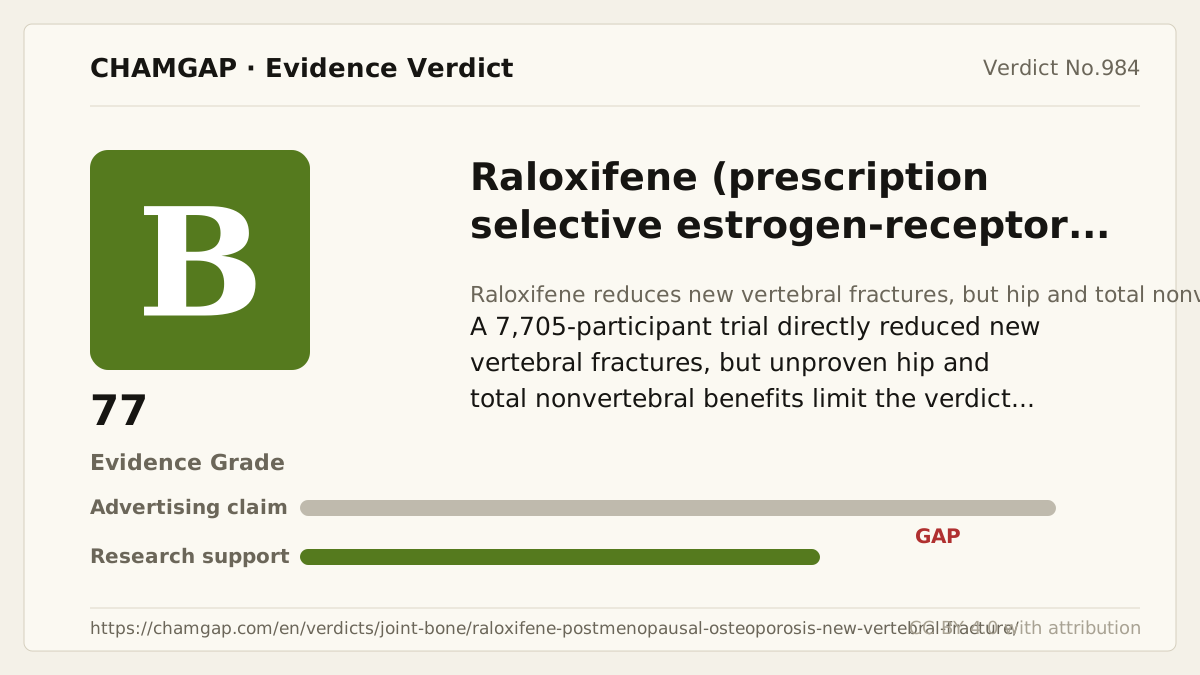
[Chamgap] Raloxifene x reduced new vertebral fractures in postmenopausal osteoporosis — Evidence Grade B·77. 3 cited sources checked. Source: https://chamgap.com/en/verdicts/joint-bone/raloxifene-postmenopausal-osteoporosis-new-vertebral-fracture/ · CC BY 4.0CC BY 4.0 — free to use with attribution; do not distort grades, numbers, or verdict meaning.
What this document does and does not do
Chamgap is an information source. It reports what research has and has not confirmed; it does not tell readers what to take or buy. That decision belongs to readers and, when needed, medical or legal professionals. This verdict reflects literature available up to the search date and may change as new research appears. Nothing here is medical advice.