
Post-hospital individualized home exercise,
does it really help with Improved mobility while reducing falls in older adults?
research showsThe grade is D. Among frail older adults recently discharged or about two months after discharge, Sherrington found 177 versus 123 falls, IRR 1.43 (95% CI 1.07-1.93). FITNESS was null for falls, RR 0.96 (0.67-1.36), and therefore did not replicate the same harm. Because F requires repeated contradiction, the result is D with 34 points.
ads claimImproved mobility and fewer falls are not interchangeable: Sherrington modestly improved mobility while increasing falls. FITNESS must not be cited as repeated fall harm to justify an F grade because its fall outcomes were null.
Useful facts when choosing a product
- The intervention combined ten physiotherapist home visits with individualized balance and leg-strength exercise up to six times weekly for 12 months.
- Both groups received a falls-prevention booklet and usual care.
- No duplicate verdict or matching PMID, DOI, or ACTRN identifier was found.
Chamgap Semantic Classification Code
Candidate index · review held
X.physiotherapist-prescribed-individualized-home-exercise-program-soon-after-hospital-discharge.behavioral.mobility-while-reducing-falls.reduce.UNKBehaviors, exposures and policies > physiotherapist-prescribed individualized home exercise program soon after hospital discharge > Behavioral delivery > mobility while reducing falls > Reduction claim > Unknown
An automated migration candidate, not an issued permanent code; exact claim scope remains under review. This machine-generated migration candidate helps retrieval but is not a permanent assignment. The original verdict ID and URL remain authoritative.
What the research actually shows
Sherrington randomized 340 recently discharged older adults, with fall rate prespecified as a primary outcome; both fall rate and the proportion falling increased. Funding came from Australian NHMRC project grant 457464 and NHMRC fellowships held by Sherrington, Clemson, and Lord. FITNESS enrolled 243 frail older adults about two months after hospital discharge and was funded by the Health Research Council of New Zealand, Auckland University of Technology Research Fund, and a Lenore Wilson Estate bequest. FITNESS was null for falls and increased only non-fall musculoskeletal injury, so it is not independent repeated contradiction.
Why this is classified as D (34)
The publicly funded Sherrington trial clearly found harm (E-) in prespecified fall rate and fallers. FITNESS was null for falls and increased only non-fall musculoskeletal injury, so it did not repeat the same harm. Without the repeated contradiction required for F, R1 gives D with 34 points.
Counterpoint. The performance-mobility improvement in Sherrington was real but must be read with fall harm. Verdict 1834 is A with 86 points; its opposite direction for Otago is explained by timing and population: community-dwelling participants there versus frail older adults recently discharged or about two months after discharge here.
Rejudgment record. Cross-check applied — Endpoint-specific separation of Sherrington's prespecified fall harm from null falls and increased non-fall musculoskeletal injury in FITNESS, supporting R1 rather than repeated contradiction
| Endpoint | H | Hard endpoint - actual events such as death |
| Replication | R1 | Single confirmatory trial |
| Independence | I2 | Decisive evidence is publicly or non-profit funded |
| Effect size | E- | Harm increased in the trials |
| Precision | C0 | The confidence interval leaves room for benefit |
Stored derived and displayed grades match; this is not a current recalculation or validity check (D).
Sub-claim grades by effect
This ingredient is marketed for several effects. A single overall grade blends strong and weak claims together, so each effect is graded separately here. The overall grade reflects the strongest disconfirming or core claim.
| Effect (sub-claim) | Grade | Basis |
|---|---|---|
| Individualized home exercise after discharge reduces falls. | D | Both fall rate and the proportion falling increased significantly. |
| Individualized home exercise after discharge improves performance mobility. | C | Performance improved by 0.13 points, but co-primary outcomes split and falls increased. |
Cross-check — AI research and Codex final gate
Evidence Table
| Study | Design | Sample | Funding | Endpoint | Result | Weight |
|---|---|---|---|---|---|---|
| Sherrington et al., PLoS One 2014 | Parallel-group randomized clinical trial | 340 randomized and analyzed by assigned group (171 exercise, 169 usual care) | Australian NHMRC project grant 457464 and NHMRC fellowships held by Sherrington, Clemson, and Lord | Co-primary: 12-month fall rate, performance mobility, and self-reported mobility | Falls 177 versus 123, IRR 1.43 (95% CI 1.07-1.93); fallers 98/171 versus 70/169, RR 1.38 (1.11-1.73); performance mobility +0.13 points (0.04-0.21); self-reported mobility null | Pivotal registered publicly funded harm trial |
| Latham et al., J Am Geriatr Soc 2003 FITNESS | Randomized home resistance-exercise trial in frail older adults about two months after discharge | 243 randomized; 112 exercise versus 110 attention-control participants in the falls analysis | Health Research Council of New Zealand, Auckland University of Technology Research Fund, and a Lenore Wilson Estate bequest | Falls, time to first fall, and non-fall musculoskeletal injury | Fallers 60/112 versus 64/110; fall rates 1.02 versus 1.07/person-year, RR 0.96 (95% CI 0.67-1.36); first-fall HR 0.97 (0.68-1.37): null for falls. Non-fall musculoskeletal injury 18 versus 5, RR 3.6 (1.5-8.0): only a different endpoint increased | Null falls trial in the same post-discharge population; signal for non-fall musculoskeletal injury |
Receipt — 2 References
All 2 cited sources were verified for existence at the original page (as of 2026-08-14).
Final verification and publication gate: Codex · Evidence date: 2026-08-14 · Corrections: none
Cite this verdict
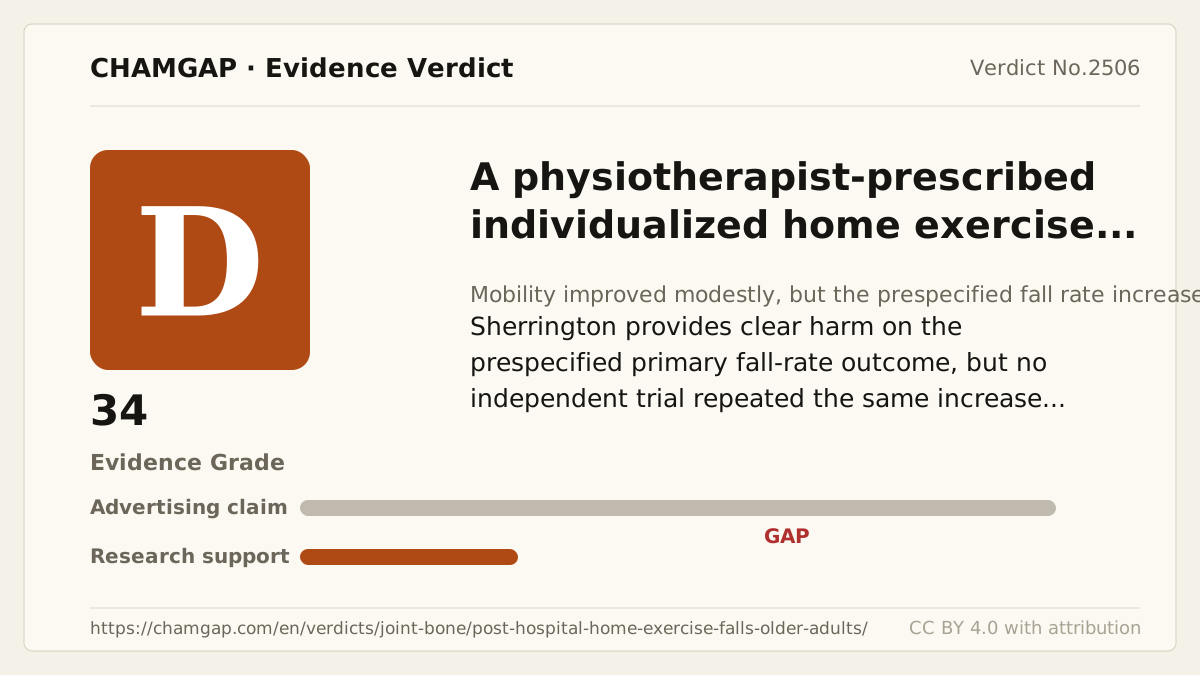
[Chamgap] Post-hospital individualized home exercise x fewer falls in older adults — Evidence Grade D·34. 2 cited sources checked. Source: https://chamgap.com/en/verdicts/joint-bone/post-hospital-home-exercise-falls-older-adults/ · CC BY 4.0CC BY 4.0 — free to use with attribution; do not distort grades, numbers, or verdict meaning.
What this document does and does not do
Chamgap is an information source. It reports what research has and has not confirmed; it does not tell readers what to take or buy. That decision belongs to readers and, when needed, medical or legal professionals. This verdict reflects literature available up to the search date and may change as new research appears. Nothing here is medical advice.