
Low-level laser photobiomodulation,
does it really help with Short-term improvement in pain and WOMAC disability in knee osteoarthritis?
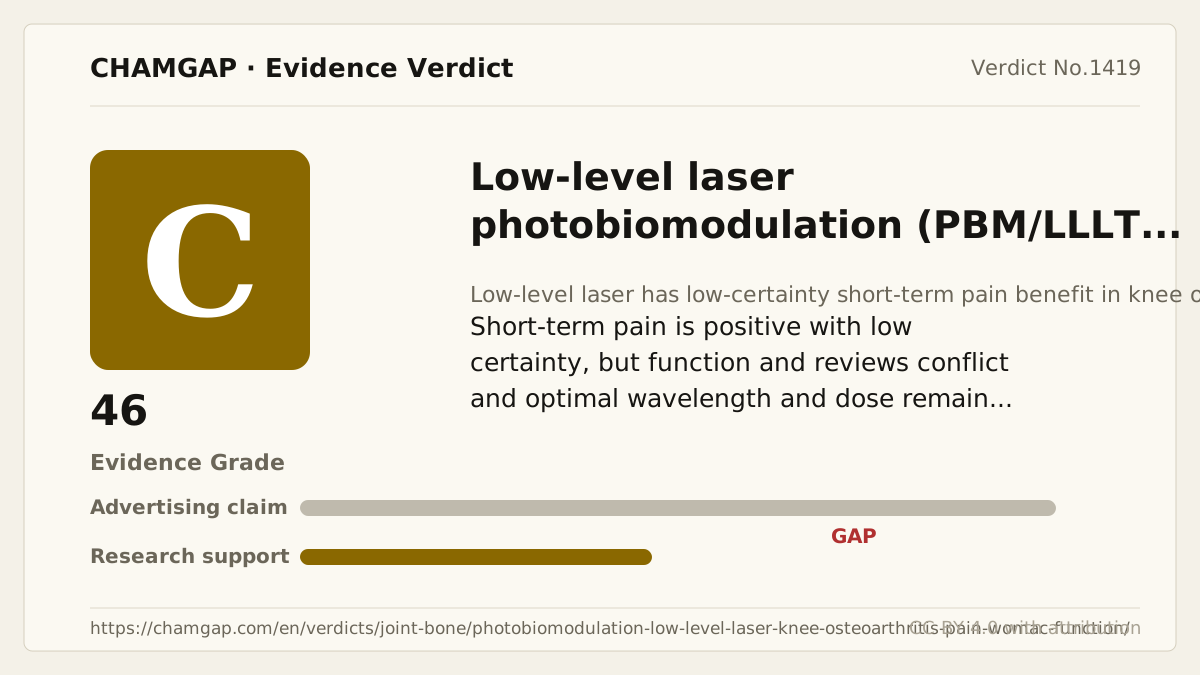
research showsLow-level laser photobiomodulation for knee osteoarthritis is rated C. A 2019 meta-analysis of 22 placebo-controlled trials and 1,063 participants found short-term pain and disability benefit at selected recommended doses, but a 2015 meta-analysis of nine trials and 518 participants was null for pain and WOMAC outcomes. A 2024 network meta-analysis of 13 trials and 673 participants found low-certainty benefit for pain only, not function or stiffness. Limited positive evidence exists, but wavelength and dose dependence and low certainty keep the grade at C.
ads claimMarketing expands red or near-infrared light into cartilage regeneration and disease treatment. Human evidence concerns mainly short-term subjective pain and function, not established structural cartilage regeneration, delayed joint replacement, or durable benefit.
Useful facts when choosing a product
- Photobiomodulation applies red or near-infrared light at near-nonthermal doses and is distinct from pulsed electromagnetic fields and static magnets.
- Trial results depend on wavelength, power, energy per point, application site, and session count, so research devices and home red-light panels are not interchangeable.
- Core knee-osteoarthritis care is exercise, strengthening, weight management, education, and validated analgesia when needed. Eye protection and device-specific contraindications are required.
Chamgap Semantic Classification Code
Candidate index · review held
P.low-level-laser-photobiomodulation.device.short-term-improvement-in-pain-and-womac-disability-in-knee-osteoarthritis.improve.MULTIProcedures, devices and tests > Low-level laser photobiomodulation > Device delivered > Short-term improvement in pain and WOMAC disability in knee osteoarthritis > Improvement claim > Multiple: primary unresolved
An automated migration candidate, not an issued permanent code; exact claim scope remains under review. This machine-generated migration candidate helps retrieval but is not a permanent assignment. The original verdict ID and URL remain authoritative.
What the research actually shows
Stausholm 2019 synthesized 22 randomized placebo-controlled trials with 1,063 participants and reported 14.23 mm more VAS pain reduction at treatment end and 15.92 mm more at one to 12 weeks, with improved disability. Huang 2015 synthesized nine sham-controlled trials with 518 participants and found immediate VAS pain SMD -0.28 (95% CI -0.66 to 0.10), with no significant WOMAC pain, stiffness, or function benefit. Fan 2024 included 13 trials with 673 participants and found pain benefit but not function or stiffness, rating the evidence low or very low certainty.
Why this is classified as C (46)
A placebo-controlled meta-analysis is positive for short-term pain and disability at selected doses, but an earlier meta-analysis was null and the newest network analysis found only low-certainty pain benefit with null function. Limited positive, low-certainty evidence yields C with 46 points.
Counterpoint. It may be tried as an adjunct to standard exercise while tracking short-term pain and function. Lack of meaningful change should prompt discontinuation, and cartilage-regeneration claims must not delay standard care.
Rejudgment record. New verdict — Accepted short-term pain and disability benefit at selected wavelengths and doses in a placebo-controlled randomized-trial meta-analysis, but applied grade C for limited positive evidence after accounting for an earlier null review, null function and stiffness in the latest network analysis, low or very low certainty, and wavelength and dose heterogeneity
Sub-claim grades by effect
This ingredient is marketed for several effects. A single overall grade blends strong and weak claims together, so each effect is graded separately here. The overall grade reflects the strongest disconfirming or core claim.
| Effect (sub-claim) | Grade | Basis |
|---|---|---|
| Short-term pain improvement in knee osteoarthritis | C | Positive in several syntheses of sham-controlled trials, but reviews conflict and current certainty is low. |
| Improved WOMAC disability | C | Some meta-analyses are positive, but the 2015 and 2024 syntheses were null for function. |
| Durable symptom relief and structural cartilage improvement | ? | No reliable clinical trial establishing durable benefit or structural cartilage improvement was identified. |
Cross-check — AI research and Codex final gate
Evidence Table
| Study | Design | Sample | Funding | Endpoint | Result | Weight |
|---|---|---|---|---|---|---|
| Stausholm MB et al. 2019 | Systematic review and meta-analysis of randomized placebo-controlled trials | Twenty-two trials and 1,063 participants | Norwegian academic and public support; some authors disclosed laser-field interests | VAS pain and disability at treatment end and one to 12 weeks | Short-term pain and disability improved versus placebo overall and in recommended-dose subgroups. | Key positive synthesis |
| Huang Z et al. 2015 | Systematic review and meta-analysis of randomized sham-controlled trials | Nine trials and 518 participants | United States NIH and Chinese public research support | Immediate and 12-week VAS and WOMAC outcomes | Pain and WOMAC pain, stiffness, and function were not significantly better than sham. | Conflicting null synthesis |
| Fan T et al. 2024 | Systematic review and network meta-analysis | Thirteen trials and 673 participants | Supported by RISports; no competing interests reported | Pain, function, stiffness, and wavelength comparisons | Overall LLLT was positive for pain but null for function and stiffness, with low or very low certainty. | Recent low-certainty synthesis |
Receipt — 3 References
All 3 cited sources were verified for existence at the original page (as of 2026-07-23).
Final verification and publication gate: Codex · Evidence date: 2026-07-23 · Corrections: none
Cite this verdict
[Chamgap] Low-level laser photobiomodulation x short-term pain and WOMAC function improvement in knee osteoarthritis — Evidence Grade C·46. 3 cited sources checked. Source: https://chamgap.com/en/verdicts/joint-bone/photobiomodulation-low-level-laser-knee-osteoarthritis-pain-womac-function/ · CC BY 4.0CC BY 4.0 — free to use with attribution; do not distort grades, numbers, or verdict meaning.
What this document does and does not do
Chamgap is an information source. It reports what research has and has not confirmed; it does not tell readers what to take or buy. That decision belongs to readers and, when needed, medical or legal professionals. This verdict reflects literature available up to the search date and may change as new research appears. Nothing here is medical advice.