
Vertebroplasty,
does it really help with Pain and functional improvement beyond sham for acute or subacute osteoporotic vertebral compression fractures?
research showsThe claim that percutaneous vertebroplasty improves pain and function beyond sham in acute or subacute osteoporotic compression fractures is rated F. The 2018 Cochrane review analyzed 21 trials, including five sham-controlled trials, and found no clinically important benefit for pain, disability, quality of life, or treatment success. VERTOS IV, designed for acute fractures, likewise found no pain advantage over sham through 12 months. The ASBMR task force concluded that vertebroplasty provides no demonstrable clinically important benefit over placebo or sham for acutely painful fractures. Potential cement leakage, embolism, infection, and adjacent fracture yield 7 points.
ads claimThe mechanical story that cement immediately stabilizes the fracture and removes its pain source is intuitive, but substantial improvement also occurs after sham. Natural recovery, local anesthesia, and procedural care should not be attributed to cement itself.
Useful facts when choosing a product
- Vertebroplasty is an invasive image-guided procedure that places a needle into the vertebral body and injects PMMA; it differs from balloon kyphoplasty.
- Many acute compression fractures improve with time, analgesia, safe early activity, and osteoporosis treatment. Neurologic deficits and alternative causes require separate evaluation.
- Cement can leak outside the vertebra and rarely cause venous pulmonary embolism or neural compression. Infection, bleeding, and anesthesia-related complications can also occur.
- Signals of new adjacent vertebral fractures have been reported. Osteoporosis medication and fall prevention remain important regardless of whether a procedure is performed.
Chamgap Semantic Classification Code
Candidate index · review held
P.percutaneous-vertebroplasty.transdermal.pain-and-functional-improvement-beyond-sham-for-acute-or-subacute-osteoporotic-vertebral-compression-fractures.improve.MULTIProcedures, devices and tests > Percutaneous vertebroplasty > Transdermal > Pain and functional improvement beyond sham for acute or subacute osteoporotic vertebral compression fractures > Improvement claim > Multiple: primary unresolved
An automated migration candidate, not an issued permanent code; exact claim scope remains under review. This machine-generated migration candidate helps retrieval but is not a permanent assignment. The original verdict ID and URL remain authoritative.
What the research actually shows
The 2018 Cochrane review included 21 randomized or quasi-randomized trials and emphasized five sham-controlled comparisons at one month. Mean differences in pain, disability, and quality of life did not reach clinically important thresholds, without a consistent exception by symptom duration. VERTOS IV randomized 180 adults with MRI edema and fractures of up to six to nine weeks to vertebroplasty or local-anesthetic sham. Both groups improved, but pain did not differ. The ASBMR task force similarly found no clinically important placebo-controlled benefit.
Why this is classified as F (7)
Clinically important added pain, functional, or quality-of-life benefit has not been reproduced across sham-controlled trials, and Cochrane and ASBMR reached negative conclusions. Serious invasive harms remain possible, yielding F with 7 points.
Counterpoint. A highly selected patient with severe persistent pain despite optimal conservative management may require specialist multidisciplinary judgment, but that possible exception does not establish general superiority over sham.
Rejudgment record. New verdict — Applied boundary rule ③ because the 2018 Cochrane review of 21 trials including five placebo or sham comparisons, the neutral acute-fracture VERTOS IV trial, the ASBMR finding of no clinically important benefit, and potential harms such as cement leakage, embolism, and infection converge
Sub-claim grades by effect
This ingredient is marketed for several effects. A single overall grade blends strong and weak claims together, so each effect is graded separately here. The overall grade reflects the strongest disconfirming or core claim.
| Effect (sub-claim) | Grade | Basis |
|---|---|---|
| Pain improvement | F | Five sham comparisons and VERTOS IV found no clinically important added pain relief. |
| Improved physical function | F | No important disability or functional advantage over placebo or sham was reproduced. |
| Improved quality of life | F | Neither disease-specific nor overall quality of life showed important benefit beyond sham. |
Cross-check — AI research and Codex final gate
Evidence Table
| Study | Design | Sample | Funding | Endpoint | Result | Weight |
|---|---|---|---|---|---|---|
| Buchbinder R et al. 2018 Cochrane review | Systematic review of randomized and quasi-randomized trials | 21 trials and 2,852 participants, including five placebo or sham trials | Academic Cochrane review | Pain, disability, quality of life, treatment success, new fractures, and serious harms | No clinically important benefit over placebo was found for pain, function, or quality of life. | Key synthesis of repeated sham evidence |
| Firanescu CE et al. 2018 VERTOS IV | Multicenter randomized double-blind sham-controlled trial | 180 adults with acute osteoporotic compression fractures | Stryker and regional research support; investigators reported study independence | Pain from one day to 12 months, quality of life, and disability | Both groups improved, but pain reduction did not differ significantly throughout follow-up. | Direct sham-controlled null result in acute fractures |
| Ebeling PR et al. 2019 ASBMR task force | Task-force report based on systematic review and meta-analysis | Comparative evidence base for vertebral augmentation | American Society for Bone and Mineral Research | Pain, disability, function, quality of life, and harms | Found no demonstrable clinically important benefit over placebo or sham for acutely painful fractures. | Major society's negative assessment |
Receipt — 3 References
All 3 cited sources were verified for existence at the original page (as of 2026-07-23).
Final verification and publication gate: Codex · Evidence date: 2026-07-23 · Corrections: none
Cite this verdict
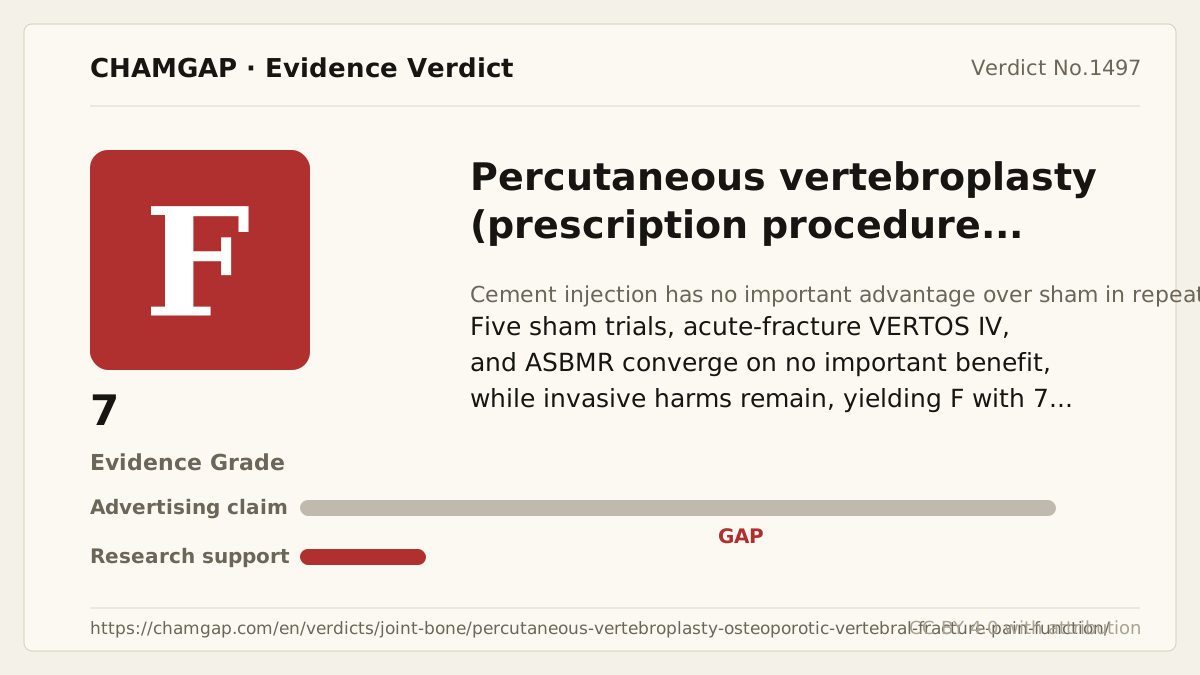
[Chamgap] Vertebroplasty x pain and function in acute or subacute osteoporotic vertebral fractures — Evidence Grade F·7. 3 cited sources checked. Source: https://chamgap.com/en/verdicts/joint-bone/percutaneous-vertebroplasty-osteoporotic-vertebral-fracture-pain-function/ · CC BY 4.0CC BY 4.0 — free to use with attribution; do not distort grades, numbers, or verdict meaning.
What this document does and does not do
Chamgap is an information source. It reports what research has and has not confirmed; it does not tell readers what to take or buy. That decision belongs to readers and, when needed, medical or legal professionals. This verdict reflects literature available up to the search date and may change as new research appears. Nothing here is medical advice.