
Dedicated orthogeriatric comprehensive care,
does it really help with Improved four-month mobility after hip fracture in previously ambulatory older adults?
research showsThe grade is C with 50 points. This publicly funded single-center trial randomized 397 patients, 198 versus 199, and assessed 174 versus 170 at four months. The prespecified primary SPPB score was 5.12 versus 4.38, adjusted difference 0.74 points (95% CI 0.18 to 1.30). The between-group difference was statistically significant, but its standardized magnitude was small (d≈0.28) and fell below the clinical-magnitude criterion. This was a small but real difference.
ads claimThe tested intervention was not a ward label. It integrated geriatric medicine, nursing, physiotherapy, occupational therapy, nutrition, medication review, and discharge planning. Evidence from general hospitalized older adults cannot be relabeled as this hip-fracture pathway.
Useful facts when choosing a product
- Participants were at least 70, community dwelling, and able to walk 10 meters before fracture.
- The pathway admitted patients directly from the emergency department to a dedicated geriatric ward while retaining orthopedic surgical care.
- The 0-to-12 SPPB combines balance, four-meter gait speed, and repeated chair rise.
Chamgap Semantic Classification Code
Candidate index · review held
P.comprehensive-orthogeriatric-care-delivered-immediately-after-admission-in-a-dedicated-geriatric-ward.procedural.mobility-after-hip-fracture-in-previously-ambulatory-older-adults.improve.UNKProcedures, devices and tests > Comprehensive orthogeriatric care delivered immediately after admission in a dedicated geriatric ward > Procedural > mobility after hip fracture in previously ambulatory older adults > Improvement claim > Unknown
An automated migration candidate, not an issued permanent code; exact claim scope remains under review. This machine-generated migration candidate helps retrieval but is not a permanent assignment. The original verdict ID and URL remain authoritative.
What the research actually shows
Prestmo and colleagues used web-based computer block randomization in the emergency department to assign 397 patients to immediate geriatric-ward or usual orthopedic-ward care. NCT00667914 and the prospective protocol specified four-month SPPB as primary, matching the paper, and the main analysis followed intention to treat. Patients and clinicians could not be masked to a ward-level intervention, and assessors were only partly masked; partial assessor unmasking was retained as one avoidable limitation. Funding came from Norwegian public, regional health, hospital, university, research-institute, and municipal sources.
Why this is classified as C (50)
The prospectively registered patient-centered primary endpoint differed significantly between groups, but no validated between-group minimum clinically important difference was available and statistical convention classified the standardized magnitude as small (d≈0.28), giving C with 50 points.
Counterpoint. Verdict 2308 is C with 56 points and pools ward and consultation-team comprehensive geriatric assessment across general hospitalized older adults. This verdict instead tests four-month mobility after hip fracture in previously ambulatory patients.
Rejudgment record. Cross-check applied — Cross-checked randomized and four-month assessment counts, registered primary endpoint, adjusted difference, masking, and funding against the Lancet article, prospective protocol, and NCT00667914
| Endpoint | P | Symptom or function itself is the target - including patient reports and performance tests |
| Replication | R1 | Single confirmatory trial |
| Independence | I2 | Decisive evidence is publicly or non-profit funded |
| Effect size | E~ | Statistically positive but below the threshold |
Stored derived and displayed grades match; this is not a current recalculation or validity check (C).
Sub-claim grades by effect
This ingredient is marketed for several effects. A single overall grade blends strong and weak claims together, so each effect is graded separately here. The overall grade reflects the strongest disconfirming or core claim.
| Effect (sub-claim) | Grade | Basis |
|---|---|---|
| Improved mobility at four months | C | The adjusted SPPB difference was 0.74 points (95% CI 0.18 to 1.30), with a small standardized magnitude (d≈0.28). |
| The same effect in every older adult with hip fracture | ? | The trial was limited to community-dwelling patients able to walk 10 meters before fracture. |
Cross-check — AI research and Codex final gate
Evidence Table
| Study | Design | Sample | Funding | Endpoint | Result | Weight |
|---|---|---|---|---|---|---|
| Prestmo A, Hagen G, Sletvold O, Helbostad JL, Thingstad P, Taraldsen K, Lydersen S, Halsteinli V, Saltnes T, Lamb SE, Johnsen LG, Saltvedt I. 2015 | Single-center parallel-group randomized controlled trial | 397 randomized, 198 versus 199; 344 assessed at four months, 174 versus 170 | Public and academic sources including the Norwegian Research Council, regional health authority, hospital, NTNU, SINTEF, and Trondheim municipality | SPPB mobility score four months after surgery | Mean 5.12 (SE 0.20) versus 4.38 (SE 0.20), adjusted difference 0.74 points (95% CI 0.18 to 1.30), P=0.010 | Single confirmatory trial of a registered patient-centered functional primary endpoint |
Receipt — 1 References
All 1 cited sources were verified for existence at the original page (as of 2026-08-15).
Final verification and publication gate: Codex · Evidence date: 2026-08-15 · Corrections: none
Cite this verdict
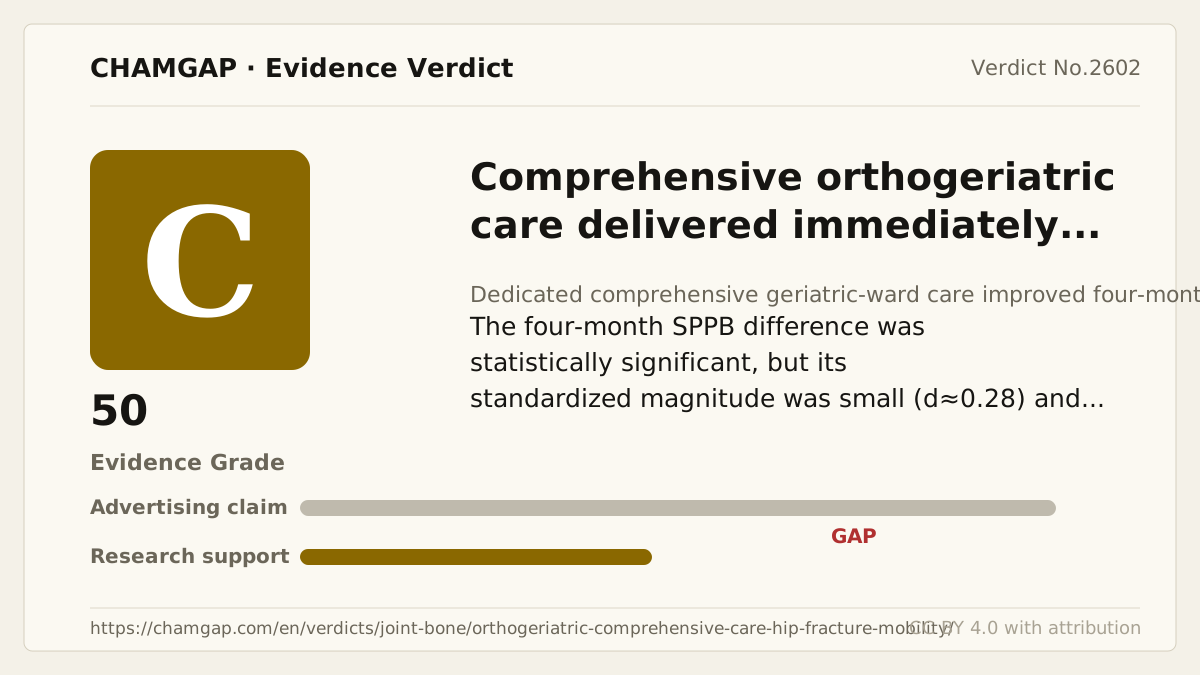
[Chamgap] Dedicated orthogeriatric comprehensive care x mobility after hip fracture — Evidence Grade C·50. 1 cited sources checked. Source: https://chamgap.com/en/verdicts/joint-bone/orthogeriatric-comprehensive-care-hip-fracture-mobility/ · CC BY 4.0CC BY 4.0 — free to use with attribution; do not distort grades, numbers, or verdict meaning.
What this document does and does not do
Chamgap is an information source. It reports what research has and has not confirmed; it does not tell readers what to take or buy. That decision belongs to readers and, when needed, medical or legal professionals. This verdict reflects literature available up to the search date and may change as new research appears. Nothing here is medical advice.