
How does nicotinic acid affect serum urate?
research showsA directly applicable estimate establishing urate lowering in adults selected for hyperuricemia was not confirmed in this review. A high-dose immediate-release (IR) trial reported increased urate, while a different extended-release (ER) trial reported no significant between-group difference. A lower final value with ER 500 mg/day in haemodialysis must be interpreted alongside the control-group rise and reporting inconsistencies; it does not establish prevention or risk of gout attacks.
ads claimThe question is whether single-agent oral nicotinic acid changes serum urate in adults with hyperuricemia. Hyperuricemia is the **proposed population**, not a diagnosis assigned to every retrieved participant. Serum urate is this page’s primary endpoint, separate from the trials’ lipid, glycemic or Lp(a) objectives. Nicotinic acid is distinguished from nicotinamide, NR and NMN. IR, ER and SR preparations, oral versus other routes, pharmacological versus dietary exposure, placebo with low-dose niacin versus zero exposure, usual-care and no-treatment comparators are not pooled. ADMIT excluded hyperuricemia, gout and renal disease. Galal enrolled haemodialysis patients without specifying hyperuricemia as an entry criterion. An elevated group average is not evidence that every individual met that proposed diagnosis. [S02,S03]
Four separate assessment dimensions
| Effect direction and size | A directly applicable estimate establishing urate lowering in adults selected for hyperuricemia was not confirmed in this review. A high-dose immediate-release (IR) trial reported increased urate, while a different extended-release (ER) trial reported no significant between-group difference. A lower final value with ER 500 mg/day in haemodialysis must be interpreted alongside the control-group rise and reporting inconsistencies; it does not establish prevention or risk of gout attacks. |
|---|---|
| Evidence certainty | The proposed S was provisional. The main evidence concerns **pharmacological oral treatment**, including Niacor and NIASPAN, so this document is classified **M (medicinal products)** under the supplied definitions. Dose alone is not an automatic rule and not every B3 product is reclassified. The Galal product’s legal market status is unreported. Existing `joint-bone` navigation and the `URATE / serum-urate` boundary are retained. The codebook `niacin` candidate and `serum-urate` example statuses are preserved; no permanent code, site ID or URL has been minted. **Why grade and score are null:** human urate studies exist, so `no_human_study=false`. Different IR/ER, nonrenal and dialysis results cannot be compressed into one replication axis for urate-lowering efficacy. This is a direction-sensitive concentration question with no confirmed directly eligible estimate in the proposed hyperuricemic population. Supplied rules do not define a valid unified axes/anchor for this scope. `grading_status=not_applicable_or_policy_missing` records that mapping gap; it is not a finding of no effect. The supplied validator returns four errors for the incomplete draft axes. An unguarded call to `derive_grade` returns C, but that invalid-input output is rejected. No unverified code–document contradiction is invented, and missing MCID alone is not used to force EX. The rule locators, validation errors and rejected result are retained in `grading_audit.json`. Bilingual content and declared-scope self-verification are complete. Document quality is **A, self-assessed**, not independent peer review or certification. `reports/TASK-1016.json` is an **unscored effect evidence report**, neither a liver-safety-only report nor a certified native efficacy SSOT. Technical status is `needs_format_mapping`; site identity is unassigned and deployment has not occurred. Codex receives byte/format/identity/build/deployment work only, not paper review, new clinical values or clinical grade selection. |
| Applicability | The question is whether single-agent oral nicotinic acid changes serum urate in adults with hyperuricemia. Hyperuricemia is the **proposed population**, not a diagnosis assigned to every retrieved participant. Serum urate is this page’s primary endpoint, separate from the trials’ lipid, glycemic or Lp(a) objectives. Nicotinic acid is distinguished from nicotinamide, NR and NMN. IR, ER and SR preparations, oral versus other routes, pharmacological versus dietary exposure, placebo with low-dose niacin versus zero exposure, usual-care and no-treatment comparators are not pooled. ADMIT excluded hyperuricemia, gout and renal disease. Galal enrolled haemodialysis patients without specifying hyperuricemia as an entry criterion. An elevated group average is not evidence that every individual met that proposed diagnosis. [S02,S03] |
| Safety | Caution: the current ER label reports increased urate and advises caution in patients predisposed to gout. ADMIT also reports urate-related dose reduction/discontinuation. This does not define one incidence across doses/forms or establish universal safety. Existing liver-safety assessment 3131 is reused without regrading. Safety in pregnancy, children, specific hepatic/renal states and drug combinations is not established by these data. |
This asks about serum-urate direction in proposed hyperuricemic adults. A directly eligible numeric contrast is unconfirmed, and IR/ER and nonrenal/dialysis evidence cannot be combined into one efficacy estimand. Human trials exist, so ? is inappropriate; increases in another population cannot be recoded as lowering benefit E+ or direct target null/harm E0/E-. Supplied rules do not define a valid unified axes profile/anchor for this scope. Only grade and score remain null; content is completed.
Useful facts when choosing a product
- **Caution.** The current DailyMed ER label reports increased urate and advises caution in patients predisposed to gout. It does not supply a mean change, denominator-based incidence or precise exposure period for this warning. No incidence is manufactured. Regulatory warnings are a separate evidence layer and do not establish mg-for-mg equivalence of release forms. [S01] ADMIT required down-titration above595 µmol/L. Diabetic threshold exceedance was3/61 on niacin and1/59 on control, denominators distinct from58/56 in the urate-mean table. One diabetic participant required urate-related dose reduction and none stopped for urate; corresponding nondiabetic counts were four reductions and one discontinuation. Possible gout discontinuation reports are kept separate, without deriving gout incidence, NNT or NNH. [S02] The existing liver-safety assessment3131 and its release-form warnings are reused without re-research or regrading. This page’s urate-scoped Caution label does not downgrade or modify that separate liver Warning. Unreported long-term, pregnancy, pediatric, hepatic/renal or interaction safety is not proven safety. Baseline niacin-deficiency testing, deficiency thresholds and total dietary niacin intake were not adequately reported. Pharmacological trials are not treated as dietary intake or deficiency-correction studies. `nutrition_extraction.json` records chemical/release form, additional and dietary exposure, concurrent vitamins, blood biomarkers versus clinical symptoms, and assay-interference/adverse-event limitations for each study. Lack of an interference assessment is not “no interference.” Trial doses are not personal treatment instructions.
- Unreported deficiency/intake is not proof of adequacy. Pharmacological oral nicotinic acid is not pooled with dietary exposure, nicotinamide, NR or NMN.
Chamgap Semantic Classification Code
Permanent code issued
M.nicotinic-acid.oral-ir-er-release-unconfirmed-strata.serum-urate.change.study-specific-low-dose-placebo-usual-care-no-treatmentMedicines > Nicotinic acid > Oral IR, ER and unconfirmed-release strata > Serum urate concentration > Change > Study-specific low-dose-containing placebo, usual care and no treatment
Technical integration of ChatGPT same-assistant self-verification, not independent clinical verification, journal peer review or certification. Original clinical grade and score remain null. The existing site symbol ? represents an unscored report, not absence of human research or a finding of no effect. Original unassigned/nondeployment statements describe research handoff; technical integration assigned 3132 and URLs. Actual deployment is recorded separately. The code identifies the intervention and claim; it never contains the evidence grade, score, or safety result.
Exact Claim Classification
These independent facets prevent evidence from different forms, routes, populations, effects, and comparators from being mixed.
| Intervention class | M · Medicine |
|---|---|
| Canonical ingredient or intervention | Nicotinic acid |
| Source or part used | Defined chemical intervention rather than an identified plant part; manufacturing origin not inferred. |
| Formulation or processing | Niacor IR up to 3,000 mg/day; 12-week active run-in, then 48 randomized weeks; control tablets partly contained active niacin; NIASPAN ER 1,000 or1,500 mg/day versus placebo,16 weeks; Author-labelled ER niacin500 mg/day plus usual care versus usual care,3 months; Nicotinic acid1.5 g three times daily (4.5 g/day),8-week period versus no treatment |
| Route | Oral |
| Dose | Niacor IR up to 3,000 mg/day; 12-week active run-in, then 48 randomized weeks; control tablets partly contained active niacin; NIASPAN ER 1,000 or1,500 mg/day versus placebo,16 weeks; Author-labelled ER niacin500 mg/day plus usual care versus usual care,3 months; Nicotinic acid1.5 g three times daily (4.5 g/day),8-week period versus no treatment |
| Duration | Niacor IR up to 3,000 mg/day; 12-week active run-in, then 48 randomized weeks; control tablets partly contained active niacin; NIASPAN ER 1,000 or1,500 mg/day versus placebo,16 weeks; Author-labelled ER niacin500 mg/day plus usual care versus usual care,3 months; Nicotinic acid1.5 g three times daily (4.5 g/day),8-week period versus no treatment |
| Population | PAD; 468 randomized, diabetes strata; hyperuricemia, gout and renal disease excluded; Stable type 2 diabetes with dyslipidemia; 148 randomized,146 exposed; gout excluded; Maintenance haemodialysis;53 randomized,50 completers,25 per arm; 13 patients with diabetes and dyslipidemia; randomized crossover |
| Effect or condition | changes in serum urate concentration |
| Primary endpoint | Serum urate concentration; ADMIT plasma/serum boundary retained; not gout attacks |
| Comparator | Niacor IR up to 3,000 mg/day; 12-week active run-in, then 48 randomized weeks; control tablets partly contained active niacin; NIASPAN ER 1,000 or1,500 mg/day versus placebo,16 weeks; Author-labelled ER niacin500 mg/day plus usual care versus usual care,3 months; Nicotinic acid1.5 g three times daily (4.5 g/day),8-week period versus no treatment |
| Duplicate-detection key | R01|nicotinic-acid|oral|URATE|release-and-population-separated |
What the research actually shows
30-second answer — A directly applicable estimate establishing serum-urate lowering in adults selected for hyperuricemia was **not confirmed** in the material reviewed. A high-dose immediate-release (IR) trial reported **increased urate**, whereas a different extended-release (ER) trial reported **no significant between-group difference**. A lower final serum value with ER 500 mg/day in haemodialysis must be interpreted alongside the control-group rise, small sample and reporting inconsistencies. Serum concentration is **not the same endpoint as gout attacks or their prevention**. [S01–S04,S06]
Current assessment: no confirmed directly applicable lowering estimate for the proposed population; the study-specific directions and numbers are disclosed below. Grade and score remain **null**, not zero. The content is `completed_with_uncertainty`, with `completed_with_declared_scope` self-verification. The task is not on hold. Safety label: **Caution**.
1. Question versus observed eligibility — The question is whether single-agent oral nicotinic acid changes serum urate in adults with hyperuricemia. Hyperuricemia is the **proposed population**, not a diagnosis assigned to every retrieved participant. Serum urate is this page’s primary endpoint, separate from the trials’ lipid, glycemic or Lp(a) objectives.
Nicotinic acid is distinguished from nicotinamide, NR and NMN. IR, ER and SR preparations, oral versus other routes, pharmacological versus dietary exposure, placebo with low-dose niacin versus zero exposure, usual-care and no-treatment comparators are not pooled. ADMIT excluded hyperuricemia, gout and renal disease. Galal enrolled haemodialysis patients without specifying hyperuricemia as an entry criterion. An elevated group average is not evidence that every individual met that proposed diagnosis. [S02,S03]
2. Evidence table — | Study / access | Actual population and design | Exposure / comparator / duration | Urate finding | Interpretation | |---|---|---|---|---| | ADMIT 2000 [S02], full article and Table 3 image | PAD; 468 randomized, diabetes strata; hyperuricemia, gout and renal disease excluded | Niacor IR up to 3,000 mg/day; 12-week active run-in, then 48 randomized weeks; control tablets partly contained active niacin | Diabetes: 339→386 versus 333→333 µmol/L. No diabetes: 375→428 versus 380→369. Each between-group p<0.001 | **Increase**, not a direct hyperuricemia-treatment estimate. Screening baseline versus repeated follow-up average; plasma/serum boundary retained | | ADVENT 2002 [S06], full article | Stable type 2 diabetes with dyslipidemia; 148 randomized,146 exposed; gout excluded | NIASPAN ER 1,000 or1,500 mg/day versus placebo,16 weeks | No significant between-group urate differences at any time point; numeric differences, CIs and urate denominator unreported | Nonsignificance does not establish zero or equivalence; not hyperuricemia-selected | | Galal 2025 [S03], full text and PDF visuals | Maintenance haemodialysis;53 randomized,50 completers,25 per arm | Author-labelled ER niacin500 mg/day plus usual care versus usual care,3 months | Mean±SE mg/dL: niacin6.41±0.257→6.05±0.192; control6.07±0.139→7.76±0.288. Source final between-group p=0.001 | **Lower final value**; niacin within-arm p=0.189, control rises. Reporting/registry/co-medication limitations retained | | Garg 1990 [S04], abstract |13 patients with diabetes and dyslipidemia; randomized crossover | Nicotinic acid1.5 g three times daily (4.5 g/day),8-week period versus no treatment | Qualitative plasma-urate increase; numeric result/CI unconfirmed | Release form and baseline hyperuricemia/renal status unconfirmed; not quantitatively pooled |
Two study families supply quantitative urate values and two supply qualitative findings. Multiple links, tables and registrations for one study are not counted as additional trials. These are not four replications of an identical PICOT. [S02–S04,S06]
3. Numbers, denominators and timing — **ADMIT.** Urate Table 3 includes control56/niacin58 with diabetes and control153/niacin162 without diabetes:429 people, not all468 randomized or the glucose denominators. Follow-up is an average across randomized weeks6,12,18,24,36,48; baseline is the first screening value before active run-in. Dispersion is SD. In the comparator,15% of tablets contained50 mg active niacin, averaging about43 mg/day at maximum exposure. It is not zero exposure. Factorial antioxidant vitamins/warfarin and possible nonrandom pravastatin addition in both groups are retained. [S02, Table 3 and Methods]
The raw difference in changes in diabetes is +47 µmol/L, whereas the follow-up-average contrast is +53. Without diabetes, the source change column gives +53 for niacin and −12 for control, yielding +65. The displayed control means give369−380=−11, yielding a displayed-mean difference in changes of+64. The source’s −12 is not silently “corrected.” These arithmetic contrasts are not adjusted longitudinal coefficients or CIs. See C01–C08.
**Galal.** The niacin within-arm change is −0.36 mg/dL and control +1.69. The final-value contrast −1.71 and difference in changes −2.05 are distinct recalculations. The source niacin within-arm p=0.189 is preserved; the printed control p=0.000 is displayed as p<0.001, not exact zero. Baseline between-group p=0.250 and final p=0.001 are Table6 values. Discussion instead prints p=0.000 for the between-group comparison. That is interpreted as p<0.001, not exact zero, and is not silently reconciled with Table6. Dispersion remains SE, not SD. The approximately27.8% control increase is reproducible, but its cause is not established by the study. [S03, Table 6; C09–C13]
Conditional SD recovery, an unadjusted Welch comparison and standardized size were computed from the stated SEs and25 per arm. The resulting p does not reproduce0.001. The methods permit t/Mann–Whitney tests; the urate-specific test and raw data were not confirmed. This is not treated as a proven arithmetic error, nor is the reported p overwritten. The conditional CI is **not a CI reported by the trial**, and the calculation is not a validated MCID or a grade for the proposed hyperuricemic population. [S03; C14–C16]
**ADVENT.** Randomized counts are49 placebo,47 ER1,000 mg and52 ER1,500 mg. Two participants in the1,000 mg arm were unexposed, leaving49/45/52 treated. These are not substitutes for an unreported urate-analysis denominator. Serum chemistry visits were at weeks4,8,12,16. A nonsignificant comparison without an effect/CI is not filled with zero. [S06; C18]
4. Contrary findings, access limits, design and interests — The lower-value/decrease signals were not omitted. **Kang2013 in CKD** surfaced in primary-index/publisher searches with a decrease signal, but the original urate table could not be accessed. Group baseline numbers visible in snippets are not treatment changes. Exact urate changes, release form and relevant co-medications are not imputed; access to the primary table is a revision trigger. [S05]
ADMIT is multicentre, randomized and double-blind, but active-run-in tolerator selection and baseline hyperuricemia exclusion limit applicability. Concealment implementation and registered urate details were not confirmed. NHLBI support was confirmed; not every product-provision or individual disclosure detail was independently resolved. [S02]
ADVENT concerns lipid/glycemic treatment in stable diabetes, with urate as incidental laboratory safety. Statins were continued by69/146 participants; diabetes medication adjustment and pre-dose aspirin were permitted. Kos support, an employee author and some speaker/shareholding relationships are reported. These findings are not re-labelled as independent replicated confirmation. [S06]
Galal is a small single-centre completer analysis with urate a secondary endpoint in the article. Sequence generation, concealment, masking, urate-modifying co-medications, dialysis-relative sampling and residual renal function were not adequately confirmed. Figure1 assigns two deaths to niacin and one to control; Results3.1 reverses them. The total of three agrees, but arm assignment is **conflicting**. The Discussion statement of no serious adverse events is not adopted as zero deaths or proof of safety. Cause of death and drug causality are not established. [S03, Figure1, §3.1, Discussion]
The Galal study reports Princess Nourah bint Abdulrahman University funding, PNURSP2025R419, and the authors declare no commercial conflicts. NCT06406140 is identified in the article; official registry details were inaccessible, so prospective registration, urate prespecification and masking are not asserted. Targeted correction/retraction searches did not locate a notice resolving these issues; that is not certification that no notice exists anywhere. [S03,S08]
5. Safety and nutritional extraction — **Caution.** The current DailyMed ER label reports increased urate and advises caution in patients predisposed to gout. It does not supply a mean change, denominator-based incidence or precise exposure period for this warning. No incidence is manufactured. Regulatory warnings are a separate evidence layer and do not establish mg-for-mg equivalence of release forms. [S01]
ADMIT required down-titration above595 µmol/L. Diabetic threshold exceedance was3/61 on niacin and1/59 on control, denominators distinct from58/56 in the urate-mean table. One diabetic participant required urate-related dose reduction and none stopped for urate; corresponding nondiabetic counts were four reductions and one discontinuation. Possible gout discontinuation reports are kept separate, without deriving gout incidence, NNT or NNH. [S02]
The existing liver-safety assessment3131 and its release-form warnings are reused without re-research or regrading. This page’s urate-scoped Caution label does not downgrade or modify that separate liver Warning. Unreported long-term, pregnancy, pediatric, hepatic/renal or interaction safety is not proven safety.
Baseline niacin-deficiency testing, deficiency thresholds and total dietary niacin intake were not adequately reported. Pharmacological trials are not treated as dietary intake or deficiency-correction studies. `nutrition_extraction.json` records chemical/release form, additional and dietary exposure, concurrent vitamins, blood biomarkers versus clinical symptoms, and assay-interference/adverse-event limitations for each study. Lack of an interference assessment is not “no interference.” Trial doses are not personal treatment instructions.
6. Classification, assessment and completion — The proposed S was provisional. The main evidence concerns **pharmacological oral treatment**, including Niacor and NIASPAN, so this document is classified **M (medicinal products)** under the supplied definitions. Dose alone is not an automatic rule and not every B3 product is reclassified. The Galal product’s legal market status is unreported. Existing `joint-bone` navigation and the `URATE / serum-urate` boundary are retained. The codebook `niacin` candidate and `serum-urate` example statuses are preserved; no permanent code, site ID or URL has been minted.
**Why grade and score are null:** human urate studies exist, so `no_human_study=false`. Different IR/ER, nonrenal and dialysis results cannot be compressed into one replication axis for urate-lowering efficacy. This is a direction-sensitive concentration question with no confirmed directly eligible estimate in the proposed hyperuricemic population. Supplied rules do not define a valid unified axes/anchor for this scope. `grading_status=not_applicable_or_policy_missing` records that mapping gap; it is not a finding of no effect.
The supplied validator returns four errors for the incomplete draft axes. An unguarded call to `derive_grade` returns C, but that invalid-input output is rejected. No unverified code–document contradiction is invented, and missing MCID alone is not used to force EX. The rule locators, validation errors and rejected result are retained in `grading_audit.json`.
Bilingual content and declared-scope self-verification are complete. Document quality is **A, self-assessed**, not independent peer review or certification. `reports/TASK-1016.json` is an **unscored effect evidence report**, neither a liver-safety-only report nor a certified native efficacy SSOT. Technical status is `needs_format_mapping`; site identity is unassigned and deployment has not occurred. Codex receives byte/format/identity/build/deployment work only, not paper review, new clinical values or clinical grade selection.
7. Reuse and revision conditions — All3,131 index records and nine candidate originals were read and compared; no exact independent urate duplicate was identified. Reused IDs are **128,2346,3082,3083,3091,3092,3129,3130,3131**; none was modified. In particular,3092’s study identities and3131’s regulatory material were reused, with new extraction limited to urate.
User/native technical receipts identify R01-049–053 with3125–3129, R01-054 with3130 and R01-055 with3131. Earlier unassigned/unpublished manifests remain historical handoff records. No site URL was directly retested.
Directly eligible hyperuricemia results, the Kang primary table, Galal corrections/raw data/registry history, release/co-medication/sampling details or an applicable scoring policy are revision triggers for a **separately authorized update**, preserving an eventual published ID. This task is complete; no next TASK or server action starts automatically.
Why this is classified as ?
This asks about serum-urate direction in proposed hyperuricemic adults. A directly eligible numeric contrast is unconfirmed, and IR/ER and nonrenal/dialysis evidence cannot be combined into one efficacy estimand. Human trials exist, so ? is inappropriate; increases in another population cannot be recoded as lowering benefit E+ or direct target null/harm E0/E-. Supplied rules do not define a valid unified axes profile/anchor for this scope. Only grade and score remain null; content is completed.
Counterpoint. The lower final value in the ER 500 mg dialysis study and the Kang CKD decrease lead are disclosed. Inaccessible Kang tables, unreported ADVENT numbers and population differences prevent a unified lowering-efficacy estimate.
Rejudgment record. This asks about serum-urate direction in proposed hyperuricemic adults. A directly eligible numeric contrast is unconfirmed, and IR/ER and nonrenal/dialysis evidence cannot be combined into one efficacy estimand. Human trials exist, so ? is inappropriate; increases in another population cannot be recoded as lowering benefit E+ or direct target null/harm E0/E-. Supplied rules do not define a valid unified axes profile/anchor for this scope. Only grade and score remain null; content is completed.
Review performed and remaining limitations
A between-group serum-urate effect and CI for oral nicotinic acid in adults selected for hyperuricemia were not confirmed in the searched material. This is neither a zero effect nor absence of all human research. The CKD paper surfaced with a decrease signal, but its original urate table was inaccessible. Baseline group values in search snippets were not adopted as treatment changes. Three deaths are reported in total, but Figure 1 assigns two to niacin and one to control, whereas Results 3.1 reverses those counts. Drug causality was not established. A conditional Welch calculation from Table 6 means, SEs and 25 per arm does not reproduce the reported p=0.001. The specific test and raw data are unconfirmed; Mann–Whitney is allowed by the methods, so the source value is not silently replaced. NCT06406140 is identified in the paper, but official registry details were inaccessible; timing, prespecification of urate and masking remain unconfirmed. Garg release form, Galal ER brand/manufacturer, relevant co-medications and dialysis sampling timing, and directly eligible quantitative SR-only effects remain unconfirmed. Baseline niacin-deficiency testing, total dietary intake and deficiency-stratified effects were not adequately reported in the material used. Galal Table 6 reports final between-group p=0.001, whereas Discussion prints p=0.000. The evidence table is explicitly tied to Table 6; the Discussion discrepancy is also disclosed, not silently reconciled. This asks about serum-urate direction in proposed hyperuricemic adults. A directly eligible numeric contrast is unconfirmed, and IR/ER and nonrenal/dialysis evidence cannot be combined into one efficacy estimand. Human trials exist, so ? is inappropriate; increases in another population cannot be recoded as lowering benefit E+ or direct target null/harm E0/E-. Supplied rules do not define a valid unified axes profile/anchor for this scope. Only grade and score remain null; content is completed. Only the task ID is assigned. No site ID, URL or permanent semantic code has been reserved.
Evidence Table
| Study | Design | Sample | Funding | Endpoint | Result | Weight |
|---|---|---|---|---|---|---|
| ADMIT 2000 [S02], full article and Table 3 image | PAD; 468 randomized, diabetes strata; hyperuricemia, gout and renal disease excluded | PAD; 468 randomized, diabetes strata; hyperuricemia, gout and renal disease excluded | NHLBI sponsorship is explicit. Niacor/Upsher-Smith is identified; additional product-support terms and individual disclosures are unconfirmed in the accessed text. | Serum urate concentration; ADMIT plasma/serum boundary retained; not gout attacks | PAD trial excluding hyperuricemia, gout and renal disease. IR target up to 3,000 mg/day, 12-week active run-in followed by 48 randomized weeks. Urate in diabetes: 339→386 µmol/L versus 333→333 in control; without diabetes: 375→428 versus 380→369. Each between-group p<0.001. These compare screening baseline with an average over follow-up visits; not all specimens can be confirmed as serum. | **Increase**, not a direct hyperuricemia-treatment estimate. Screening baseline versus repeated follow-up average; plasma/serum boundary retained |
| ADVENT 2002 [S06], full article | Stable type 2 diabetes with dyslipidemia; 148 randomized,146 exposed; gout excluded | Stable type 2 diabetes with dyslipidemia; 148 randomized,146 exposed; gout excluded | Kos Pharmaceuticals funding and employee authorship; speaker-bureau relationships/small stock holding disclosed. | Serum urate concentration; ADMIT plasma/serum boundary retained; not gout attacks | Stable type 2 diabetes with dyslipidemia; ER 1,000/1,500 mg/day versus placebo for 16 weeks. The article reports no significant urate differences between groups at any time point. Urate differences, CIs and endpoint denominators are unreported; this does not establish an effect of 0 or equivalence. | Nonsignificance does not establish zero or equivalence; not hyperuricemia-selected |
| Galal 2025 [S03], full text and PDF visuals | Maintenance haemodialysis;53 randomized,50 completers,25 per arm | Maintenance haemodialysis;53 randomized,50 completers,25 per arm | Princess Nourah Bint Abdulrahman University project PNURSP2025R419; authors declare no commercial/financial conflicts. | Serum urate concentration; ADMIT plasma/serum boundary retained; not gout attacks | Maintenance haemodialysis: ER 500 mg/day plus usual care versus usual care for 3 months, 25 completers per arm. Mean±SE: niacin 6.41±0.257→6.05±0.192 mg/dL; control 6.07±0.139→7.76±0.288. The final between-group difference of −1.71 mg/dL is recalculated; source p=0.001. The niacin within-arm change is −0.36, p=0.189, while control rises +1.69. Conflicting death allocation and conditional test-reproduction limits are retained. Table 6 p=0.001 also differs from Discussion p=0.000; the discrepancy is disclosed without alteration. | **Lower final value**; niacin within-arm p=0.189, control rises. Reporting/registry/co-medication limitations retained |
| Garg 1990 [S04], abstract | 13 patients with diabetes and dyslipidemia; randomized crossover | 13 patients with diabetes and dyslipidemia; randomized crossover | Funding: inaccessible full text | Serum urate concentration; ADMIT plasma/serum boundary retained; not gout attacks | The abstract of a crossover trial in 13 patients with diabetes and dyslipidemia reports increased plasma urate with 4.5 g/day for 8 weeks. Numeric urate results and release form were not confirmed; no quantitative pooling is performed. | Release form and baseline hyperuricemia/renal status unconfirmed; not quantitatively pooled |
Receipt — 13 References
Evidence access cutoff: 2026-09-16. Each citation states its actual access level (full-text transcription, abstract, index, or other) and remaining limitations. Bibliographic checking does not certify the study results or treatment efficacy.
Technical integration by: Codex · Evidence date: 2026-09-16 · Corrections: none
Cite this verdict
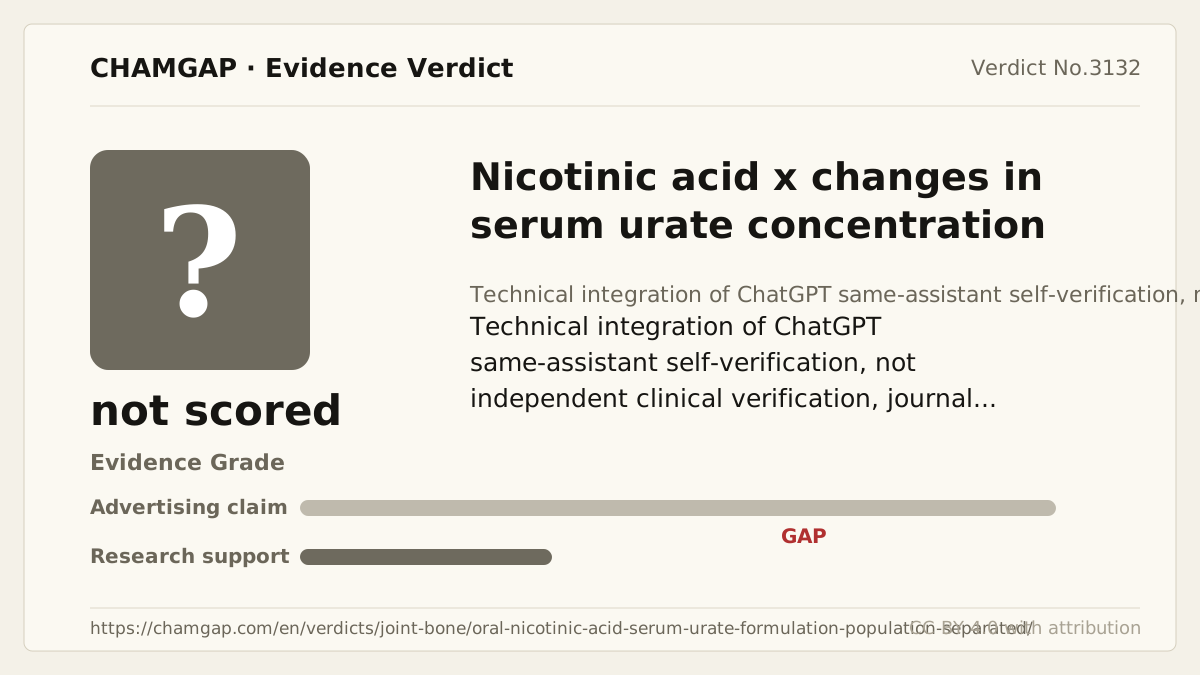
[Chamgap] How does nicotinic acid affect serum urate? — Evidence Grade ?. 13 cited sources checked. Source: https://chamgap.com/en/verdicts/joint-bone/oral-nicotinic-acid-serum-urate-formulation-population-separated/ · CC BY 4.0CC BY 4.0 — free to use with attribution; do not distort grades, numbers, or verdict meaning.
What this document does and does not do
Chamgap is an information source. It reports what research has and has not confirmed; it does not tell readers what to take or buy. That decision belongs to readers and, when needed, medical or legal professionals. This verdict reflects literature available up to the search date and may change as new research appears. Nothing here is medical advice.