
Nursing-home physical restraints,
does it really help with The claim that physical restraints prevent falls and fall-related fractures?
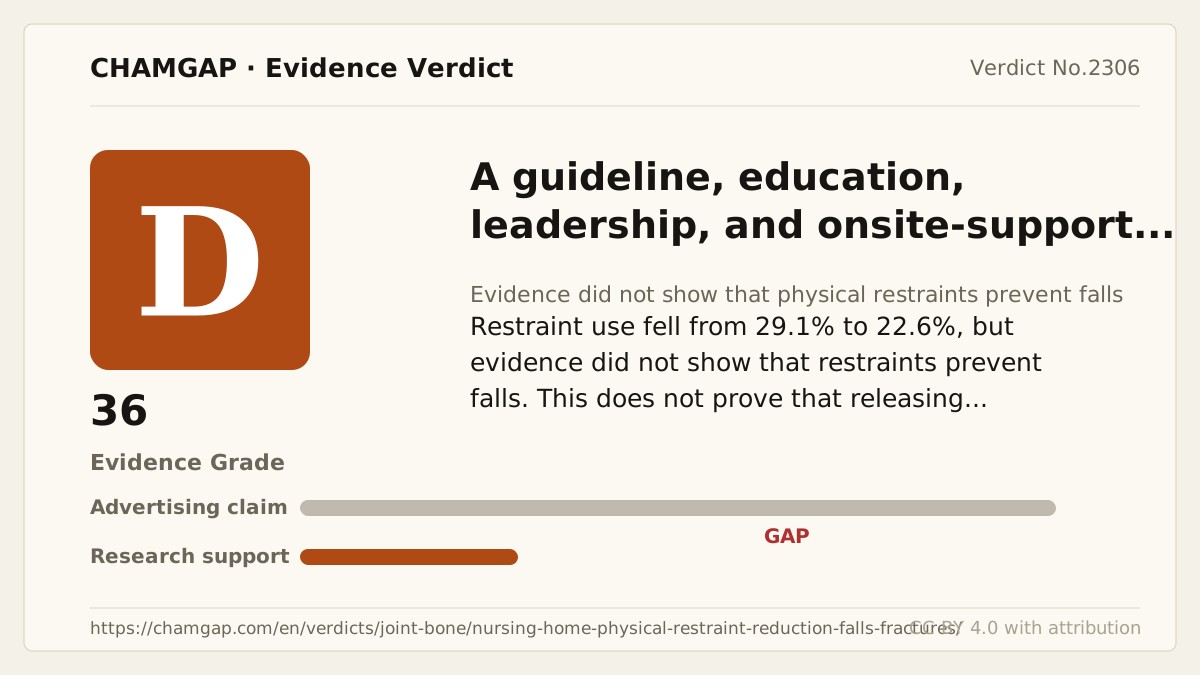
research showsThe grade is D. In the Kopke cluster trial, restraint use at six months fell to 423/1,868 residents (22.6%) in intervention facilities versus 525/1,802 (29.1%) in controls. During follow-up, at least one fall occurred in 528/2,283 (23.1%) versus 565/2,166 (26.1%), and fall-related fracture in 32/2,283 (1.4%) versus 40/2,166 (1.9%), with neither difference significant. This does not support the claim that restraints prevent falls, but it does not prove that releasing restraints is always safe.
ads claimThe custom that residents must be restrained to prevent falls was not supported. A null prevention result must not be enlarged into proof that restraint release is risk-free in every resident.
Useful facts when choosing a product
- Randomization involved 36 facilities or independently operating units, not individual residents.
- Restraint use at six months was 22.6% versus 29.1%, showing that the intervention changed practice.
- Falls and fractures were analyzed with facility clustering accounted for.
Chamgap Semantic Classification Code
Candidate index · review held
X.guideline.behavioral.the-claim-that-physical-restraints-prevent-falls-and-fall-related-fractures.prevent.UNKBehaviors, exposures and policies > guideline > Behavioral delivery > The claim that physical restraints prevent falls and fall-related fractures > Occurrence-prevention claim > Unknown
An automated migration candidate, not an issued permanent code; exact claim scope remains under review. This machine-generated migration candidate helps retrieval but is not a permanent assignment. The original verdict ID and URL remain authoritative.
What the research actually shows
Thirty-six German nursing homes or independently operating units were randomized for six months, 18 per group. The intervention combined a 290-page guideline, a 90-minute staff program, leadership endorsement, trained key nurses with structured support, and printed materials. Controls also received three brochures and a short presentation on restraints and alternatives. Random-effects models accounted for facility clustering. Masked external observers assessed restraint use, but falls and fractures were secondary outcomes prospectively collected through routine facility records; masking for their assessment could not be verified. Restraint use was 423/1,868 (22.6%) versus 525/1,802 (29.1%).
Why this is classified as D (34)
A well-conducted single cluster trial with successful restraint reduction found null fall and fracture differences but did not exclude important benefit, giving D with 34 points.
Counterpoint. Falls were secondary outcomes in a trial powered primarily for restraint use, not a precision trial of the claim that restraints prevent falls.
Rejudgment record. Cross-check applied — The achieved reduction in restraint use, cluster-adjusted absolute fall and fracture results, and separate masking roles were verified
| Endpoint | H | Hard endpoint - actual events such as death |
| Replication | R1 | Single confirmatory trial |
| Independence | I2 | Decisive evidence is publicly or non-profit funded |
| Effect size | E0 | Null |
| Precision | C0 | The confidence interval leaves room for benefit |
Stored derived and displayed grades match; this is not a current recalculation or validity check (D).
Sub-claim grades by effect
This ingredient is marketed for several effects. A single overall grade blends strong and weak claims together, so each effect is graded separately here. The overall grade reflects the strongest disconfirming or core claim.
| Effect (sub-claim) | Grade | Basis |
|---|---|---|
| Physical restraints prevent falls | D | Rates were 23.1% versus 26.1%, without a significant difference. |
| Physical restraints prevent fall-related fractures | D | Rates were 1.4% versus 1.9%, without a significant difference. |
Cross-check — AI research and Codex final gate
Evidence Table
| Study | Design | Sample | Funding | Endpoint | Result | Weight |
|---|---|---|---|---|---|---|
| Kopke et al. 2012 | Six-month cluster randomized trial in 36 nursing homes | 3,771 at baseline; 4,449 observed; 2,283 versus 2,166 in fall analyses | Public funding from the German Federal Ministry of Education and Research | Restraint use at six months and residents with falls or fall-related fractures during follow-up | Restraints 22.6% versus 29.1%; falls 23.1% versus 26.1%, OR 0.85 (0.60 to 1.21); fractures 1.4% versus 1.9%, OR 0.76 (0.42 to 1.38) | Pivotal cluster-randomized evidence |
Receipt — 1 References
All 1 cited sources were verified for existence at the original page (as of 2026-08-05).
Final verification and publication gate: Codex · Evidence date: 2026-08-05 · Corrections: none
Cite this verdict
[Chamgap] Nursing-home physical restraints x falls and fractures — Evidence Grade D·34. 1 cited sources checked. Source: https://chamgap.com/en/verdicts/joint-bone/nursing-home-physical-restraint-reduction-falls-fractures/ · CC BY 4.0CC BY 4.0 — free to use with attribution; do not distort grades, numbers, or verdict meaning.
What this document does and does not do
Chamgap is an information source. It reports what research has and has not confirmed; it does not tell readers what to take or buy. That decision belongs to readers and, when needed, medical or legal professionals. This verdict reflects literature available up to the search date and may change as new research appears. Nothing here is medical advice.