
Nonfermented milk,
does it really help with Prevention of total and hip fractures in adults?
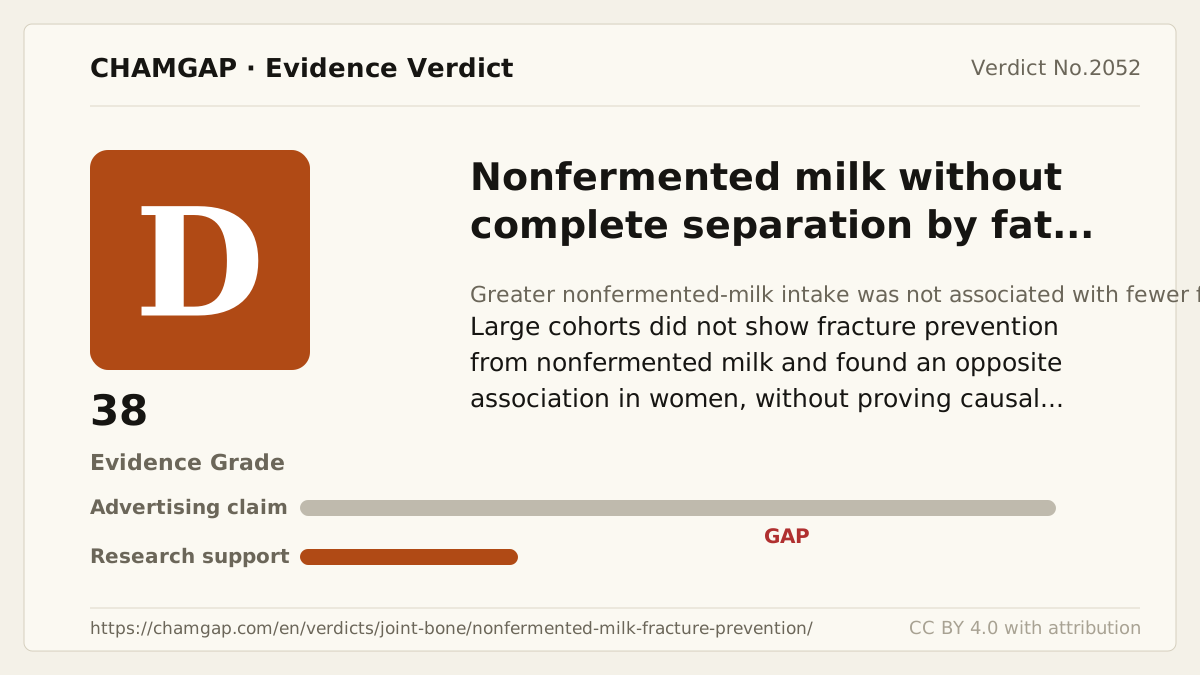
research showsThe grade is D with 34 points. Prospective cohorts of 61,433 Swedish women and 45,339 men found no reduction in fractures with greater milk intake. In women, each additional 200 g/day was associated with a 9% higher hip-fracture hazard; estimates in men were null. Observational data cannot establish that milk causes fractures.
ads claimCalcium content does not itself establish fracture prevention. Verdict 1997 is D with 28 points and concerns whole full-fat yogurt and bone-metabolism markers, a different intervention and outcome.
Useful facts when choosing a product
- The study defined one glass as 200 g of nonfermented milk and mainly contrasted less than one with at least three glasses daily; effects were not fully separated by fat content.
- USDA data for generic whole milk per 244 g cup list about 276 mg calcium, 11.7 g carbohydrate, 4.6 g saturated fat, and 24 mg cholesterol. These are not direct measurements of the Swedish cohort's milk.
- Women had two exposure assessments, but an analysis uniformly excluding the first years of events was not confirmed in the publicly checked material.
- Verdict 1997 concerns full-fat yogurt and bone markers, and verdict 249 concerns isolated milk basic protein and bone markers; neither duplicates actual fracture events.
Chamgap Semantic Classification Code
Candidate index · review held
F.nonfermented-milk-without-complete-separation-by-fat-content.food.total-and-hip-fractures.prevent.UNKFoods and beverages > Nonfermented milk without complete separation by fat content > Food consumption > total and hip fractures > Occurrence-prevention claim > Unknown
An automated migration candidate, not an issued permanent code; exact claim scope remains under review. This machine-generated migration candidate helps retrieval but is not a permanent assignment. The original verdict ID and URL remain authoritative.
What the research actually shows
The Swedish Mammography Cohort recorded 17,252 fractures, including 4,259 hip fractures, among 61,433 women. The Cohort of Swedish Men recorded 5,066 fractures, including 1,166 hip fractures, among 45,339 men. Women had repeated food-frequency assessment, men baseline assessment, and outcomes came from national registers. Correlation with diet records was about 0.7 for total milk, but item-specific values were 0.33 for whole milk and 0.64 for low-fat milk. About 54.8% of invitees were absent from the analysis, a substantial selection exclusion, and multiple comparisons across exposures, sexes, endpoints, and sensitivity analyses were not adjusted. Public Swedish funding was reported, without dairy-industry support.
Why this is classified as D (34)
Large publicly funded cohort data did not show a preventive association, but no validated benefit boundary exists and selection exclusion, unadjusted multiple comparisons, and reverse causation prevent causal refutation, giving D with 34 points.
Counterpoint. D does not deny milk's calcium content or convert the female association into proven causal harm.
Rejudgment record. Cross-check applied — Sex-specific hazard ratios, event counts, repeated exposure assessment, reverse-causation checks, and funding were verified in the original report
| Endpoint | H | Hard endpoint - actual events such as death |
| Replication | R1 | Single confirmatory trial |
| Independence | I2 | Decisive evidence is publicly or non-profit funded |
| Effect size | E0 | Null |
| Precision | C0 | The confidence interval leaves room for benefit |
Stored derived and displayed grades match; this is not a current recalculation or validity check (D).
Sub-claim grades by effect
This ingredient is marketed for several effects. A single overall grade blends strong and weak claims together, so each effect is graded separately here. The overall grade reflects the strongest disconfirming or core claim.
| Effect (sub-claim) | Grade | Basis |
|---|---|---|
| Greater nonfermented milk intake prevents total and hip fractures | D | Neither large sex-specific cohort supported a preventive association. |
Cross-check — AI research and Codex final gate
Evidence Table
| Study | Design | Sample | Funding | Endpoint | Result | Weight |
|---|---|---|---|---|---|---|
| Michaëlsson K et al. 2014 Swedish cohorts | Two large prospective cohorts | 61,433 women with 17,252 fractures, 4,259 hip; 45,339 men with 5,066 fractures, 1,166 hip | Public Swedish funding including the Swedish Research Council; no dairy-industry funding reported | Any fracture and hip fracture | Per 200 g/day, women HR 1.02 (1.00-1.04) and 1.09 (1.05-1.13); men 1.01 (0.99-1.03) and 1.03 (0.99-1.07) | Actual fracture events from observational evidence |
Receipt — 2 References
All 2 cited sources were verified for existence at the original page (as of 2026-08-03).
Final verification and publication gate: Codex · Evidence date: 2026-08-03 · Corrections: none
Cite this verdict
[Chamgap] Nonfermented milk x fracture prevention — Evidence Grade D·34. 2 cited sources checked. Source: https://chamgap.com/en/verdicts/joint-bone/nonfermented-milk-fracture-prevention/ · CC BY 4.0CC BY 4.0 — free to use with attribution; do not distort grades, numbers, or verdict meaning.
What this document does and does not do
Chamgap is an information source. It reports what research has and has not confirmed; it does not tell readers what to take or buy. That decision belongs to readers and, when needed, medical or legal professionals. This verdict reflects literature available up to the search date and may change as new research appears. Nothing here is medical advice.