
Neck-mounted smartphone holder,
does it really help with Reduced nonspecific neck pain and disability in adults with heavy smartphone use?
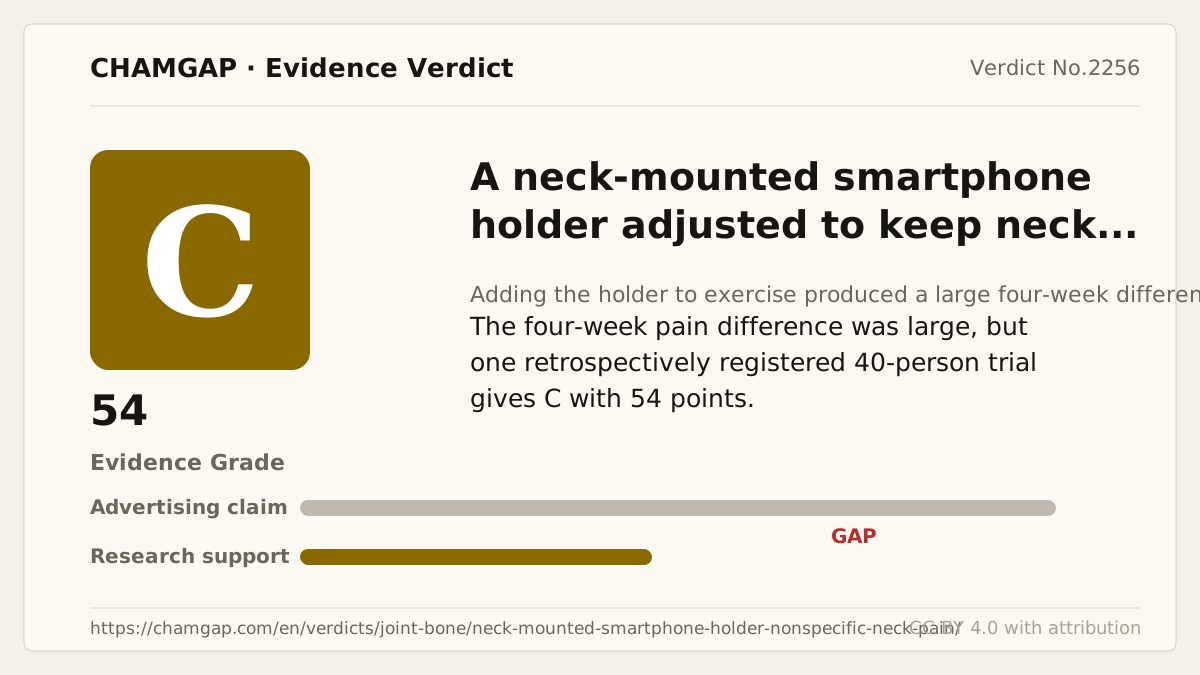
research showsThe grade is C. In a 40-person trial, pain after four weeks was 2.35 points lower on a 0-10 scale with holder plus exercise than with exercise alone, 95% CI 1.76-2.94 points lower. The difference was large, but this was one very small short trial without a sham holder; participants and assessors knew treatment, and actual holder adherence was not measured.
ads claimThe holder can physically raise a phone to eye level, but that adjustment does not by itself establish durable pain treatment. The observed benefit applies to four weeks with concurrent exercise.
Useful facts when choosing a product
- Kinovea was used to adjust the holder to 0-15 degrees of neck flexion and eye-level viewing.
- Instructions limited use to 25 minutes per session, three to four times daily, but actual adherence was not monitored.
- Both groups received 12 strengthening and stretching sessions over four weeks.
Chamgap Semantic Classification Code
Candidate index · review held
X.neck-mounted-smartphone-holder-adjusted-to-keep-neck-flexion-at-0-15-degrees.behavioral.nonspecific-neck-pain-and-disability-with-heavy-smartphone-use.reduce.MULTIBehaviors, exposures and policies > neck-mounted smartphone holder adjusted to keep neck flexion at 0-15 degrees > Behavioral delivery > nonspecific neck pain and disability with heavy smartphone use > Reduction claim > Multiple: primary unresolved
An automated migration candidate, not an issued permanent code; exact claim scope remains under review. This machine-generated migration candidate helps retrieval but is not a permanent assignment. The original verdict ID and URL remain authoritative.
What the research actually shows
Forty adults aged 18-45 with nonspecific neck pain were allocated by sealed envelopes to holder plus exercise or exercise alone, 20 per arm, and all completed 12 sessions and four-week assessment. Pain was 1.65±0.81 versus 4.00±0.94, difference -2.35, 95% CI -2.94 to -1.76. NCT06767098 was submitted on January 5, 2025, after the November 25, 2024 study start, so registration was retrospective. The paper reported no specific public, commercial, or nonprofit grant. Whether a manufacturer provided or supported the device was not stated in the paper. Holder adherence was not monitored.
Why this is classified as C (50)
A large randomized pain and disability difference is limited by a 40-person, four-week, unblinded, no-sham design, giving C with 50 points.
Counterpoint. This was an add-on to exercise, not holder monotherapy, and neither durability nor equivalence across products was tested.
Rejudgment record. Cross-check applied — Verified the between-group pain estimate and table SDs, rejected transfer of a within-person change threshold, and incorporated small-sample, short, unblinded, active-control limitations
| Endpoint | P | Symptom or function itself is the target - including patient reports and performance tests |
| Replication | R1 | Single confirmatory trial |
| Independence | I1 | Mixed funding sources |
| Effect size | E+ | Meets the clinically important threshold |
Stored derived and displayed grades match; this is not a current recalculation or validity check (C).
Sub-claim grades by effect
This ingredient is marketed for several effects. A single overall grade blends strong and weak claims together, so each effect is graded separately here. The overall grade reflects the strongest disconfirming or core claim.
| Effect (sub-claim) | Grade | Basis |
|---|---|---|
| Reduced neck pain at four weeks | C | The difference was -2.35 points in a small unblinded trial. |
| Reduced disability at four weeks | C | The NBQ difference was -14.85 points. |
| Durable pain treatment | ? | There was no long-term follow-up beyond four weeks. |
Cross-check — AI research and Codex final gate
Evidence Table
| Study | Design | Sample | Funding | Endpoint | Result | Weight |
|---|---|---|---|---|---|---|
| Mohamed Abdel Moneim et al. 2025 | Single-center randomized active-control trial | 40 randomized and analyzed, 20 per arm | No specific public, commercial, or nonprofit grant reported | Four-week NPRS pain and NBQ disability | NPRS 1.65±0.81 versus 4.00±0.94, difference -2.35, 95% CI -2.94 to -1.76 | Large direct effect from a small retrospectively registered trial |
Receipt — 3 References
All 3 cited sources were verified for existence at the original page (as of 2026-08-05).
Final verification and publication gate: Codex · Evidence date: 2026-08-05 · Corrections: none
Cite this verdict
[Chamgap] Neck-mounted smartphone holder x nonspecific neck pain — Evidence Grade C·50. 3 cited sources checked. Source: https://chamgap.com/en/verdicts/joint-bone/neck-mounted-smartphone-holder-nonspecific-neck-pain/ · CC BY 4.0CC BY 4.0 — free to use with attribution; do not distort grades, numbers, or verdict meaning.
What this document does and does not do
Chamgap is an information source. It reports what research has and has not confirmed; it does not tell readers what to take or buy. That decision belongs to readers and, when needed, medical or legal professionals. This verdict reflects literature available up to the search date and may change as new research appears. Nothing here is medical advice.