
Naproxen,
does it really help with Improvement of pain and function in knee or hip osteoarthritis?
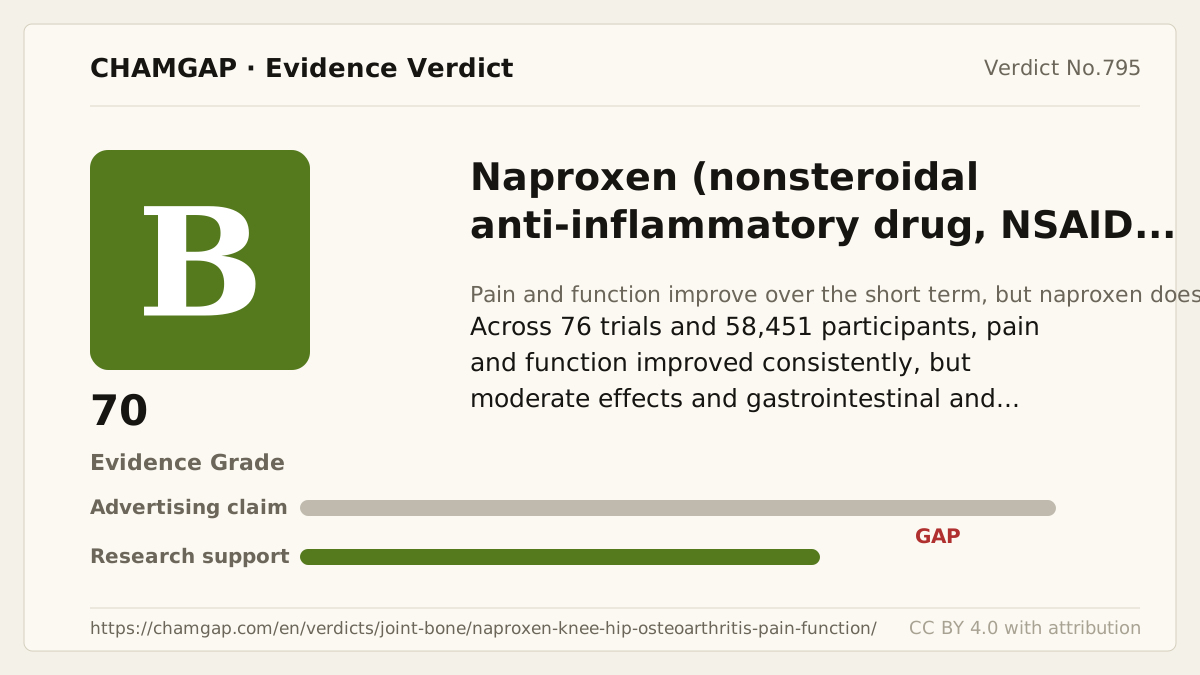
research showsNaproxen is rated B because it consistently improves pain and function in knee or hip osteoarthritis. A network meta-analysis of 76 trials and 58,451 participants confirmed pain and function improvement plus a significant naproxen dose-response relation. Average benefit was nevertheless moderate, some regimens did not clearly reach the prespecified minimum clinically important difference, and treatment does not modify joint structure. Gastrointestinal bleeding and cardiovascular and renal risks must be weighed separately, supporting B with 70 points.
ads claimMarketing can say naproxen treats arthritis or imply long-term safety because it is familiar and sold without prescription in some forms. Evidence supports symptom relief in pain and function while taking it, not cartilage regeneration or interruption of disease progression, and both nonprescription and prescription products share NSAID risks.
Useful facts when choosing a product
- Naproxen and naproxen sodium differ by formulation, salt form, and nonprescription or prescription dose. Numeric strengths should not be exchanged without checking the exact label or prescription.
- For osteoarthritis, use the lowest effective dose for the shortest practical duration and do not duplicate other NSAIDs hidden in cold or pain products, including ibuprofen, dexibuprofen, or aspirin used as an analgesic.
- Risk is higher with a history of peptic ulcer or gastrointestinal bleeding, cardiovascular disease, heart failure, hypertension, kidney disease, dehydration, or advanced age. Black stool, vomiting blood, chest pain, breathlessness, edema, or reduced urine needs urgent assessment.
- Anticoagulants, antiplatelet drugs, corticosteroids, some antidepressants, ACE inhibitors, angiotensin-receptor blockers, and diuretics can increase bleeding or renal risk, so the complete medication list should be reviewed with a clinician or pharmacist.
Chamgap Semantic Classification Code
Candidate index · review held
M.naproxen.UNK.pain-and-function-in-knee-or-hip-osteoarthritis.improve.MULTIMedicinal interventions > Naproxen > Unknown > pain and function in knee or hip osteoarthritis > Improvement claim > Multiple: primary unresolved
An automated migration candidate, not an issued permanent code; exact claim scope remains under review. This machine-generated migration candidate helps retrieval but is not a permanent assignment. The original verdict ID and URL remain authoritative.
What the research actually shows
Goldstein and colleagues randomized 214 outpatients with moderate-to-severe lower-limb osteoarthritis pain for three weeks to naproxen 375 mg twice daily, several lanepitant doses, or placebo. Naproxen significantly reduced average pain more than placebo from week one and required less rescue analgesia. Essex and colleagues assigned 589 patients with knee osteoarthritis to six months of celecoxib or naproxen 500 mg twice daily; the rates achieving a 20% WOMAC total-score response were similar at 52.7% and 49.7%, while gastrointestinal-adverse-event discontinuation was higher with naproxen. The 2017 network meta-analysis by da Costa and colleagues included 76 trials and 58,451 participants, synthesized pain and function, found every preparation and dose to favor placebo in pain point estimates, and identified a significant linear dose response only for naproxen. PRECISION in 24,081 participants primarily informs long-term cardiovascular, gastrointestinal, and renal safety rather than efficacy.
Why this is classified as B (70)
A network meta-analysis of 76 trials and 58,451 participants consistently confirmed pain and function improvement and a naproxen dose-response relation. Average benefit is nevertheless moderate, some doses do not clearly exceed a minimum clinically important difference, and structural disease modification is unsupported. Gastrointestinal, cardiovascular, and renal harms remain independent safety issues, yielding B with 70 points.
Counterpoint. A short trial can determine whether pain, walking, stairs, and daily function improve enough to matter personally; if benefit is small, long-term exposure offers little net value. Persistent pain, night pain, or rapid functional loss should prompt reassessment of diagnosis and nonpharmacologic, injection, or surgical options.
Rejudgment record. New verdict — Applied B because placebo-controlled trials and a network meta-analysis of 76 trials with 58,451 participants established direct improvement in knee or hip osteoarthritis pain and function plus naproxen dose response, while average effects were moderate and evidence for a minimum clinically important difference or structural disease modification was limited
Sub-claim grades by effect
This ingredient is marketed for several effects. A single overall grade blends strong and weak claims together, so each effect is graded separately here. The overall grade reflects the strongest disconfirming or core claim.
| Effect (sub-claim) | Grade | Basis |
|---|---|---|
| Improvement of pain and function in knee or hip osteoarthritis | B | Placebo-controlled trials and a large network meta-analysis improved direct symptoms and function, but the average effect was moderate. |
| Cartilage preservation or slower structural progression of osteoarthritis | D | In a 355-participant 24-month MRI active-comparator trial, cartilage loss was greater with naproxen than licofelone, providing no support for structural preservation, and disease-modifying superiority over placebo has not been established. |
Cross-check — AI research and Codex final gate
Evidence Table
| Study | Design | Sample | Funding | Endpoint | Result | Weight |
|---|---|---|---|---|---|---|
| Goldstein DJ et al. 2000 | Parallel randomized double-blind placebo- and active-controlled trial | 214 outpatients with moderate-to-severe lower-limb osteoarthritis pain | Development trial led by Lilly Research Laboratories | Three-week average pain, pain relief, patient global assessment, and rescue analgesic use | Naproxen 375 mg twice daily produced less pain and significantly less rescue-medication use than placebo from week one through week three. | Direct short-term placebo-controlled pain evidence |
| da Costa BR et al. 2017 | Systematic review and network meta-analysis of randomized NSAID and paracetamol trials | 76 randomized trials with 58,451 participants | Swiss National Science Foundation and Arco Foundation | Pain and physical function in knee or hip osteoarthritis | Pain point estimates favored every preparation and dose over placebo, with a significant linear dose-response relation for naproxen. | Pivotal independent large synthesis |
| Essex MN et al. 2012 | Randomized double-blind double-dummy active-controlled trial at 47 centers | 589 randomized patients with knee osteoarthritis and 586 treated | Industry trial authored by Pfizer employees | Twenty-percent improvement in WOMAC total score at six months and gastrointestinal tolerability | Response rates were similar at 52.7% with celecoxib and 49.7% with naproxen, while gastrointestinal-adverse-event discontinuation was higher with naproxen. | Supportive medium-term active-controlled symptom and function evidence |
| Nissen SE et al. 2016 PRECISION | Multinational randomized double-blind cardiovascular-safety noninferiority trial | 24,081 arthritis patients at increased cardiovascular risk | Sponsored by Pfizer | Cardiovascular death, myocardial infarction, stroke, and gastrointestinal and renal events | Moderate-dose celecoxib was noninferior to naproxen and ibuprofen for cardiovascular events, with differences in gastrointestinal and renal safety. | Large long-term safety evidence kept separate from efficacy |
| Raynauld JP et al. 2009 | Multicenter randomized double-blind 24-month structural active-controlled trial | 355 patients with knee osteoarthritis | Industry development trial with sponsorship and conflicts reported in the full paper | Quantitative MRI cartilage-volume loss and radiographic joint-space change | Cartilage-volume loss was significantly lower with licofelone than with naproxen, providing no support for structural superiority of naproxen. | Limited direct evidence not supporting the disease-modification claim |
Receipt — 5 References
All 5 cited sources were verified for existence at the original page (as of 2026-07-20).
Final verification and publication gate: Codex · Evidence date: 2026-07-20 · Corrections: none
Cite this verdict
[Chamgap] Naproxen x improved pain and function in knee or hip osteoarthritis — Evidence Grade B·70. 5 cited sources checked. Source: https://chamgap.com/en/verdicts/joint-bone/naproxen-knee-hip-osteoarthritis-pain-function/ · CC BY 4.0CC BY 4.0 — free to use with attribution; do not distort grades, numbers, or verdict meaning.
What this document does and does not do
Chamgap is an information source. It reports what research has and has not confirmed; it does not tell readers what to take or buy. That decision belongs to readers and, when needed, medical or legal professionals. This verdict reflects literature available up to the search date and may change as new research appears. Nothing here is medical advice.