
Mixed fish consumption,
does it really help with Prevention of incident rheumatoid arthritis?
research showsThe grade is D with 34 points. A synthesis of seven observational studies and 174,701 participants found RR 0.96, 95% CI 0.92 to 1.01, per additional weekly serving, with I-squared 0%. In the newer E3N cohort of 62,629 women, only moderate intake was associated, HR 0.74, 0.59 to 0.94; the highest group was null, 0.99, 0.80 to 1.22, with linear-trend P=.65.
ads claimThe observation pooled sardines, mackerel, salmon, tuna, cod, haddock, and flatfish; it is not a prescription for one species. Verdict 1680 is F with 3 points for omega-3 capsules and atrial fibrillation, a different intervention and outcome from whole fish and rheumatoid-arthritis incidence.
Useful facts when choosing a product
- The E3N middle category was 16.7-31.1 g/day, about 117-218 g/week. Preparation, canned status, and wild versus farmed origin were not separated.
- Lean fish included cod, haddock, and flatfish, while oily fish included sardines, mackerel, salmon, trout, and tuna.
- The E3N questionnaire reported fish-group relative validity correlation 0.39 and reproducibility 0.51.
- One mercury value cannot be assigned to mixed species. FDA mean total-mercury values range from 0.013 ppm for sardines to 0.689 ppm for bigeye tuna and are not direct methylmercury measurements of cohort foods.
Chamgap Semantic Classification Code
Candidate index · review held
F.mixed-intake-of-lean-and-oily-fish.oral.incident-rheumatoid-arthritis.prevent.UNKFoods and beverages > Mixed intake of lean and oily fish > Oral > incident rheumatoid arthritis > Occurrence-prevention claim > Unknown
An automated migration candidate, not an issued permanent code; exact claim scope remains under review. This machine-generated migration candidate helps retrieval but is not a permanent assignment. The original verdict ID and URL remain authoritative.
What the research actually shows
The 2014 dose-response meta-analysis included four case-control and three prospective cohort studies, 174,701 participants and 3,346 cases. RR per weekly serving was 0.96, 95% CI 0.92-1.01, I-squared 0%, with nonlinearity P=.15. The 2022 E3N analysis identified 480 cases among 62,629 women. Fish was measured once in 1993, and rheumatoid arthritis was identified through an algorithm that began with self-report. Funding included public ANR and FOREUM support, and the article declared no conflicts.
Why this is classified as D (34)
A one-time low-validity FFQ and self-report-based case ascertainment accompany null pooled and highest-intake results, giving D with 34 points.
Counterpoint. D retains the moderate-intake signal without treating it as proven overall prevention.
Rejudgment record. Cross-check applied — The seven-study dose-response synthesis, newer E3N article, and FFQ validation were reconciled to separate a middle-category signal from the overall linear prevention claim
| Endpoint | H | Hard endpoint - actual events such as death |
| Replication | R1 | Single confirmatory trial |
| Independence | I2 | Decisive evidence is publicly or non-profit funded |
| Effect size | E0 | Null |
| Precision | C0 | The confidence interval leaves room for benefit |
Stored derived and displayed grades match; this is not a current recalculation or validity check (D).
Sub-claim grades by effect
This ingredient is marketed for several effects. A single overall grade blends strong and weak claims together, so each effect is graded separately here. The overall grade reflects the strongest disconfirming or core claim.
| Effect (sub-claim) | Grade | Basis |
|---|---|---|
| Increasing fish intake linearly reduces rheumatoid-arthritis incidence | D | Both the pooled RR and E3N linear trend were null. |
| Possible nonlinear protection at one to two servings weekly | C | E3N showed a middle-category signal not confirmed by the highest group or overall synthesis. |
Cross-check — AI research and Codex final gate
Evidence Table
| Study | Design | Sample | Funding | Endpoint | Result | Weight |
|---|---|---|---|---|---|---|
| Di Giuseppe D et al. 2014 | Dose-response meta-analysis of observational studies | Seven studies; 174,701 participants; 3,346 rheumatoid-arthritis cases | Swedish academic and public research setting | Incident rheumatoid arthritis | RR 0.96, 95% CI 0.92-1.01, per weekly serving; I-squared 0%; nonlinearity P=.15 | Consistently null overall linear synthesis |
| Nguyen Y et al. 2022 E3N | Prospective observational cohort | 62,629 women; 480 incident rheumatoid-arthritis cases | ANR-10-COHO-0006 and FOREUM Foundation | Incident rheumatoid arthritis identified by a validated algorithm beginning with self-report | Middle group HR 0.74, 0.59-0.94; highest group 0.99, 0.80-1.22; linear-trend P=.65 | Newer large cohort limited by a one-time low-validity FFQ |
Receipt — 3 References
All 3 cited sources were verified for existence at the original page (as of 2026-08-03).
Final verification and publication gate: Codex · Evidence date: 2026-08-03 · Corrections: none
Cite this verdict
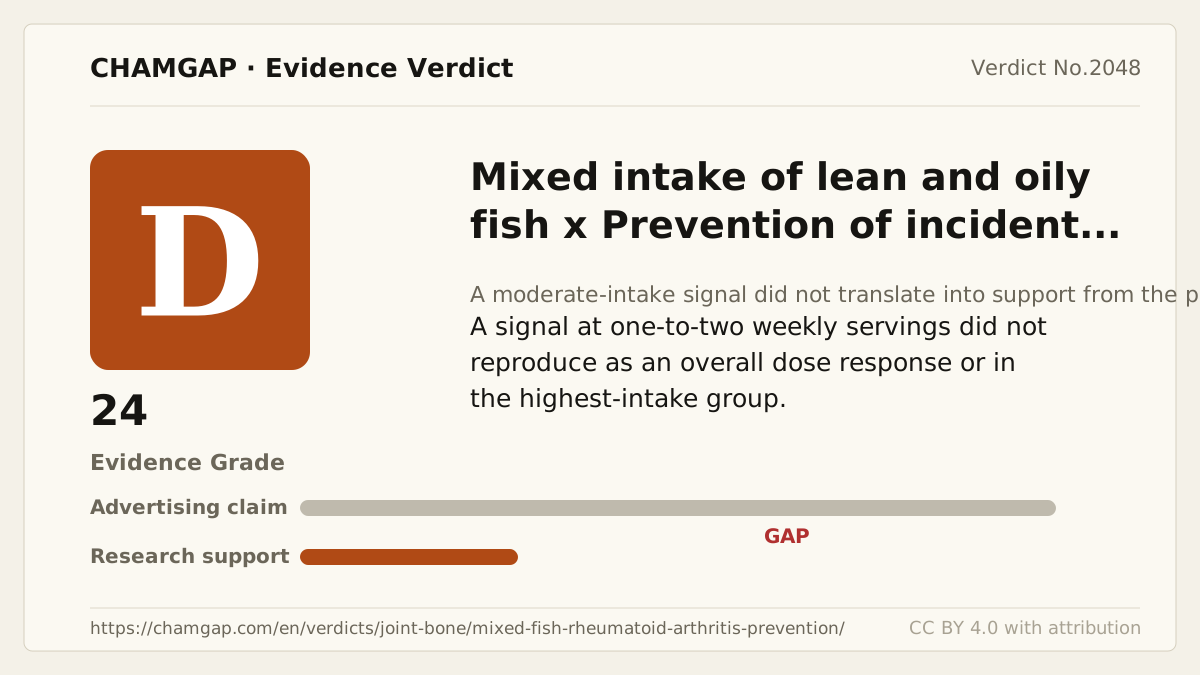
[Chamgap] Mixed fish consumption x prevention of rheumatoid arthritis — Evidence Grade D·34. 3 cited sources checked. Source: https://chamgap.com/en/verdicts/joint-bone/mixed-fish-rheumatoid-arthritis-prevention/ · CC BY 4.0CC BY 4.0 — free to use with attribution; do not distort grades, numbers, or verdict meaning.
What this document does and does not do
Chamgap is an information source. It reports what research has and has not confirmed; it does not tell readers what to take or buy. That decision belongs to readers and, when needed, medical or legal professionals. This verdict reflects literature available up to the search date and may change as new research appears. Nothing here is medical advice.