
Meloxicam,
does it really help with Improved pain, stiffness, and WOMAC function scores in knee or hip osteoarthritis?
research showsMeloxicam is rated B because it consistently improves pain, stiffness, and WOMAC function in knee or hip osteoarthritis. Across seven randomized trials involving about 20,000 participants, placebo-controlled WOMAC improvement and the MELISSA and SELECT active-comparator findings were consistent. These patient-reported symptoms and functions are treatment targets themselves, not surrogate outcomes. Industry sponsorship and short follow-up remain limitations, but they are the same weaknesses present in the peer celecoxib B66 verdict. The evidence does not establish cartilage restoration or long-term disease modification, but consistency and parity of evidence support B with 66 points. Gastrointestinal bleeding, cardiovascular thrombosis, kidney injury, hypertension, and edema must be assessed separately from efficacy.
ads claimPromotion can expand short-term relief into claims that meloxicam treats the joint, prevents cartilage loss, or avoids surgery. The evidence best fits relief of pain, stiffness, and impaired function over weeks to months while treatment is taken; it does not show restoration of joint structure or a changed long-term natural history.
Useful facts when choosing a product
- Meloxicam is a prescription NSAID rather than a supplement. A common osteoarthritis regimen starts at 7.5 mg once daily and may increase to 15 mg when necessary; the prescription and product label take priority.
- Both benefit and harm can vary with dose and duration, so the lowest effective dose for the shortest necessary period is the governing principle.
- Unsupervised combination with another NSAID such as ibuprofen, naproxen, or diclofenac can increase gastrointestinal, renal, and cardiovascular harm.
- A history of ulcer or bleeding, cardiovascular disease, hypertension, kidney disease, edema, anticoagulant use, or late pregnancy requires particular caution. Black stools, vomiting blood, chest pain, shortness of breath, or reduced urine output warrants urgent medical assessment.
Chamgap Semantic Classification Code
Candidate index · review held
M.meloxicam.UNK.pain-stiffness-and-womac-function-scores-in-knee-or-hip-osteoarthritis.improve.MULTIMedicinal interventions > Meloxicam > Unknown > pain, stiffness, and WOMAC function scores in knee or hip osteoarthritis > Improvement claim > Multiple: primary unresolved
An automated migration candidate, not an issued permanent code; exact claim scope remains under review. This machine-generated migration candidate helps retrieval but is not a permanent assignment. The original verdict ID and URL remain authoritative.
What the research actually shows
Yocum and colleagues randomized 774 patients with a flare of knee or hip osteoarthritis to meloxicam 3.75, 7.5, or 15 mg, diclofenac 100 mg, or placebo for 12 weeks. Final changes in WOMAC total were -10.2 with placebo, -15.3 with meloxicam 7.5 mg, and -18.9 with 15 mg; WOMAC pain, stiffness, and physical function also favored 7.5 mg and 15 mg over placebo. Boehringer Ingelheim funded the trial. The 2021 da Costa network meta-analysis synthesized 192 trials and 102,829 participants with at least 100 participants per arm; maximum-dose meloxicam was estimated to be among the more effective commonly used NSAIDs for pain and function. Eighty percent of included trials had commercial funding, and median follow-up was 8.6 weeks. Both sources concern symptom relief, not structural disease modification.
Why this is classified as B (66)
Seven randomized trials involving about 20,000 participants show consistent placebo-controlled WOMAC improvement and concordant MELISSA and SELECT active-comparator results. Pain, stiffness, and WOMAC function are direct patient outcomes and treatment targets, so patient reporting alone does not invoke a surrogate-outcome ceiling. Industry sponsorship and short follow-up remain limitations, but they match those of celecoxib B66 and the evidence strength is comparable, supporting B with 66 points. Gastrointestinal bleeding, cardiovascular, renal, and edema risks remain separate safety concerns.
Counterpoint. For an individual patient, less pain can materially improve walking and participation in rehabilitation. Meloxicam does not replace exercise, weight management, physical therapy, or risk assessment, and lack of benefit should prompt review of the diagnosis and plan rather than indefinite dose escalation.
Rejudgment record. Consistency recalibration (rule 1 clarification) — Treated pain, stiffness, and WOMAC function as direct patient outcomes and treatment targets rather than surrogates; consistent placebo- and active-controlled results across seven trials involving about 20,000 participants, with industry sponsorship and short follow-up comparable to celecoxib B66, support B
Sub-claim grades by effect
This ingredient is marketed for several effects. A single overall grade blends strong and weak claims together, so each effect is graded separately here. The overall grade reflects the strongest disconfirming or core claim.
| Effect (sub-claim) | Grade | Basis |
|---|---|---|
| Reduced pain in knee or hip osteoarthritis | B | Pain is a direct patient outcome and treatment target, with consistent improvement across placebo- and active-controlled trials. |
| Improved stiffness in osteoarthritis | B | Stiffness, a treatment target, improved consistently across multiple trials but does not establish structural disease modification. |
| Improved WOMAC physical function | B | WOMAC function is a direct patient outcome with repeated improvement, but the finding does not extend to long-term disability or joint replacement. |
Cross-check — AI research and Codex final gate
Evidence Table
| Study | Design | Sample | Funding | Endpoint | Result | Weight |
|---|---|---|---|---|---|---|
| Yocum D et al. 2000 | Twelve-week multicenter randomized double-blind double-dummy placebo- and active-controlled trial | 774 patients with a flare of knee or hip osteoarthritis | Funded by meloxicam manufacturer Boehringer Ingelheim | WOMAC total, pain, stiffness, physical function, patient pain, and disease activity | Meloxicam 7.5 mg and 15 mg were significantly superior to placebo across key endpoints, with efficacy evident by two weeks and maintained through week 12. | Pivotal direct efficacy evidence; industry funded with short-term patient-reported endpoints |
| da Costa BR et al. 2021 | Systematic review and network meta-analysis of randomized osteoarthritis analgesic trials | 192 trials and 102,829 participants; at least 100 participants per arm | Public and nonprofit support including the Arthritis Society and St Michael's Hospital Foundation; 80% of included trials had commercial funding | Osteoarthritis pain, physical function, and discontinuation due to adverse events | Oral NSAIDs improved pain and function, and maximum-dose meloxicam was estimated to be relatively effective among common NSAIDs, but follow-up was predominantly short term. | Large independent class synthesis; limited for meloxicam-specific long-term effects |
Receipt — 2 References
All 2 cited sources were verified for existence at the original page (as of 2026-07-23).
Final verification and publication gate: Codex · Evidence date: 2026-07-23 · Corrections: none
Cite this verdict
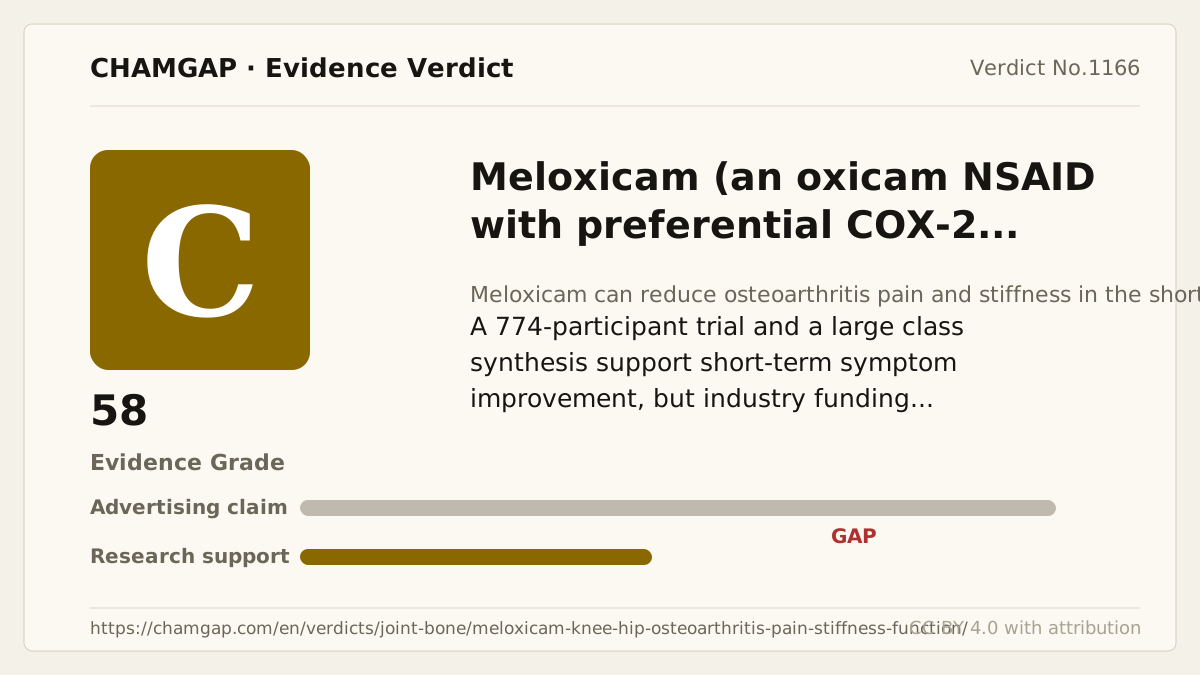
[Chamgap] Meloxicam x improved pain, stiffness, and function in knee or hip osteoarthritis — Evidence Grade B·66. 2 cited sources checked. Source: https://chamgap.com/en/verdicts/joint-bone/meloxicam-knee-hip-osteoarthritis-pain-stiffness-function/ · CC BY 4.0CC BY 4.0 — free to use with attribution; do not distort grades, numbers, or verdict meaning.
What this document does and does not do
Chamgap is an information source. It reports what research has and has not confirmed; it does not tell readers what to take or buy. That decision belongs to readers and, when needed, medical or legal professionals. This verdict reflects literature available up to the search date and may change as new research appears. Nothing here is medical advice.