
Luminous doorframe night lighting,
does it really help with Reduced nighttime falls among assisted-living residents with dementia?
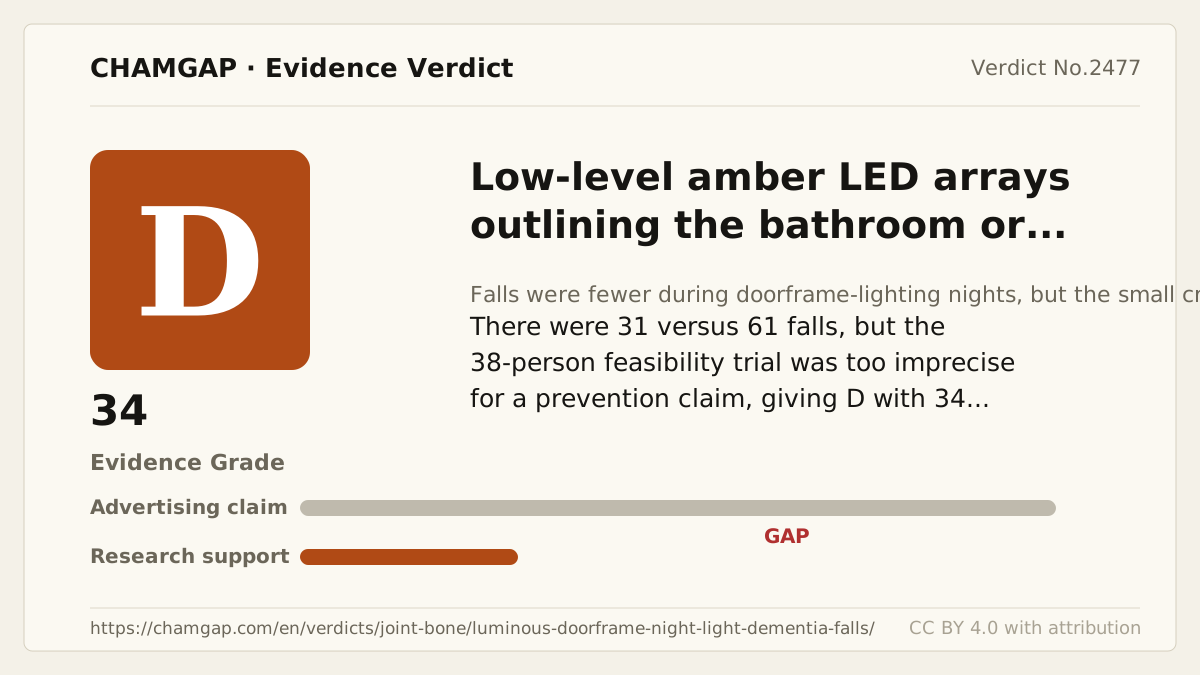
research showsThe grade is D with 34 points. In a 38-person randomized crossover feasibility trial, camera-confirmed falls numbered 31 over 3,604 lighting nights and 61 over 4,271 standard-nightlight nights. The period-adjusted incidence-density ratio was 0.66 (95% CI 0.35 to 1.22; P=0.18), allowing both a large reduction and an increase. The small, early-stopped study was strongly influenced by one resident with 34 falls.
ads claimThis was not a generic motion-sensor lamp. The system placed 68 amber LEDs above and 140 on each side of the bathroom or entry doorframe, continuously operating from 7 pm to 7 am at no more than 0.5 lux at the cornea from two meters, with glare shields. No bundled fall-prevention program was reported.
Useful facts when choosing a product
- Control rooms used one standard 0.5-watt, 2700-K LED nightlight in the bedroom and one in the bathroom.
- All three sides operated throughout the night on only 75.4% of recorded lighting nights.
- The original Funding sources text states: “This work was supported by the National Institute on Aging (Grant R21AG059111).”
Chamgap Semantic Classification Code
Candidate index · review held
UNK.low-level-amber-led-arrays-outlining-the-bathroom-or-entry-doorframe.UNK.nighttime-falls-among-assisted-living-residents-with-dementia.reduce.UNKUnknown > Low-level amber LED arrays outlining the bathroom or entry doorframe > Unknown > nighttime falls among assisted-living residents with dementia > Reduction claim > Unknown
An automated migration candidate, not an issued permanent code; exact claim scope remains under review. This machine-generated migration candidate helps retrieval but is not a permanent assignment. The original verdict ID and URL remain authoritative.
What the research actually shows
Residents were assigned to one of four sequences, `CCLL`, `CLLC`, `LCCL`, or `LLCC`, across planned 90-day periods. No washout was reported. Illumination has little biological persistence after switch-off, but behavior after a fall and progressive frailty can carry across periods. The model included period effects, but a separate calendar-season analysis was not reported. Researchers reviewed infrared video recorded from 7 pm to 7 am; a more detailed operational fall definition could not be confirmed in the accessible text.
Why this is classified as D (34)
A publicly funded crossover trial measured real falls, but its very small sample, attrition, early stopping, and wide interval give D with 34 points.
Counterpoint. Verdict 2310 is D with 34 points for hospital bed-exit alarms, verdict 2449 is C with 56 points for hospital nonslip socks, and verdict 2450 is C with 56 points for barefoot or sock-only mobility. Their interventions and settings differ from fixed low-level doorframe lighting in dementia care.
Rejudgment record. Cross-check applied — Real fall events but a very wide interval in a 38-person feasibility study with attrition and early stopping
| Endpoint | H | Hard endpoint - actual events such as death |
| Replication | R1 | Single confirmatory trial |
| Independence | I2 | Decisive evidence is publicly or non-profit funded |
| Effect size | E0 | Null |
| Precision | C0 | The confidence interval leaves room for benefit |
Stored derived and displayed grades match; this is not a current recalculation or validity check (D).
Sub-claim grades by effect
This ingredient is marketed for several effects. A single overall grade blends strong and weak claims together, so each effect is graded separately here. The overall grade reflects the strongest disconfirming or core claim.
| Effect (sub-claim) | Grade | Basis |
|---|---|---|
| Reduction in nighttime falls among assisted-living residents with dementia | D | The point estimate favored fewer falls, but the 95% confidence interval included 1. |
Cross-check — AI research and Codex final gate
Evidence Table
| Study | Design | Sample | Funding | Endpoint | Result | Weight |
|---|---|---|---|---|---|---|
| Zimmerman et al. 2024 | Randomized crossover feasibility trial in assisted living | 38 residents; 30 observed in both conditions; 7,875 recorded nights | Original wording: “This work was supported by the National Institute on Aging (Grant R21AG059111).” | Falls confirmed on infrared video from 7 pm to 7 am | 31 falls over 3,604 nights versus 61 over 4,271; adjusted incidence-density ratio 0.66 (95% CI 0.35-1.22), P=0.18 | Exploratory single trial |
Receipt — 1 References
All 1 cited sources were verified for existence at the original page (as of 2026-08-08).
Final verification and publication gate: Codex · Evidence date: 2026-08-08 · Corrections: none
Cite this verdict
[Chamgap] Luminous doorframe night lighting x nighttime falls in dementia care — Evidence Grade D·34. 1 cited sources checked. Source: https://chamgap.com/en/verdicts/joint-bone/luminous-doorframe-night-light-dementia-falls/ · CC BY 4.0CC BY 4.0 — free to use with attribution; do not distort grades, numbers, or verdict meaning.
What this document does and does not do
Chamgap is an information source. It reports what research has and has not confirmed; it does not tell readers what to take or buy. That decision belongs to readers and, when needed, medical or legal professionals. This verdict reflects literature available up to the search date and may change as new research appears. Nothing here is medical advice.