
Lumbar support,
does it really help with Prevention of low back pain incidence and related sick leave in physical workers?
research showsIn the actual six-month analysis of 282 from 312 randomized workers, low back pain incidence was 36% versus 34% and sick leave was 0.4 versus 0.4 days per month, so both primary outcomes failed. A Cochrane review of seven preventive trials and 14,437 participants also found no advantage over no intervention or training, but heterogeneity precluded quantitative pooling, so C1 precision is not established. The grade is D with 34 points, not F.
ads claimMarketing connects firm support and restricted posture with injury prevention. Mechanical support is real, but prevention is a separate clinical question and the large trial was null.
Useful facts when choosing a product
- A lumbar support wraps and compresses the trunk and limits some flexion and rotation. This is a physical fact of its construction and use.
- In the van Poppel trial, 43% wore the support at least half of working time, which is part of its real-world implementation effect.
- The trial in about 4,000 postal workers tested education rather than a lumbar support and was not counted as direct evidence for this verdict.
Chamgap Semantic Classification Code
Candidate index · review held
P.lumbar-support.device.low-back-pain-incidence-and-related-sick-leave-in-physical-workers.prevent.MULTIProcedures, devices and tests > Lumbar support > Device delivered > low back pain incidence and related sick leave in physical workers > Occurrence-prevention claim > Multiple: primary unresolved
An automated migration candidate, not an issued permanent code; exact claim scope remains under review. This machine-generated migration candidate helps retrieval but is not a permanent assignment. The original verdict ID and URL remain authoritative.
What the research actually shows
The pivotal prevention trial randomized 312, lost 30, and analyzed 282. Both primary outcomes, low back pain incidence and related sick leave, failed. Many prevention trials lacked allocation concealment and assessor masking, and incidence was an unmasked subjective outcome. The 2008 Cochrane review separated seven prevention trials with 14,437 participants from eight treatment trials with 1,361 participants; prevention was no better than no intervention or training, but heterogeneity precluded quantitative pooling, while treatment evidence conflicted. A randomized study in about 4,000 postal workers tested a back-education program rather than belts and was therefore not pooled as direct evidence. A belt physically wraps and compresses the trunk and limits some movement, but evidence does not show that this prevents low back pain or sick leave. The comparable assistive-device prevention claim is verdict 1760, which is D with 24 points, for orthotic insoles and low back pain prevention.
Why this is classified as D (34)
The axis profile is C, H, RX, I2, E0, B1, and CX. Missing allocation concealment or assessor masking and an unmasked subjective endpoint give B1. Results are repeatedly null, but heterogeneity prevented pooling and precision remains CX, yielding D with 34 points.
Counterpoint. Short-term support during a specific task or symptom relief in someone who already has pain are separate questions. A belt should not replace safe lifting practices or workplace redesign.
Rejudgment record. Cross-check applied — Scored the occupational prevention trial and preventive evidence set as repeated E0 and RX, while assigning CX precision because no quantitative pooled confidence interval was available
| Endpoint | H | Hard endpoint - actual events such as death |
| Replication | RX | Repeatedly refuted in the same indication |
| Independence | I2 | Decisive evidence is publicly or non-profit funded |
| Effect size | E0 | Null |
| Precision | CX | No pooled confidence interval could be confirmed |
Stored derived and displayed grades match; this is not a current recalculation or validity check (D).
Sub-claim grades by effect
This ingredient is marketed for several effects. A single overall grade blends strong and weak claims together, so each effect is graded separately here. The overall grade reflects the strongest disconfirming or core claim.
| Effect (sub-claim) | Grade | Basis |
|---|---|---|
| Prevention of low back pain incidence in physical workers | D | The primary endpoint failed at 36% versus 34%. |
| Prevention of sick leave related to low back pain | D | Both groups had 0.4 days per month, with no difference. |
| Primary prevention in workers without previous low back pain | D | The preventive evidence set showed no advantage over no intervention or training. |
Cross-check — AI research and Codex final gate
Evidence Table
| Study | Design | Sample | Funding | Endpoint | Result | Weight |
|---|---|---|---|---|---|---|
| van Poppel MNM et al. 1998 | Workplace two-by-two factorial randomized controlled trial | 312 randomized; 282 in the actual six-month analysis | Funding source not reported in the abstract; academically led with no identified belt-manufacturer sponsorship | Six-month low back pain incidence and related sick leave | Both primary outcomes failed: incidence 36% versus 34%, P=.81; sick leave 0.4 versus 0.4 days per month, P=.52. | Pivotal direct prevention trial |
| van Duijvenbode IC et al. 2008 | Cochrane systematic review of randomized trials | Seven prevention trials with 14,437 participants; eight treatment trials with 1,361 participants | Cochrane and academic institutional support; no commercial belt-manufacturer funding reported | Low back pain incidence, sick leave, and treatment pain and function | Moderate evidence found no prevention advantage over no intervention or training; heterogeneity precluded quantitative pooling, and treatment evidence was conflicting. | Large prevention evidence synthesis |
Receipt — 2 References
All 2 cited sources were verified for existence at the original page (as of 2026-07-24).
Final verification and publication gate: Codex · Evidence date: 2026-07-24 · Corrections: none
Cite this verdict
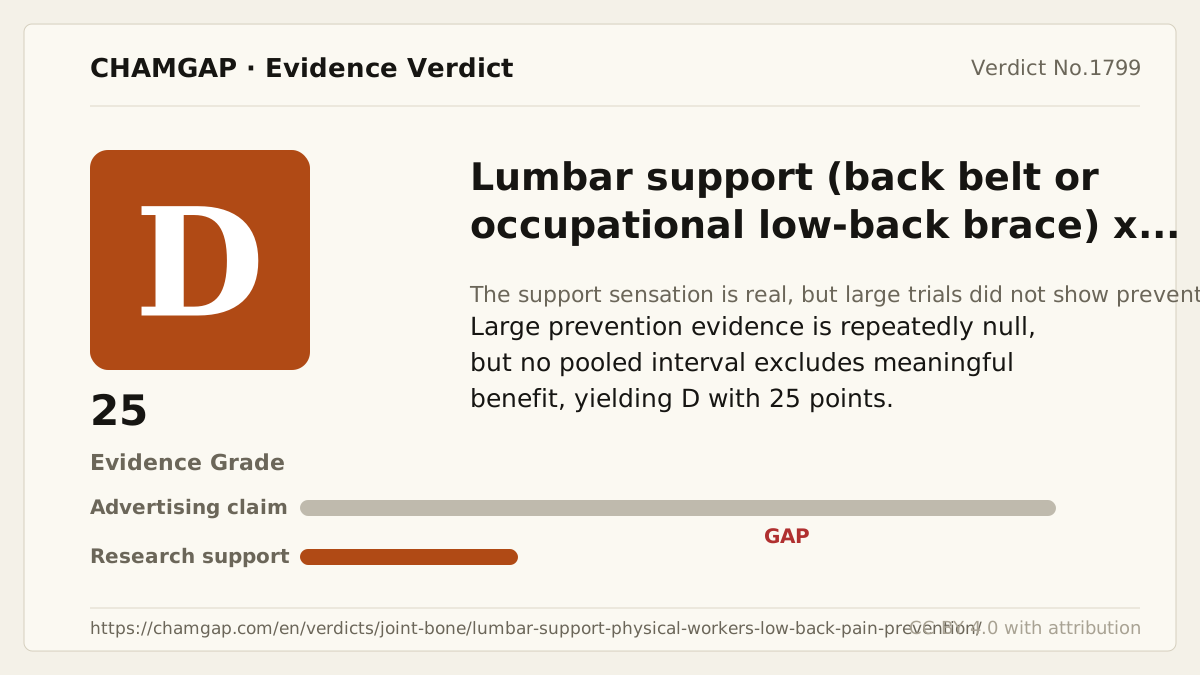
[Chamgap] Lumbar support x prevention of low back pain in physical workers — Evidence Grade D·34. 2 cited sources checked. Source: https://chamgap.com/en/verdicts/joint-bone/lumbar-support-physical-workers-low-back-pain-prevention/ · CC BY 4.0CC BY 4.0 — free to use with attribution; do not distort grades, numbers, or verdict meaning.
What this document does and does not do
Chamgap is an information source. It reports what research has and has not confirmed; it does not tell readers what to take or buy. That decision belongs to readers and, when needed, medical or legal professionals. This verdict reflects literature available up to the search date and may change as new research appears. Nothing here is medical advice.