
Lumbar fusion,
does it really help with Greater disability improvement than intensive cognitive and exercise rehabilitation?
research showsThe grade is D. Results were not uniform. In Fairbank's 349-person trial, one coprimary outcome, ODI, favored surgery by -4.1 points (95% CI -8.1 to -0.1), P=0.045, while shuttle walking did not differ. Brox randomized 64 and found adjusted ODI difference 2.3 (-6.7 to 11.4), P=0.33. Repeated trials did not show a clear consistent advantage, but no agreed validated between-group threshold permits complete exclusion of benefit, giving D with 30 points.
ads claimDegenerative imaging findings and mechanical segment fixation do not establish better daily disability than intensive rehabilitation. Specific structural indications must not be mixed with nonspecific pain.
Useful facts when choosing a product
- The comparison rehabilitation combined fear-reduction education with intensive exercise over three weeks.
- By nine years, 18 of 58 participants originally assigned to fusion had undergone additional surgery, commonly hardware removal.
- No duplicate ingredient-indication combination was found in the existing list.
Chamgap Semantic Classification Code
Candidate index · review held
P.instrumented-lumbar-fusion.device.greater-disability-improvement-than-intensive-cognitive-and-exercise-rehabilitation.improve.MULTIProcedures, devices and tests > Instrumented lumbar fusion > Device delivered > Greater disability improvement than intensive cognitive and exercise rehabilitation > Improvement claim > Multiple: primary unresolved
An automated migration candidate, not an issued permanent code; exact claim scope remains under review. This machine-generated migration candidate helps retrieval but is not a permanent assignment. The original verdict ID and URL remain authoritative.
What the research actually shows
Fritzell randomized 294, 222 to fusion and 72 to usual nonsurgical care; at two years pain change was 21.0 versus 4.3, P=0.002, and ODI change 11.6 versus 2.8, P=0.015, favoring surgery, but a between-group 95% CI was not confirmed. Brox 2003 randomized 64 to fusion or intensive cognitive-exercise rehabilitation and analyzed 62; adjusted primary ODI difference was 2.3 (95% CI -6.7 to 11.4), P=0.33. A 60-person prior-disc-surgery trial using the same intensive comparator found -7.3 (-17.3 to 2.7), P=0.15. Fairbank randomized 349, 176/173, to fusion or intensive rehabilitation; ODI was -4.1 (-8.1 to -0.1), P=0.045, but the coprimary shuttle walk was null. Whether the comparator was usual care or intensive rehabilitation materially changed the conclusion.
Why this is classified as D (30)
Multiple publicly funded randomized trials failed to establish disability superiority, but intervals do not fully exclude an approximately 10-point benefit, giving D with 30 points.
Counterpoint. This does not apply to separate structural surgical indications.
Rejudgment record. Cross-check applied — Multiple publicly funded randomized trials failed to show ODI superiority over intensive cognitive and exercise rehabilitation, but confidence intervals did not fully exclude an approximately 10-point benefit
| Endpoint | P | Symptom or function itself is the target - including patient reports and performance tests |
| Replication | R0 | Trials conflict in direction |
| Independence | I2 | Decisive evidence is publicly or non-profit funded |
| Effect size | E0 | Null |
| Precision | C0 | The confidence interval leaves room for benefit |
Stored derived and displayed grades match; this is not a current recalculation or validity check (D).
Sub-claim grades by effect
This ingredient is marketed for several effects. A single overall grade blends strong and weak claims together, so each effect is graded separately here. The overall grade reflects the strongest disconfirming or core claim.
| Effect (sub-claim) | Grade | Basis |
|---|---|---|
| Superior disability improvement at one year | D | The primary ODI difference was 2.3 points, P=0.33. |
| Superior disability improvement at nine years | D | The adjusted difference was 1.9 points (-7.8 to 11.6). |
Cross-check — AI research and Codex final gate
Evidence Table
| Study | Design | Sample | Funding | Endpoint | Result | Weight |
|---|---|---|---|---|---|---|
| Brox et al. 2003 | Randomized active-controlled intention-to-treat trial | 64 randomized; 62 analyzed at one year | Norwegian government and Health and Rehabilitation Foundation | Primary ODI disability | Adjusted difference 2.3 points (95% CI -6.7 to 11.4), P=0.33 | Pivotal null trial |
| Fairbank et al. 2005 MRC Spine Stabilisation | 15-center randomized active-controlled trial | 349 randomized | UK Medical Research Council | Coprimary 24-month ODI and shuttle walking | ODI -4.1 points (95% CI -8.1 to -0.1), P=0.045; no difference in shuttle walking | Independent larger replication |
| Brox et al. 2006 post-discectomy trial | Randomized active-controlled intention-to-treat trial | 60 randomized; 97% followed at one year | Norwegian public and nonprofit funding | Primary ODI | Adjusted difference -7.3 points (-17.3 to 2.7), P=0.15 | Null trial in a separate population from the same network |
Receipt — 3 References
All 3 cited sources were verified for existence at the original page (as of 2026-08-01).
Final verification and publication gate: Codex · Evidence date: 2026-08-01 · Corrections: none
Cite this verdict
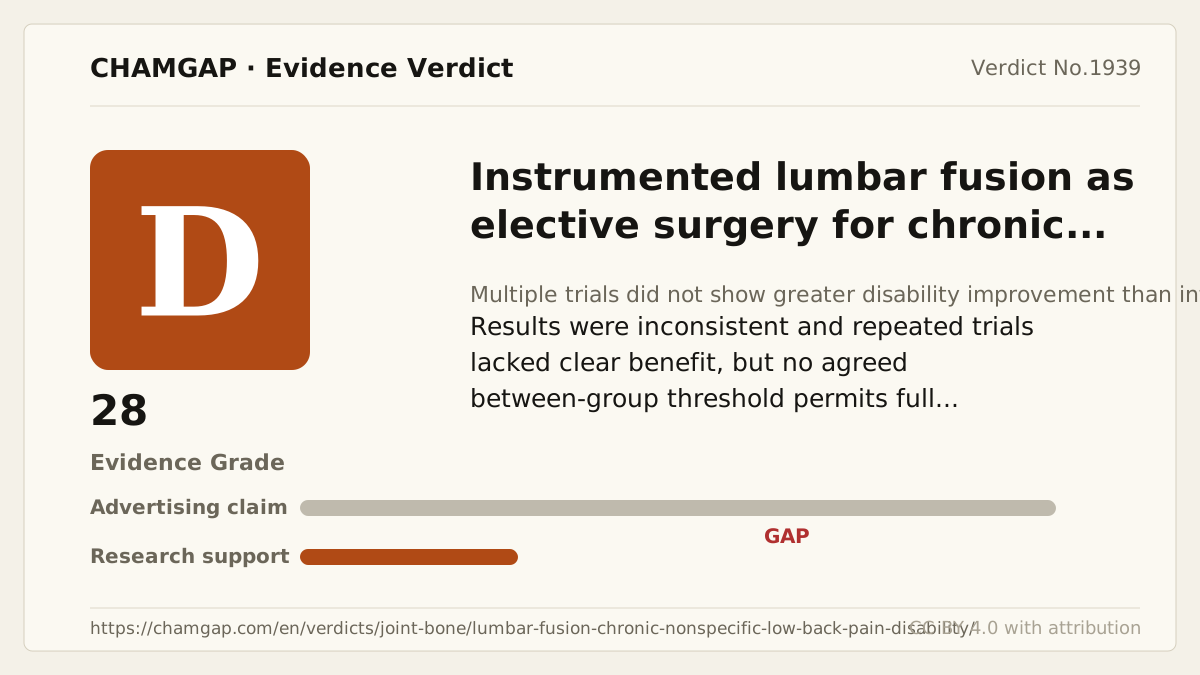
[Chamgap] Lumbar fusion x disability improvement in chronic nonspecific low back pain — Evidence Grade D·30. 3 cited sources checked. Source: https://chamgap.com/en/verdicts/joint-bone/lumbar-fusion-chronic-nonspecific-low-back-pain-disability/ · CC BY 4.0CC BY 4.0 — free to use with attribution; do not distort grades, numbers, or verdict meaning.
What this document does and does not do
Chamgap is an information source. It reports what research has and has not confirmed; it does not tell readers what to take or buy. That decision belongs to readers and, when needed, medical or legal professionals. This verdict reflects literature available up to the search date and may change as new research appears. Nothing here is medical advice.