
Low-intensity pulsed ultrasound,
does it really help with Acceleration of fracture union and functional recovery?
research showsTRUST randomized 501 tibial-fracture patients and analyzed 481 for SF-36 PCS and 482 for radiographic healing. Both co-primary endpoints failed: PCS difference 0.55 points (95% CI -0.75 to 1.84) and healing HR 1.07 (0.86 to 1.34). The upper benefit bound of 1.84 points excludes the general 3-to-5-point patient-important threshold adopted by the TRUST protocol, and four low-risk-of-bias trials repeatedly failed in the same fracture-healing indication, yielding F with 12 points.
ads claimMarketing expands the physical fact of ultrasound-energy delivery and cellular explanations into faster clinical union. High-quality clinical trials did not verify that health outcome.
Useful facts when choosing a product
- The TRUST active device delivered low-intensity pulsed ultrasound at 30 mW/cm2 through coupling gel for 20 minutes daily and logged use with an automatic timer.
- The sham had the same appearance, tactile cues, sounds, and operation but no therapeutic ultrasound output, supporting masking.
- Ultrasound-energy delivery is a measurable physical fact, while acceleration of fracture union is a separate clinical efficacy claim.
- FDA clearance and guideline recommendations are recorded only as context and were not used in any grading axis.
Chamgap Semantic Classification Code
Candidate index · review held
P.low-intensity-pulsed-ultrasound.device.acceleration-of-fracture-union-and-functional-recovery.improve.shamProcedures, devices and tests > Low-intensity pulsed ultrasound > Device delivered > Acceleration of fracture union and functional recovery > Improvement claim > Sham procedure or device
An automated migration candidate, not an issued permanent code; exact claim scope remains under review. This machine-generated migration candidate helps retrieval but is not a permanent assignment. The original verdict ID and URL remain authoritative.
What the research actually shows
TRUST randomized 501 and included 481 for PCS, 96% with 2,303 of 2,886 observations, and 482 for radiographic healing, 96% with 82 censored, in primary analyses. The industry sponsor ended the study early, leaving 73 participants with less than twelve months of follow-up, but repeated-measures, adjusted, and imputed analyses agreed. Among 26 trials, the four most trustworthy low-risk fracture trials were null in the same fracture-healing indication. Low-risk pooled radiographic healing was 1.7% earlier (95% CI 11.2% earlier to 8.8% later), and pain changed by 0.93 points lower on a 100-point scale (2.51 lower to 0.64 higher). What is true and where support ends: the active device delivers 30 mW/cm2 pulsed ultrasound for 20 minutes daily, but energy delivery did not accelerate union or function. Evidence was not mixed with other indications: verdict 1728, which is D with 28 points, concerns chronic low back pain; verdict 1746, which is C with 42 points, concerns knee osteoarthritis; and verdict 1770, which is D with 24 points, concerns acute ankle sprain.
Why this is classified as F (12)
The axis profile is C, P, RX, I1, E0, B1, and C1. Low-risk trials repeatedly failed in the same fracture-healing indication, and TRUST's upper PCS confidence bound of 1.84 excluded the protocol's general 3-to-5-point patient-important threshold, satisfying the formula for F with 12 points.
Counterpoint. Direct evidence is less certain for underrepresented groups such as established nonunion or children. That separate gap does not rescue the general claim of accelerating routine fresh-fracture healing.
Rejudgment record. Cross-check applied — Calculated RX, E0, and C1 from repeated low-risk randomized failures in fracture healing and TRUST's upper PCS confidence bound of 1.84 points excluding the protocol's general 3-to-5-point patient-important threshold
| Endpoint | P | Symptom or function itself is the target - including patient reports and performance tests |
| Replication | RX | Repeatedly refuted in the same indication |
| Independence | I1 | Mixed funding sources |
| Effect size | E0 | Null |
| Precision | C1 | The confidence interval excludes meaningful benefit |
Stored derived and displayed grades match; this is not a current recalculation or validity check (F).
Sub-claim grades by effect
This ingredient is marketed for several effects. A single overall grade blends strong and weak claims together, so each effect is graded separately here. The overall grade reflects the strongest disconfirming or core claim.
| Effect (sub-claim) | Grade | Basis |
|---|---|---|
| Acceleration of SF-36 physical functional recovery after fracture | F | The 0.55-point effect, 95% CI -0.75 to 1.84, excluded the protocol's general 3-to-5-point patient-important threshold. |
| Acceleration of radiographic fracture union | F | TRUST and low-risk trials repeatedly failed in the same indication. |
| Reduction of fracture-related reoperation | D | The pooled RR was null at 0.80 (0.55 to 1.16) and left room for meaningful benefit. |
Cross-check — AI research and Codex final gate
Evidence Table
| Study | Design | Sample | Funding | Endpoint | Result | Weight |
|---|---|---|---|---|---|---|
| Busse JW et al. 2016 (TRUST) | Multicenter randomized double-blind sham-controlled trial | 501 randomized; 481 in the PCS and 482 in the radiographic-healing primary analyses | Manufacturer funding from Smith & Nephew; the sponsor ended the trial early | Co-primary SF-36 PCS and time to radiographic healing | Both failed: PCS 0.55 (-0.75 to 1.84), healing HR 1.07 (0.86 to 1.34). The PCS interval excluded the protocol's general 3-to-5-point patient-important threshold. | Largest precise refuting trial |
| Schandelmaier S et al. 2017 | Systematic review and meta-analysis of randomized trials | Twenty-six trials; four pivotal low-risk trials and three low-risk pain trials with 626 participants | Academic MAGIC and BMJ Rapid Recommendations collaboration; no commercial manufacturer sponsorship reported | Return to work, reoperation, pain, weight bearing, and radiographic healing | Low-risk trials were null for patient-important outcomes and radiographic healing; benefits were concentrated in high-risk trials. | Synthesis of repeated refutation in the same indication |
Receipt — 2 References
All 2 cited sources were verified for existence at the original page (as of 2026-07-24).
Final verification and publication gate: Codex · Evidence date: 2026-07-24 · Corrections: none
Cite this verdict
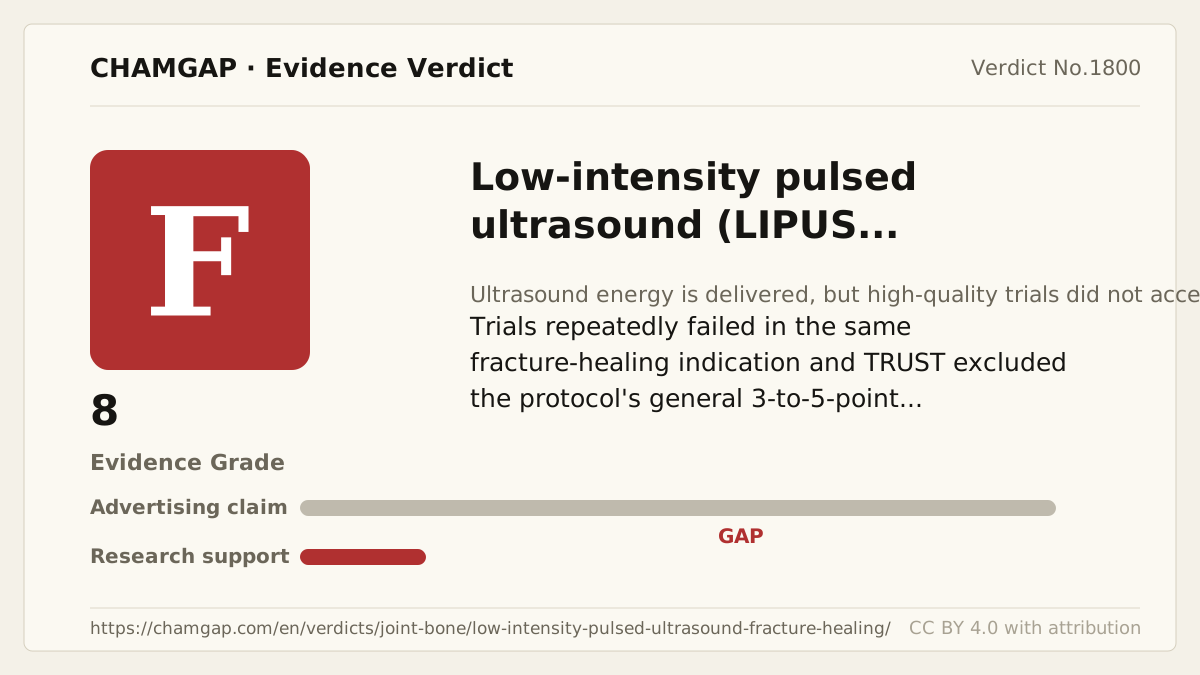
[Chamgap] Low-intensity pulsed ultrasound x fracture union and functional recovery — Evidence Grade F·12. 2 cited sources checked. Source: https://chamgap.com/en/verdicts/joint-bone/low-intensity-pulsed-ultrasound-fracture-healing/ · CC BY 4.0CC BY 4.0 — free to use with attribution; do not distort grades, numbers, or verdict meaning.
What this document does and does not do
Chamgap is an information source. It reports what research has and has not confirmed; it does not tell readers what to take or buy. That decision belongs to readers and, when needed, medical or legal professionals. This verdict reflects literature available up to the search date and may change as new research appears. Nothing here is medical advice.